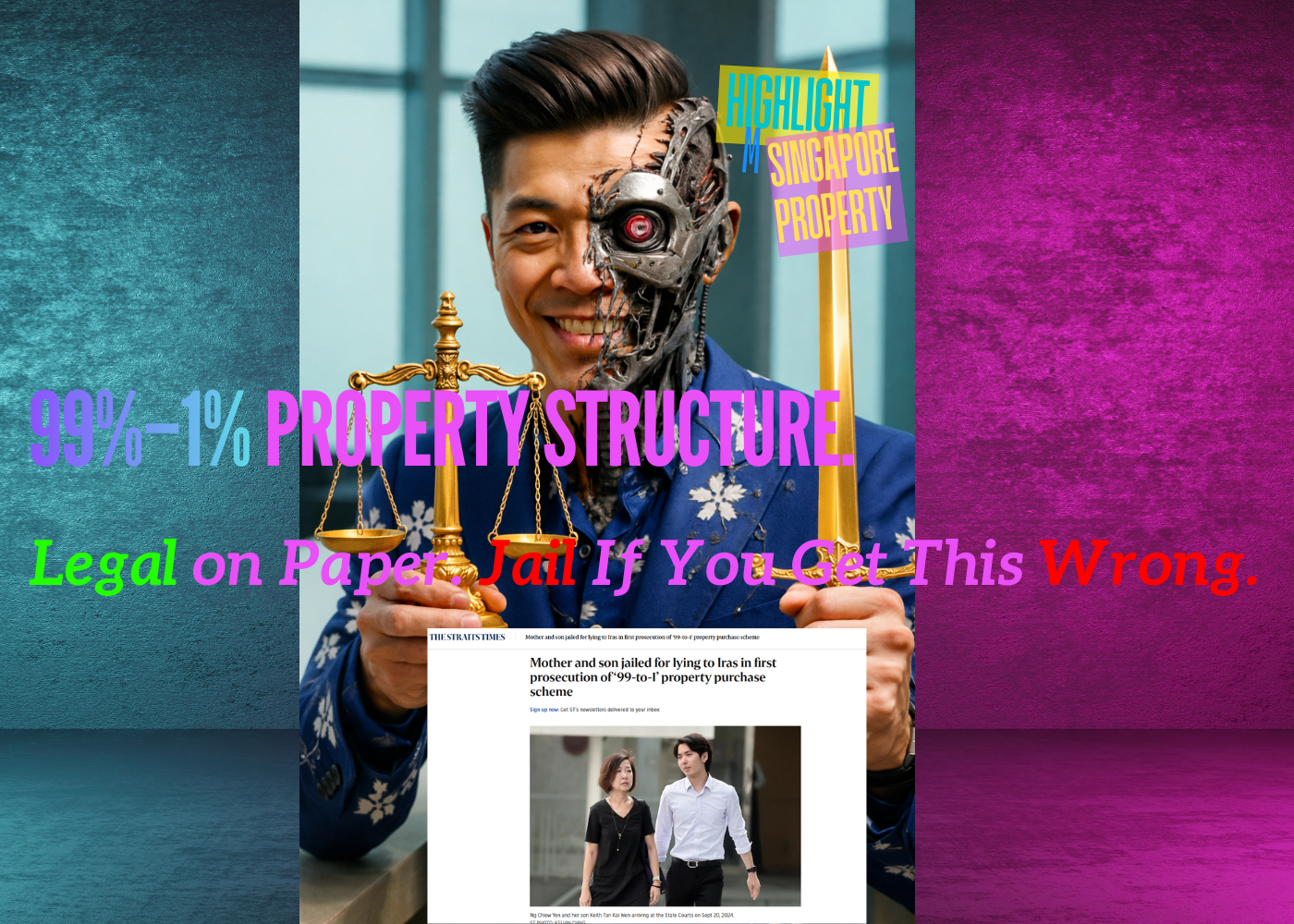
99%–1% Property Structure. Legal on Paper. Jail If You Get This Wrong.
99%–1% Property Ownership in Singapore
Legal Structure, Court Reality, and the Hidden Risks Most People Ignore
The 99%–1% property ownership structure has been widely discussed in Singapore. Some see it as smart planning. Others treat it as a loophole.
A recent court case clarified one critical point: The structure itself is not illegal. The intention behind it is what determines legality.
This article breaks down:
• The legal background
• Why the court ruled the way it did
• When 99%–1% is legal
• How it is commonly used for decoupling
• Thereal pitfalls most people fail to anticipate
This is not opinion. This is how the law actually works.
The Legal Background: Why This Case Matters
In the case referenced, the issue was not the 99%–1% structure itself. The issue was misrepresentation and intent.
The buyers structured ownership at 99%–1% and declared information to the bank and authorities that did not reflect the true economic reality of the transaction.
The court focused on three things:
- Who was actually funding the purchase
- Who was bearing the financial risk
- Whether declarations were truthful
The ruling was clear.
You may choose any ownership ratio you want. You may not lie about why you are doing it.
Why the Court Ruled This Way
Singapore property law is form-neutral but intent-sensitive.
The court does not ask: “Is 99%–1% allowed?”
It asks: “Is the structure being used to mislead, evade, or falsely declare?”
Key legal principles applied:
• Substance over form
• Truthful disclosure obligations
• Anti-avoidance doctrine
If a structure exists only on paper, while the economic reality is different, the court will disregard the paper structure.
That is exactly what happened.
The punishment was not for clever planning. It was for false representation.
Is 99%–1% Legal in Singapore?
Yes. Unequivocally yes.
99%–1% ownership is legal if all of the following are true:
• Both parties genuinely contribute according to their ownership
• Loan servicing reflects economic reality
• Declarations to banks, IRAS, and lawyers are accurate
• The intention is not tax evasion or duty avoidance
The structure becomes “unstable” only when:
• One party funds everything but claims minority ownership
• Income, liabilities, or intentions are misrepresented
• The structure is used to disguise beneficial ownership
Structure is allowed. Dishonesty is not.
Why 99%–1% Is Commonly Used for Decoupling
In practice, 99%–1% is often used as a preparation step for future decoupling.
The logic is simple:
• Smaller share is easier to transfer later
• Stamp duty exposure appears lower
• Exit seems cleaner on paper
This is where many people get it wrong.
Decoupling is not a right. It is a transaction that must pass scrutiny at that future point in time.
The Pitfalls of Using 99%–1% for Future Decoupling
Here is what most people do not think through.
1. Intent Is Assessed Retrospectively
If authorities determine that the original intent was always duty avoidance, the entire structure can be challenged later.
You do not get judged only on today’s paperwork. You get judged on pattern, funding flow, and behaviour over time.
2. Beneficial Ownership Can Override Legal Title
If one party paid the downpayment, serviced the loan, and bore all risk, the court may treat them as the true owner, regardless of stated percentage.
That destroys the decoupling strategy.
3. Banks Are Not Passive
Banks reassess:
• Income dependency
• Loan sustainability
• Ownership changes
Decoupling that looks clean legally can fail commercially.
4. Policy Risk Is Real
ABSD rules have changed multiple times. What is “possible” today may be restricted tomorrow.
Structuring purely for decoupling without flexibility is reckless.
5. Cost vs Benefit Is Often Miscalculated
Legal fees, BSD, refinancing costs, opportunity loss. Many end up saving less than expected or worse, triggering compliance issues.
The Core Truth Most People Miss
99%–1% is not a loophole. It is a legal structure that requires economic truth.
If your structure:
• Matches funding reality
• Matches risk allocation
• Matches declared intent
You are safe.
If your structure:
• Exists only to avoid duty
• Relies on false declarations
• Breaks under scrutiny
You are exposed.
The court has made that line very clear.
Final Thought
The question is not: “Can I do 99%–1%?”
The real question is: “Will this structure still stand if examined five years later?”
Most people never ask that. That is why they get into trouble.
Before You Structure, Get It Right
If you are considering: • 99%–1% ownership • Decoupling strategies • Multi-property planning • ABSD exposure management
Do not copy structures from WhatsApp chats or forums.
Message me directly. I help clients design legally defensible, future-proof structures that survive scrutiny, not just look clever today.
Structure matters. Intent matters more.
#M #ThisIsM #ThisisMMikeChin #Propnex #MAssociate #Msingaporeproperty #AIForRealtors #RealEstate #PropertyForSale #InvestIngRealEstate #RealEstateInvestment #HomeBuyers #PropertyInvestment #DreamHome #HouseGoals #PropertyMarket #RealEstateLife #RealEstateExpert #HomesForSale #InvestIngProperty #RealEstateDevelopment #NewHome #OpenHouse #RealEstateSingapore #CondoLife #LuxuryLiving #HomeSweetHome #RealEstateTips #RealEstateInvestor #businessmentorship