Boon Keat ❂ CHIN
Real Estate Consultant | Trusted Advisor with 14+ Years of Experience | Founder of M | MIKE Framework Architect l FCPA (AUS) CA (SIN) MBA
Singapore Property: How to Buy Safely When ABSD Can Cost You Hundreds of Thousands
The biggest mistake is not paying ABSD. The biggest mistake is structuring your property purchase around avoiding it without understanding the legal, financing and exit consequences.
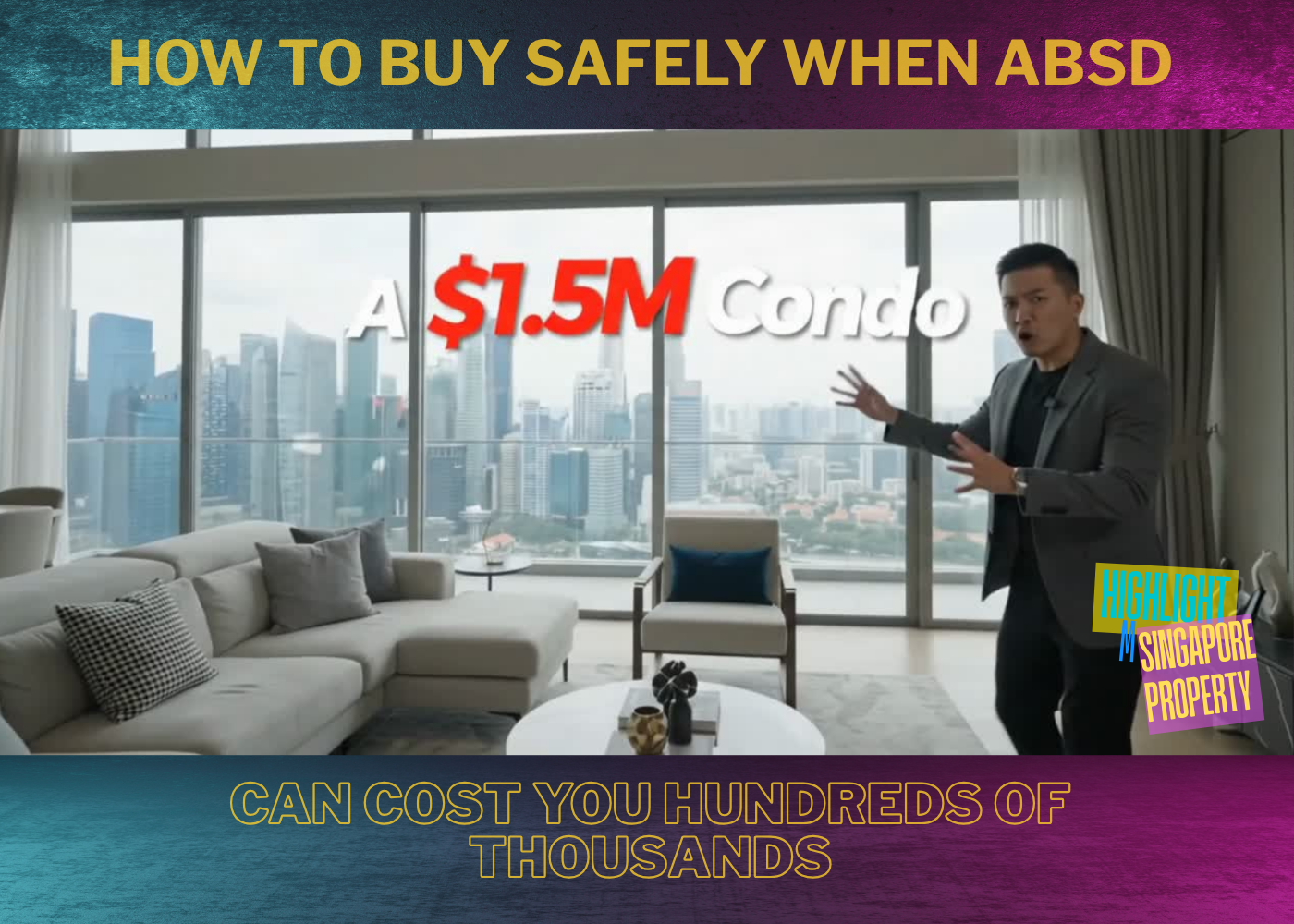
Imagine finding a $1.5 million condominium that fits your investment strategy perfectly.
Then you discover the ABSD.
If you are a Singapore Citizen buying your second residential property, the current ABSD rate is 20%.
That means:
$1.5 million × 20% = $300,000.
And that is before Buyer’s Stamp Duty, legal costs, financing costs, renovation, maintenance and other transaction expenses.
Suddenly, the investment is no longer a $1.5 million decision.
It is a $1.8 million capital decision before considering BSD and financing.
This is why ABSD has fundamentally changed the way Singaporeans need to think about property investing.
But here is the part many buyers get wrong.
They ask:
“How can I avoid ABSD?”
I believe the better question is:
“How do I structure my property journey so that ABSD does not destroy my returns or force me into unnecessary risk?”
That is a completely different question.
And it leads to a much safer approach.
1. First, understand what ABSD is actually doing
ABSD is not simply another transaction cost.
It changes the economics of property ownership.
As of today, the headline rates for residential property are:
| Buyer profile | ABSD |
|---|---|
| Singapore Citizen, 1st residential property | 0% |
| Singapore Citizen, 2nd property | 20% |
| Singapore Citizen, 3rd and subsequent | 30% |
| Singapore PR, 1st property | 5% |
| Singapore PR, 2nd property | 30% |
| Singapore PR, 3rd and subsequent | 35% |
| Foreigner | 60% |
| Entity | 65% |
These rates apply based on the buyer’s profile and residential property count, subject to applicable reliefs, remissions and specific rules.
The important point is this:
ABSD is calculated on the higher of the purchase price or market value.
So you cannot simply negotiate a lower contractual price and assume the tax automatically follows the lower number.
And for a second property, the 20% ABSD for a Singapore Citizen is not theoretical.
On a $2 million property:
$2,000,000 × 20% = $400,000.
That is real capital.
Which means your investment has to work much harder.
2. The real question is not “Can I afford the property?”
It is:
“Can I afford the property after ABSD?”
This is where many property buyers make a fundamental mistake.
They calculate:
Purchase price – loan = cash required.
That is incomplete.
Your actual acquisition equation is closer to:
**Purchase price
- BSD
- ABSD
- legal fees
- financing costs
- renovation
- holding costs
= total capital commitment**
And if you are buying a second property, ABSD can become one of the largest components.
For example, suppose you are buying a $1.5 million property as a Singapore Citizen’s second residential property.
ABSD alone:
$300,000
That $300,000 does not buy you a larger apartment.
It does not increase your rental income.
It does not improve the location.
It does not increase the property’s floor area.
It is simply a tax cost that has to be incorporated into your investment mathematics.
Therefore, a property that looks attractive before ABSD may become unattractive after ABSD.
That is why property selection should come after tax and capital-structure analysis, not before it.
3. Your first rule: calculate the tax before you fall in love with the property
This sounds obvious.
Yet many buyers do the exact opposite.
They spend three months researching:
- Districts
- MRT stations
- Schools
- Floor plans
- Views
- Facilities
- Rental demand
- Developer reputation
Then they discover the ABSD implications at the end.
That is backwards.
Before analysing the property, determine:
Step 1
What is your citizenship or residency status?
Step 2
How many Singapore residential properties do you currently own?
Step 3
Are you buying alone or jointly?
Step 4
Does your spouse own residential property?
Step 5
Are you using a trust or other ownership structure?
Step 6
Are you buying an HDB flat, private residential property or another asset class?
Step 7
What happens to your property count after the transaction?
IRAS specifically determines ABSD liability based on factors including the buyer’s profile, property count and whether the property is held in a trust.
Only after answering these questions should you calculate the investment.
4. The old “sell one, buy two” strategy is no longer as simple
The traditional strategy was straightforward.
A married couple owns one property.
They sell it.
Then each spouse purchases another property separately.
The objective was to keep each person’s property count low.
But today’s environment is substantially more complicated.
The attached analysis highlights how tighter financing rules and higher property prices have reduced the feasibility of this strategy for many households.
This is important because ABSD is only one side of the equation.
The other side is:
Financing capacity.
You can theoretically reduce your ABSD exposure through a particular ownership structure.
But if the resulting mortgage cannot be supported by the remaining borrower, the structure may not work.
This leads to an important principle:
Never design an ownership structure first and ask the bank whether it works later.
Do the financing analysis first.
5. Decoupling: potentially legitimate, but not a magic button
Decoupling is one of the most discussed strategies among married property owners.
The basic idea is that one spouse transfers their interest in a jointly owned property to the other spouse.
The transferring spouse may then have no residential property ownership, potentially changing their ABSD position for a future purchase.
But this is a genuine property transaction.
It is not simply:
“Remove my name from the title.”
The attached source correctly highlights several considerations, including stamp duty, CPF refunds, financing capacity and the ability of the remaining owner to qualify for the mortgage.
And there is another major issue that property owners sometimes underestimate.
SSD.
For residential properties acquired on or after 4 July 2025, Singapore’s SSD regime was tightened from a three-year to a four-year holding period, with rates of 16%, 12%, 8% and 4% depending on the holding period.
So if you are considering a transfer, do not rely on an old decoupling calculator using the previous SSD rules.
The rules have changed.
You also need to examine:
- CPF principal used
- accrued interest
- outstanding mortgage
- valuation
- BSD
- SSD, if applicable
- legal fees
- refinancing requirements
- income requirements
- future purchase plans
The transaction has to work as a complete system.
6. The dangerous mistake: confusing “legal structure” with “tax avoidance”
This is where things become extremely serious.
One of the strategies frequently discussed online is the 99:1 arrangement.
A genuine 99:1 ownership arrangement entered into from the beginning is not automatically illegal.
But there is a critical distinction.
IRAS has specifically investigated two-step 99:1 arrangements where one person first purchases 100% of the property and subsequently transfers a small percentage to another buyer who has a higher ABSD profile.
IRAS says such arrangements may be viewed as tax avoidance depending on the facts and circumstances.
And this is not theoretical.
In February 2025, IRAS announced that a mother and son were each sentenced to two weeks’ imprisonment for providing false and misleading information during an audit involving a two-step 99:1 arrangement.
IRAS also states that where tax avoidance is established, it may recover the rightful stamp duty and impose a 50% surcharge on the additional duty payable. Further penalties may apply if the amount remains unpaid by the deadline.
There is a very important lesson here.
Do not confuse cleverness with safety.
If your strategy requires:
- concealing the real intention,
- creating artificial transactions,
- backdating documents,
- providing misleading explanations,
- deleting evidence,
you are no longer talking about legitimate property planning.
You are creating legal risk.
And no amount of property appreciation is worth that.
7. “Can I just buy it under my child’s name?”
This is another strategy that sounds simple until you examine the legal structure.
A trust can be used for legitimate estate-planning purposes.
But residential property held in a trust can trigger 65% ABSD upfront, subject to the applicable remission rules.
For a $1.5 million residential property:
$1.5 million × 65% = $975,000.
That is almost $1 million.
IRAS does provide a remission mechanism for qualifying trusts involving identifiable individual beneficiaries, with applications generally required within six months from execution of the relevant instrument.
But this is exactly why a trust should never be treated as a simple ABSD workaround.
A trust is a legal ownership structure.
The beneficial ownership, control, financing, tax treatment and future disposal consequences all matter.
If parents put an asset into a child’s trust, they should not assume:
“It is still basically our property.”
That may not be how the law treats it.
The attached material highlights precisely this issue. Once the trust is structured in a way that gives the child beneficial ownership, the parents may not simply treat the property as their personal asset.
That is why trusts should be designed with qualified legal and tax professionals.
Not with a property agent’s WhatsApp message.
8. What about the HDB owner-occupier strategy?
This is where forward planning becomes particularly important.
Some couples structure their HDB ownership with one person as owner and the other as occupier.
But this is not something you should casually change later because you suddenly discover an attractive condominium.
HDB’s current rules state that during the applicable Minimum Occupation Period, the flat owner, spouse and occupiers cannot acquire private residential property. After the MOP is fulfilled, there is no limit on the number of private properties that can be acquired, subject to the prevailing rules.
There are also rules surrounding retaining the HDB flat after acquiring private property.
So the strategic question should be asked before buying the HDB, not five years later.
For a young couple, the property journey could potentially look very different depending on whether they plan:
HDB → Private property
or
Private property → HDB
or
HDB + future private property
The sequence matters.
And this is where property planning becomes more like financial engineering.
9. Sometimes the safest answer is not another residential property
This is a point that deserves more attention.
Singapore investors often become obsessed with residential property.
But if ABSD makes the economics unattractive, why automatically force the investment into another residential unit?
Alternative asset classes may include:
- Commercial property
- Industrial property
- Retail
- Overseas property
- REITs
- Other investment assets
The attached material highlights commercial and industrial properties as potential alternatives because residential ABSD treatment does not apply in the same way.
But this does not mean commercial property is automatically better.
There are different risks:
- Shorter lease terms
- Tenant concentration
- Vacancy
- Financing differences
- GST implications
- Liquidity
- Sector-specific demand
- Maintenance
- Exit pool
Similarly, overseas property avoids Singapore residential ABSD, but introduces:
- Currency risk
- Foreign tax
- Political risk
- Legal differences
- Financing risk
- Property management risk
- Exit liquidity
So the correct question is not:
“How do I avoid ABSD?”
It is:
“Which asset gives me the best risk-adjusted outcome after all taxes and costs?”
That is a much more powerful question.
10. The ABSD Break-Even Test
Here is a framework I would encourage investors to use.
Before buying a second residential property, calculate:
Total acquisition cost
**Purchase price
- BSD
- ABSD
- legal fees
- renovation
- other acquisition costs**
Then calculate:
Total annual carrying cost
**Mortgage interest
- maintenance
- property tax
- insurance
- vacancy allowance
- repairs**
Then estimate:
Exit cost
**Selling costs
- potential SSD
- outstanding loan
- taxes or other applicable costs**
Only after calculating these numbers should you ask:
“How much does this property need to appreciate before I actually make money?”
This is where many property buyers get a shock.
A property can increase from:
$1.5 million → $1.7 million
and still produce a disappointing return after financing and transaction costs.
Conversely, a property with a lower headline appreciation rate may produce a better risk-adjusted result because the entry price, rental yield, holding cost and exit liquidity are more favourable.
Price appreciation is not the same as investment return.
11. The “ABSD Payback Period” is something every investor should know
Suppose your second property costs:
$1.5 million
Your ABSD:
$300,000
Imagine the property generates $45,000 of annual gross rental income.
Ignoring all other costs for a moment:
$300,000 ÷ $45,000 = 6.67 years.
That means you are effectively using nearly seven years of gross rental income just to equal the ABSD.
And that is before:
- mortgage interest
- maintenance
- property tax
- vacancy
- repairs
- agent fees
- income tax
- financing costs
This doesn’t mean the investment is bad.
It means the entry mathematics must justify the tax burden.
That is the difference between investing and simply buying another property.
12. My 7-Step SAFE Property Framework
If you are considering buying another Singapore property, I would use this framework.
S. Status
Determine:
- Citizenship
- PR status
- Foreign status
- Existing residential property count
- Spouse’s property ownership
Do this before viewing properties.
A. ABSD
Calculate the exact ABSD liability.
Do not estimate.
Do not rely on a friend’s experience from five years ago.
Do not assume the rate will be the same because someone else bought a similar property.
IRAS determines the applicable rate based on the buyer’s circumstances at the relevant purchase date.
F. Financing
Stress-test:
- Down payment
- Mortgage
- Interest rate
- TDSR
- Rental income assumptions
- Vacancy
- Income changes
The property must remain financially survivable if the market does not immediately move in your favour.
E. Exit
Ask:
Who will buy this property from me?
Not:
“Will this property go up?”
Those are completely different questions.
Your exit buyer may be:
- HDB upgrader
- Young couple
- Investor
- Family
- High-net-worth buyer
- Foreign buyer
Each segment has different affordability constraints.
P. Premium
Determine what you are paying for.
Is it:
- Location?
- Land scarcity?
- MRT?
- School?
- Layout?
- Rental demand?
Or are you paying a huge premium for:
- Branding?
- Facilities?
- View?
- Marketing?
- Prestige?
When ABSD is already expensive, paying an unnecessary property premium makes the investment even harder to justify.
E. Execution
Before signing anything involving:
- Decoupling
- Trust
- 99:1
- Ownership restructuring
- HDB ownership
- Property transfers
get proper legal and tax advice.
A property transaction is not a place to experiment.
SAFE. But don’t forget the final E.
E. Economics
At the end of the day:
Does the investment actually make financial sense?
If the answer is no, walk away.
There will always be another property.
There may not be another $300,000.
13. The biggest mistake is trying to “beat” ABSD
Here is my biggest takeaway from this entire discussion.
Singapore’s property market is highly regulated.
The government has progressively used:
- ABSD
- BSD
- SSD
- Financing restrictions
- TDSR
- HDB eligibility rules
- Trust taxation
- Anti-avoidance provisions
to influence how residential property is purchased and held.
You can dislike the rules.
You can think they are expensive.
But if you are investing in Singapore property, the rules are part of the investment environment.
The professional approach is not to fight the rules.
It is to understand them.
Then structure your investment around them.
14. Don’t let a $300,000 tax bill make you make a $1.5 million mistake
This is the paradox.
A buyer becomes so focused on saving ABSD that they make an even bigger mistake.
For example:
They buy a property they don’t really want.
They use an unnecessarily complicated ownership structure.
They stretch their income.
They depend on rental income to survive.
They lock up excessive liquidity.
They buy a dual-key property at a huge premium simply because it avoids a second property count.
Or worse.
They enter a contrived arrangement that creates tax or legal exposure.
All to save tax.
That is backwards.
Tax should influence your property strategy. It should not control your life.
15. The Singapore property game has changed
The old question was:
“Which property should I buy?”
The new question is:
“What should my property ownership structure look like over the next 5, 10 and 15 years?”
That is a much more sophisticated question.
Because the biggest property decisions are often made years before the transaction happens.
If you know you eventually want:
HDB → Condo
you should think about that before buying the HDB.
If you know you want:
Condo → Second Condo
you need to model ABSD before buying the first condo.
If you want:
Residential → Commercial
you need to understand the different financing, tax and tenant risks.
If you want:
Family wealth transfer
you need to think about estate planning and trusts before you need them.
And if you want to use any ownership restructuring:
Talk to the lawyer and tax adviser before signing the OTP.
Not after.
The Final Property Principle
I believe there are three levels of property investors.
The first asks:
“What property should I buy?”
The second asks:
“What price should I pay?”
The third asks:
“How should I structure my entire property journey so that the tax, financing, ownership and exit strategy work together?”
That third question is where serious property planning begins.
ABSD is not simply a tax.
It is a capital-allocation constraint.
And when a tax can potentially cost $300,000, $400,000 or more, you cannot treat it as an afterthought.
You need to put the tax into the property equation from Day 1.
Because the objective is not:
“Avoid ABSD at all costs.”
The objective is:
Buy the right asset.
Use the right structure.
Stay within the law.
Protect your liquidity.
And make sure the numbers still work after every tax and cost.
That is what I call SAFE Property Investing.
Want to know whether your next property purchase still makes sense after ABSD?
Before you commit to the next property, I can help you look at the numbers from a different angle:
Purchase price → ABSD → financing → rental income → holding cost → exit value → actual potential return.
If you are considering upgrading, buying a second property, restructuring ownership or simply want to know whether your current property is still the right asset for your next move, DM me “ABSD” and let’s start with the numbers.
You can also request a free property valuation to understand your current equity position before making your next move.
Don’t let the ABSD number scare you into making the wrong decision.
Understand the numbers first. Then make the decision.
#M #ThisIsM #ThisisMMikeChin #Propnex #MAssociate #Msingaporeproperty #AIForRealtors #RealEstate #PropertyForSale #InvestIngRealEstate #RealEstateInvestment #HomeBuyers #PropertyInvestment #DreamHome #HouseGoals #PropertyMarket #RealEstateLife #RealEstateExpert #HomesForSale #InvestIngProperty #RealEstateDevelopment #NewHome #OpenHouse #RealEstateSingapore #CondoLife #LuxuryLiving #HomeSweetHome #RealEstateTips #RealEstateInvestor #businessmentorship
www.msingaporeproperty.com