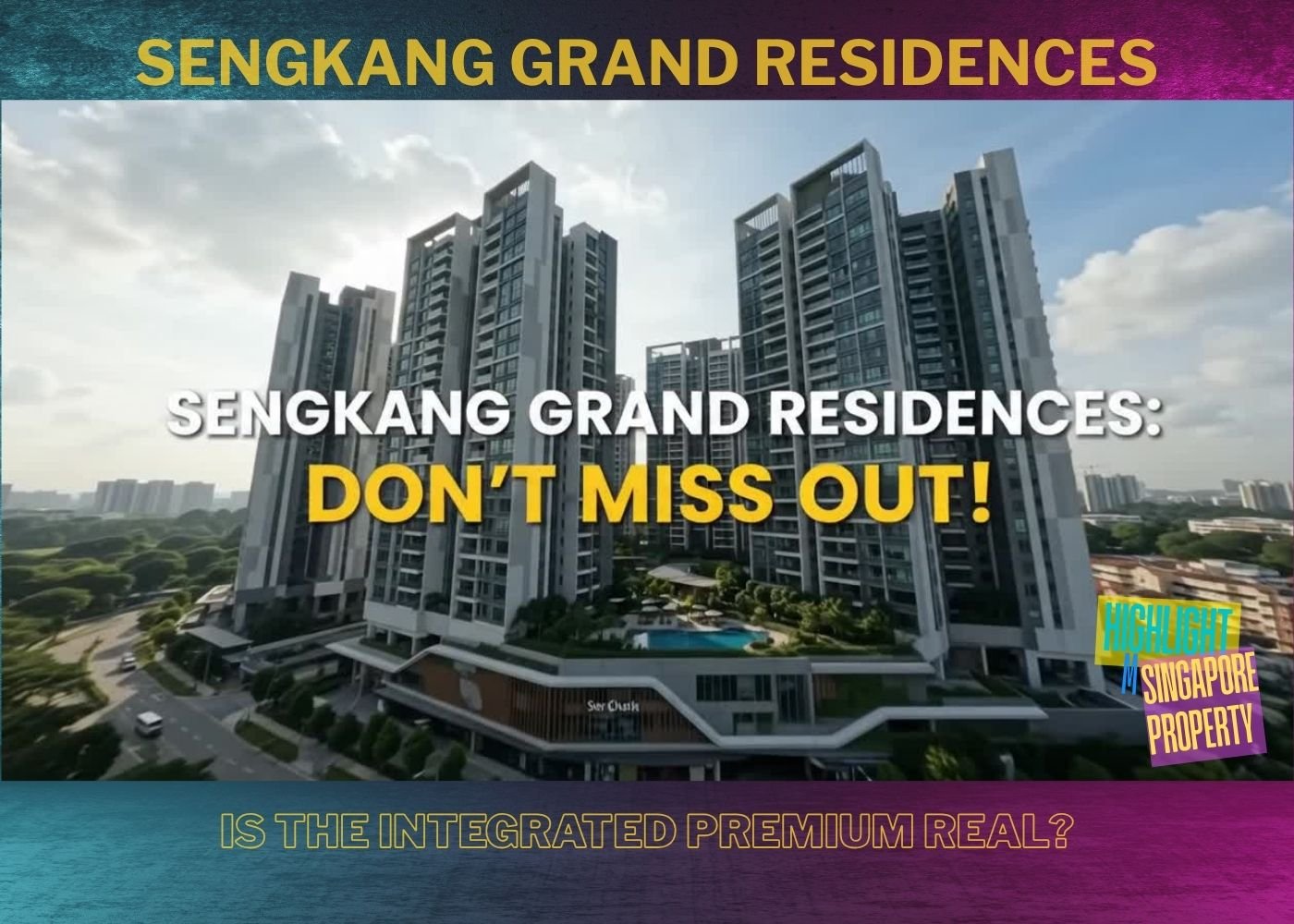
Sengkang Grand Residences: Is the Integrated Premium Real?
Full Investment Analysis and Gap Analysis vs Jewel @ Buangkok and The Quartz
Sengkang Grand Residences is one of the most interesting property valuation case studies in District 19.
It sits directly above Buangkok MRT, is integrated with Sengkang Grand Mall, a bus interchange, hawker centre, childcare centre and community facilities, and was one of the earlier suburban projects to demonstrate that buyers would pay a substantial premium for an integrated development.
Today, however, the question is no longer whether Sengkang Grand is convenient.
We already know it is.
The more important investment question is:
How much of Sengkang Grand’s current premium is genuinely attributable to its integrated status, and how much is simply the value of being newer with a longer remaining lease?
That distinction matters.
Because if most of the premium is simply age and lease, then an investor may be able to buy Jewel @ Buangkok or The Quartz at a substantial discount while still accessing much of the same location ecosystem.
On the other hand, if the integration creates a durable rental and resale moat, then paying a premium for Sengkang Grand may be rational.
This is where the numbers become interesting.
1. Sengkang Grand Residences at a Glance
| Factor | Sengkang Grand Residences |
|---|---|
| District | D19 |
| Tenure | 99-year leasehold |
| Lease commencement | 2018 |
| Units | 680 |
| Development | Integrated residential, retail and transport hub |
| MRT | Buangkok MRT |
| Bus | Buangkok Integrated Transport Hub |
| Mall | Sengkang Grand Mall |
| Commercial component | 3-storey retail mall |
| Key amenities | Hawker centre, childcare, community club, retail |
| TOP | Around 2023 |
| Current 12M median PSF | ~S$2,066 psf |
| Current 12M transactions | 39 |
| Current 12M median price | ~S$1.58m |
| Gross rental yield | Roughly 2.7% to 3% depending on unit type and methodology |
CapitaLand describes Sengkang Grand as a 680-unit integrated development with more than 300,000 sq ft of lifestyle and community conveniences, directly connected to Buangkok MRT and incorporating a mall, community club, hawker centre, childcare centre and bus interchange.
The project is therefore fundamentally different from a conventional condominium.
It is not simply a condominium next to an MRT station.
It is part of the transport and commercial infrastructure of the neighbourhood.
2. The Original Pricing Story
This is important because today’s valuation cannot be understood without going back to the launch.
Sengkang Grand launched in November 2019 at around S$1,600 psf.
Launch weekend sales were strong.
Around 216 units were sold out of the 280 units released, with an average selling price around S$1,700 psf.
CDL subsequently reported that Sengkang Grand had achieved an average selling price above S$1,725 psf, with 655 of its 680 units sold as of February 2022.
The original proposition was therefore very clear.
Buyers were paying more for:
- Newer product.
- Longer remaining lease.
- Direct MRT access.
- Integrated mall.
- Bus interchange.
- Hawker centre.
- Childcare.
- Community facilities.
- Large residential development scale.
- Convenience.
And the market accepted that proposition.
The question today is whether that premium has expanded too far.
3. The Sengkang Grand Investment Thesis
There are actually four different investment theses embedded inside Sengkang Grand.
Thesis 1. Integrated convenience
The resident can theoretically leave the apartment, access the mall, groceries, food, childcare, public transport and buses without having to make the same external journey as residents in conventional developments.
That is a genuine lifestyle advantage.
Thesis 2. Structural scarcity
True integrated developments are less common than conventional condominiums.
The uploaded research argues that this scarcity creates a structural moat, particularly for time-sensitive professionals and families.
The important point is not the exact number of integrated developments.
The important point is that a normal condominium cannot simply reproduce direct integration with an MRT station, bus interchange and commercial mall.
That is difficult to replicate.
Thesis 3. Rental premium
Sengkang Grand attracts tenants willing to pay more for convenience.
Current URA-based rental records show:
- 1-bedroom units around S$3,000 to S$3,200
- 2-bedroom units around S$3,500 to S$4,000
- 3-bedroom units around S$4,700 to S$5,100
- 4-bedroom units can exceed S$6,000
Recent transactions include a 3-bedroom around 1,000 to 1,100 sq ft renting for S$5,100, equivalent to approximately S$4.86 psf per month.
Thesis 4. Future Northeast growth
The wider North-East region is still undergoing decentralisation.
URA’s Master Plan 2025 highlights:
- Punggol Digital District
- Sengkang West
- Seletar
- additional employment opportunities
- improved connectivity
- new community amenities
- continued development of Sengkang
URA also identifies Sengkang Town Centre as an area that could become more vibrant through an integrated community hub with commercial, healthcare, sports and recreation facilities connected to Sengkang MRT.
So Sengkang Grand is not sitting in a stagnant neighbourhood.
But there is an important distinction.
A good masterplan supports the location. It does not automatically guarantee capital appreciation.
4. The Real Gap Analysis
Now we get to the interesting part.
As of September 2026, the latest 12-month median PSF across the three projects is approximately:
| Development | 12M Median PSF | Lease Start | Approx. Remaining Lease | Age Position |
|---|---|---|---|---|
| Sengkang Grand Residences | S$2,066 | 2018 | ~91 years | Newest |
| Jewel @ Buangkok | S$1,838 | 2012 | ~85 years | Middle |
| The Quartz | S$1,552 | 2005 | ~78 years | Oldest |
These figures are based on recent URA caveat data compiled through September 2026.
That creates the headline gaps:
Sengkang Grand vs Jewel
S$2,066 minus S$1,838 = S$228 psf
Sengkang Grand is approximately 12.4% more expensive.
Sengkang Grand vs The Quartz
S$2,066 minus S$1,552 = S$514 psf
Sengkang Grand is approximately 33.1% more expensive.
At first glance, that looks like a huge integrated premium.
But that is where a conventional comparative market analysis can become misleading.
5. The Age Adjustment
The uploaded research makes an important observation.
The Quartz’s lease commenced in 2005.
Jewel’s lease commenced in 2012.
Sengkang Grand’s lease commenced in 2018.
So:
- Sengkang Grand is approximately 6 years newer than Jewel.
- Sengkang Grand is approximately 13 years newer than The Quartz.
The uploaded analysis uses a District 19 historical rule of thumb suggesting that a 6 to 7-year age difference can account for approximately S$200 to S$300 psf.
However, I would not treat this as a formal valuation rule.
Lease decay is not linear.
The relationship between remaining lease and value changes over time.
Still, it is useful as a sensitivity test.
Against Jewel
6 years of age difference at S$200 to S$300 psf per 7 years gives an illustrative age adjustment of approximately:
S$171 to S$257 psf.
The actual current PSF gap is:
S$228 psf.
Therefore, after applying that crude age adjustment, the residual premium is approximately:
negative S$29 to positive S$57 psf.
That is an extremely important observation.
It suggests that a large portion, potentially most, of the Sengkang Grand versus Jewel PSF difference can be explained by age and remaining lease rather than integration alone.
6. Now Compare Sengkang Grand With The Quartz
The same exercise becomes even more interesting.
The Quartz lease commenced in 2005.
Sengkang Grand’s lease commenced in 2018.
That’s roughly a 13-year difference.
Using the same illustrative S$200 to S$300 psf per seven-year heuristic:
Age adjustment:
approximately S$371 to S$557 psf.
Actual PSF gap:
S$514 psf.
Residual difference after age adjustment:
approximately negative S$43 to positive S$143 psf.
Again, this is not a valuation.
It is a sensitivity test.
But the message is powerful.
The headline 33% Sengkang Grand premium over The Quartz looks much larger than the potential residual premium after accounting for age and lease.
This is why I would be cautious about saying:
“Sengkang Grand commands a huge integrated-development premium.”
The data does not prove that.
A more accurate statement is:
Sengkang Grand commands a substantial headline premium, but a significant portion of that premium can be explained by its newer lease, newer construction and more modern product. The residual premium appears much smaller.
That is a very different investment conclusion.
7. The Halo Effect
The uploaded research also discusses the “halo effect”.
The thesis is that when a new integrated development enters a neighbourhood, surrounding developments can benefit because they gain access to improved amenities and infrastructure without having to pay the full integrated-development premium.
This is particularly relevant here.
Consider the geography.
You have:
Sengkang Grand
↓
Buangkok MRT
↓
Sengkang Grand Mall
↓
Buangkok Integrated Transport Hub
↓
Jewel @ Buangkok
↓
The Quartz
The older projects do not possess the same integration.
But they participate in the same neighbourhood ecosystem.
That creates the central gap-analysis question:
Why pay 100% of the integrated premium if you can capture 70% to 90% of the location benefit by buying a resale project nearby?
This is exactly why Jewel and The Quartz remain relevant competitors.
8. The Jewel @ Buangkok Gap
Jewel is probably the more important competitor.
Why?
Because The Quartz is old enough that the product difference becomes very obvious.
Jewel is different.
It is approximately 10 years old, has around 85 years of lease remaining, and is only a few minutes from Buangkok MRT.
Current 12-month median PSF is around S$1,838.
Sengkang Grand is around S$2,066.
The gap is only around S$228 psf.
And some individual transactions show how narrow the gap can become.
For example:
Jewel
936 sq ft
S$1.891m
S$2,019 psf
Sengkang Grand
936 sq ft
Recent transactions around S$1.98m to S$1.99m
Approximately S$2,112 to S$2,124 psf in comparable transactions.
This is fascinating.
At the same approximate size, the quantum difference can be surprisingly small.
The buyer is not necessarily choosing:
S$2.3m versus S$1.6m.
Sometimes the decision is closer to:
S$2.0m versus S$1.9m.
That changes the investment equation significantly.
9. Jewel’s Biggest Advantage
Jewel’s advantage is simple.
It gives you access to the same micro-location without paying the full new-project premium.
You still get:
- Buangkok MRT nearby
- Sengkang Grand Mall nearby
- Buangkok amenities
- established neighbourhood
- established rental market
- larger resale stock
- lower entry PSF
Current Jewel rental data also shows healthy demand.
One current URA-based dataset records approximately 112 rental contracts over the last 12 months, with median rent around S$3,400 and an estimated gross yield around 3.22%.
That makes Jewel particularly interesting for a yield-sensitive investor.
10. The Quartz Gap
The Quartz is a different proposition.
It is much older.
Lease commencement:
2005
Sengkang Grand:
2018
That is a 13-year difference.
The Quartz therefore cannot compete directly on:
- newness
- facilities
- finishes
- lease runway
- integrated living experience
But it has another weapon.
Quantum and space.
Recent Quartz transactions include:
- 1,141 sq ft at S$1.61k psf
- 1,335 sq ft at S$1.617k psf
- 1,550 sq ft at S$1.665k psf
- 1,163 sq ft at S$1.441k psf
- 1,216 sq ft around S$1.503k psf.
This is a completely different value proposition.
A buyer may sacrifice newness and integration in exchange for:
more square footage per dollar.
11. The Quartz Rental Thesis
The Quartz is also not a weak rental asset.
Current URA rental records show 3-bedroom units commonly renting around S$4,300 to S$4,900, depending on size and unit characteristics.
Another URA-based dataset puts the project’s 3-bedroom median rental around S$4,850 and estimated gross yield around 3.23% on matched 3-bedroom data.
This creates a very interesting investor equation.
Sengkang Grand
Higher capital value.
Higher rental PSF.
Newer product.
Better convenience.
The Quartz
Lower capital value.
Larger units.
Older product.
Lower PSF.
Potentially attractive yield relative to purchase price.
This is not simply a comparison of “new versus old”.
It is a comparison of capital efficiency versus convenience premium.
12. Rental Gap Analysis
Let’s simplify the current rental picture.
| Factor | Sengkang Grand | Jewel | The Quartz |
|---|---|---|---|
| Typical 3BR rent | ~S$4,700 to S$5,100 | ~S$4,000 to S$4,500 | ~S$4,300 to S$4,900 |
| Rental PSF | Higher | Moderate | Lower |
| Product age | New | Mid-aged | Older |
| Tenant proposition | Convenience | Convenience + value | Space + value |
| Indicative yield | ~2.7% to 3% | ~3.2% | ~3.1% on matched datasets |
Sengkang Grand clearly wins on absolute rental PSF.
But that does not automatically mean it wins on rental yield.
This is a classic property investment trap.
Higher rent does not necessarily mean higher yield.
If I pay S$2.1m for a unit and collect S$5,100 a month, the rental income is higher.
But if I can buy another property for S$1.7m and collect S$4,500, the cheaper property may produce a better return on capital.
That distinction becomes increasingly important when mortgage rates, TDSR and opportunity cost are considered.
13. The Integrated Development Premium
Now let’s answer the central question.
Is the integrated premium real?
Yes, but I would not assume the entire premium is attributable to integration.
There are at least four components:
Component A. Lease premium
Sengkang Grand has a materially longer remaining lease.
Component B. Age premium
It is much newer.
Component C. Product premium
The layouts, facilities, mechanical systems and finishes are newer.
Component D. Integration premium
This is the part that cannot easily be replicated.
Direct connection to:
- MRT
- mall
- bus interchange
- hawker centre
- childcare
- community facilities
That fourth component is real.
But based on the current gap against Jewel, I would estimate that the pure integration premium is much smaller than the headline 12.4% PSF difference suggests.
That is the key investment insight.
14. Why Integration Still Matters Long Term
There is another side to this argument.
An integrated development can be difficult to reproduce.
You cannot simply build another condominium beside Sengkang Grand and suddenly create:
- MRT access
- bus interchange
- mall
- hawker centre
- community club
- childcare
The uploaded research makes another important point.
Commercial management matters.
A poorly managed commercial podium can eventually become a liability.
A professionally curated mall with a strong anchor tenant mix can potentially support the residential component over a longer holding period.
Sengkang Grand Mall is currently operated as a genuine community retail hub.
CapitaLand says the mall has more than 90 brands, including FairPrice Finest, McDonald’s, UNIQLO and childcare operators.
This is important.
The value of Sengkang Grand is not just:
“I can walk to a mall.”
It is:
“The mall, transport hub and community facilities are structurally integrated into the neighbourhood.”
That is harder to replicate.
15. The Buangkok Transport Moat
The transport story has become stronger since launch.
Buangkok Bus Interchange commenced operations in December 2024.
LTA explicitly describes it as integrated with Sengkang Grand Mall and Buangkok MRT, making it Singapore’s 12th Integrated Transport Hub.
This matters because the original launch thesis has now become operational reality.
The development is no longer selling a future concept.
The infrastructure exists.
The mall exists.
The bus interchange exists.
The MRT exists.
The community facilities exist.
That reduces execution risk compared with an integrated development that is still under construction.
16. The Future Growth Story
There is another interesting catalyst.
The new Hougang Central integrated development has been awarded to the CapitaLand, UOL and CICT consortium for approximately S$1.5 billion.
The site has:
- approximately 504,820 sq ft site area
- 2.5 plot ratio
- around 300,000 sq ft commercial component
- residential component
- integrated bus interchange
- direct connectivity to the North-East Line
- planned connection to the Cross Island Line
- target completion around 2030/31.
This is important for Sengkang Grand.
But I would not simply assume that a new integrated project automatically means Sengkang Grand will appreciate by the same amount.
Instead, think of it as a regional pricing benchmark.
If future Northeast integrated projects launch at materially higher prices because of land and construction costs, existing integrated developments such as Sengkang Grand may look comparatively affordable.
That is the positive thesis.
The negative thesis is that the new development also gives buyers another new integrated alternative.
Therefore:
New integrated supply can both validate Sengkang Grand’s pricing and compete with it.
17. The 2026 Price Gap
Here is the gap in its simplest form.
Sengkang Grand
~S$2,066 psf
Jewel
~S$1,838 psf
The Quartz
~S$1,552 psf
Therefore:
Sengkang Grand premium over Jewel: ~12.4%
Sengkang Grand premium over Quartz: ~33.1%
But after considering lease age:
Against Jewel
The residual gap may be relatively modest.
Against Quartz
The residual gap is still meaningful, but substantially smaller than the headline 33%.
This leads to an important conclusion.
Jewel is the more dangerous competitor to Sengkang Grand because it offers a newer resale product with a relatively small PSF discount while retaining almost the same micro-location ecosystem.
The Quartz is a different product.
It competes more aggressively on quantum and space.
18. The Quantum Test
PSF is not enough.
Let’s look at the actual money.
A Sengkang Grand 2-bedroom around 764 sq ft has recently transacted around:
S$1.57m
A Jewel 2-bedroom around 721 to 732 sq ft has recently transacted around:
S$1.30m to S$1.31m
That means the buyer may be paying roughly:
S$260,000 to S$270,000 more
for a broadly similar-sized home.
That is the real decision.
Not:
“Is Sengkang Grand better?”
It clearly has more integration.
The real question is:
Is the additional S$250,000 to S$300,000 worth paying for that additional convenience and newer product?
For an own-stay buyer with a high value on time and convenience, the answer may be different from an investor focused on capital efficiency.
That is exactly why there is no single correct answer.
19. 3-Bedroom Analysis
This is where I find Sengkang Grand particularly interesting.
A 3-bedroom unit gives the project a stronger family proposition.
Recent Sengkang Grand transactions include:
- 936 sq ft around S$2.0m
- 1,055 sq ft at S$2.3m
- around S$2,100 to S$2,180 psf for recent examples.
Jewel has recently transacted:
- 936 sq ft at S$2.019 psf
- 872 sq ft at S$1.864 psf
- 1,141 sq ft at S$2.007 psf.
The gap becomes surprisingly narrow at the family-unit level.
That is a major point in Sengkang Grand’s favour.
If the quantum difference between a good Jewel unit and a good Sengkang Grand unit is only around S$100,000 to S$200,000, the integration premium becomes easier to justify.
If the gap expands to S$300,000 to S$400,000, I become much more cautious.
20. Unit Selection Hierarchy
If buying Sengkang Grand today, I would not simply buy the cheapest unit.
I would rank the unit selection based on exit liquidity plus rental efficiency.
Tier 1
3-bedroom around 900 to 1,000 sq ft
This is the sweet spot.
Why?
- family demand
- manageable quantum
- good rental demand
- broad resale buyer pool
- sufficient space
- stronger own-stay appeal
The 3-bedroom segment has already demonstrated strong rental demand.
Tier 2
Efficient 2-bedroom around 600 to 800 sq ft
Strong for:
- singles
- couples
- investors
- smaller families
- rental demand
But the price gap against Jewel becomes critical.
Tier 3
4-bedroom
Good for own-stay.
But investment liquidity becomes more dependent on quantum.
Tier 4
Very high quantum units
These require more careful scrutiny.
A large unit does not automatically produce better investment returns.
21. The 2-Bedroom Trap
This is one area where I would be careful.
Sengkang Grand’s small units command very high PSF.
That is not necessarily bad.
Small units often command higher PSF.
But the investor should compare:
Sengkang Grand 2BR
against
Jewel 2BR
on:
- purchase price
- rent
- rental yield
- renovation
- maintenance
- resale liquidity
- holding period
If the Sengkang Grand unit costs S$250,000 more but only produces S$300 to S$500 more rent per month, the additional capital may take a long time to justify.
This is why the quantum gap is more important than the PSF gap.
22. GFA and Usable Space
Modern projects can appear expensive on PSF because buyers are comparing them with older projects built under different measurement regimes.
Older developments can also have larger floor plans.
So you should never compare:
S$2,066 psf vs S$1,552 psf
without checking:
- internal efficiency
- balcony space
- planter areas
- structural walls
- aircon ledges
- household shelter
- corridor allocation
- actual furniture placement
The Quartz may look dramatically cheaper on PSF.
But part of that discount buys a different physical product.
The reverse is also true.
A new development can have a higher PSF while delivering a more efficient internal layout.
The correct comparison is:
Price per usable square foot, not just price per headline square foot.
23. Capital Appreciation Test
Let’s use Sengkang Grand’s current ~S$2,066 psf as the starting point.
These are scenario calculations, not forecasts.
3% annual growth
5 years:
~S$2,396 psf
8 years:
~S$2,620 psf
10 years:
~S$2,777 psf
4% annual growth
5 years:
~S$2,514 psf
8 years:
~S$2,827 psf
10 years:
~S$3,060 psf
5% annual growth
5 years:
~S$2,640 psf
8 years:
~S$3,060 psf
10 years:
~S$3,371 psf
This is why entry price matters.
At S$2,066 psf, the investor does not need spectacular growth to achieve a reasonable nominal appreciation scenario.
But the margin of safety becomes much smaller if buying at S$2,300 to S$2,400 psf.
24. The Price Matrix
This is the price matrix I would use as a negotiation framework.
| Sengkang Grand Entry PSF | My Analysis |
|---|---|
| Below S$1,950 | Very interesting |
| S$1,950 to S$2,050 | Attractive value zone |
| S$2,050 to S$2,150 | Defensible |
| S$2,150 to S$2,250 | Pay attention to unit quality |
| S$2,250 to S$2,350 | Convenience premium becomes significant |
| S$2,350 to S$2,450 | Requires exceptional stack, floor and facing |
| Above S$2,450 | Very little valuation margin |
This is not a statement that a unit above S$2,450 cannot appreciate.
It means the buyer is increasingly relying on future market appreciation rather than buying obvious relative value.
25. My Gap-Adjusted Target
If I were constructing a purchase strategy rather than simply describing the project, I would use:
Sengkang Grand
Target: approximately S$2,000 to S$2,150 psf
This is where the integrated proposition remains reasonably supported by:
- newer lease
- new product
- MRT
- mall
- transport hub
- rental demand
- neighbourhood growth
Jewel @ Buangkok
Target: approximately S$1,750 to S$1,850 psf
The attraction is the ability to capture much of the same neighbourhood and transport ecosystem without paying the full Sengkang Grand premium.
Current market median is approximately S$1,838 psf.
The Quartz
Target: approximately S$1,450 to S$1,550 psf
Here the investment thesis is different.
You are buying:
- larger space
- lower PSF
- mature resale market
- established rental demand
rather than buying the newest integrated product.
Current market median is approximately S$1,552 psf.
26. Three Different Investment Strategies
This is where I would segment the buyer.
Strategy A. Premium Convenience Buyer
Choose:
Sengkang Grand
Suitable for someone who values:
- direct MRT access
- mall convenience
- family amenities
- newer construction
- longer lease
- own-stay quality
- time savings
For this buyer, the premium is easier to justify.
27. Strategy B. Capital-Efficient Investor
Choose:
Jewel @ Buangkok
The thesis:
“I want Buangkok, but I don’t need to own the most expensive condominium in Buangkok.”
This investor wants:
- lower entry price
- established rental market
- good MRT proximity
- access to Sengkang Grand’s surrounding amenities
- lower capital requirement
The current PSF gap is meaningful but not enormous.
That makes Jewel the most direct relative-value challenge to Sengkang Grand.
28. Strategy C. Space and Yield Investor
Choose:
The Quartz
The thesis becomes:
“I would rather own more square footage at a lower capital cost.”
This is particularly relevant for:
- families
- larger 3-bedroom requirements
- tenants who value space
- investors who want larger absolute rental units
- buyers less concerned about newness
The Quartz’s older lease is the major risk.
But its lower PSF creates a different margin of safety.
29. The Resale Liquidity Question
This is an important hidden advantage of Sengkang Grand.
The project has 680 units.
That is large enough to create a meaningful transaction pool.
Recent data shows around 39 transactions in the last 12 months.
Jewel has also shown strong liquidity, with around 39 transactions in the last 12 months.
The Quartz has fewer recent transactions, around 21 over the same period.
Therefore:
Sengkang Grand and Jewel currently have stronger evidence of active resale liquidity than The Quartz.
This matters.
A good investment is not only about buying cheaply.
You also need someone willing to buy from you later.
30. The Biggest Risk for Sengkang Grand
The biggest risk is not the mall.
The biggest risk is:
Overpaying for the mall.
The integrated concept is already proven.
But once the market fully recognises the convenience, the next buyer may not be willing to pay an unlimited premium for it.
This is the classic problem with a high-quality asset.
Everyone knows it is good.
Therefore, the investment question becomes:
How much did you pay for the quality?
31. The Biggest Risk for Jewel
Jewel’s biggest risk is different.
It could remain permanently positioned as:
“Almost as convenient as Sengkang Grand, but older.”
If Sengkang Grand continues to strengthen its premium brand, Jewel may always trade at a discount.
However, that discount is also the reason investors buy it.
32. The Biggest Risk for The Quartz
The Quartz has the longest lease-decay risk.
At around 78 years remaining, it is not old in absolute Singapore property terms.
But the gap versus a 91-year lease Sengkang Grand is already noticeable.
As the development ages further, buyers will increasingly ask:
“Why buy this older condominium when I can buy a newer development nearby?”
The Quartz therefore needs to remain attractive through price and space.
33. Future Competition Risk
The Northeast is not finished developing.
The Hougang Central integrated development is expected to create another major mixed-use node with approximately 300,000 sq ft of commercial space and a target completion around 2030/31.
This creates both:
Opportunity
A higher regional price benchmark could make Sengkang Grand look relatively affordable.
Risk
Newer integrated developments may offer buyers:
- newer facilities
- new leases
- new retail
- new marketing
- new layouts
Therefore, Sengkang Grand cannot depend solely on being “integrated.”
It needs to maintain a meaningful price-to-value relationship.
34. Master Plan Gap
URA’s Master Plan 2025 identifies the North-East as a region with continued growth in housing, amenities, employment and connectivity.
Sengkang Grand benefits from being part of this broader ecosystem.
But I would make one important distinction:
Regional development is a tailwind, not a guaranteed return.
Punggol Digital District can improve employment access.
Sengkang West can bring more activity.
Seletar can add economic opportunities.
Future transport improvements can improve accessibility.
But none of these automatically guarantee that Sengkang Grand will outperform Jewel or The Quartz.
That is why the entry price remains the most important variable.
35. My PMFX Framework
Using the same framework:
P = Price
7.5/10
At approximately S$2,066 psf, the pricing is not cheap.
But it is supported by the project’s age, lease and integration.
The biggest issue is whether a buyer is paying too much for convenience.
M = Market
8.5/10
The North-East continues to receive infrastructure, employment and community investment.
F = Fundamentals
9/10
MRT.
Bus interchange.
Mall.
Hawker centre.
Childcare.
Community facilities.
Rental demand.
Large development.
These are strong fundamentals.
X = Exit
8/10
The project has demonstrated transaction activity and a broad buyer profile.
The main exit risk is price.
If bought too high, the next buyer may simply choose Jewel or another competing integrated project.
36. Overall Scorecard
Sengkang Grand Residences
| Category | Score |
|---|---|
| Location | 9.0/10 |
| MRT connectivity | 10/10 |
| Amenities | 10/10 |
| Rental demand | 9/10 |
| Lease | 9/10 |
| Project quality | 8.5/10 |
| Resale liquidity | 8/10 |
| Capital growth potential | 8/10 |
| Price value | 7.5/10 |
| Future competition risk | 6.5/10 |
| Overall at the right price | 8.3/10 |
The important words are:
At the right price.
37. Comparative Scorecard
| Factor | Sengkang Grand | Jewel | The Quartz |
|---|---|---|---|
| Location | 9.5 | 9.0 | 8.5 |
| MRT | 10 | 9 | 9 |
| Mall convenience | 10 | 8.5 | 8 |
| Newness | 9.5 | 8 | 6.5 |
| Lease runway | 9.5 | 8.5 | 7 |
| Space value | 7 | 8 | 9 |
| Rental demand | 9 | 8.5 | 8.5 |
| Yield potential | 7.5 | 8.5 | 8.5 |
| Resale liquidity | 8.5 | 8.5 | 7.5 |
| Entry value | 7.5 | 8.5 | 9 |
| Investment character | Premium convenience | Relative value | Space/value |
These are analytical scores, not market facts.
38. Who Should Consider Sengkang Grand?
I would look closely at Sengkang Grand if the buyer is:
1. An own-stay buyer
Especially a family that values convenience.
2. A dual-income household
Time saved has real economic value.
3. A buyer with a 7 to 10-year horizon
The longer the holding period, the more useful the newer lease and integrated infrastructure become.
4. A buyer who values MRT access
This is difficult to replicate.
5. An investor targeting professional tenants
The rental profile supports the convenience thesis.
39. Who Should Be More Careful?
I would be more cautious if the buyer is:
1. Purely yield driven
Jewel and The Quartz can offer more attractive capital efficiency.
2. Highly TDSR constrained
The additional quantum matters.
3. Buying purely because “integrated developments always appreciate more”
That is not a sufficiently strong investment thesis.
4. Buying above S$2,300 psf
At this level, the margin of safety becomes thinner.
5. Planning a short holding period
Transaction costs can overwhelm relatively small PSF appreciation.
40. The Three-Property Decision Tree
If I had three clients tomorrow:
Client A
“I want the best convenience and I don’t mind paying a little more.”
Sengkang Grand.
Client B
“I want Buangkok, but I want to pay less.”
Jewel @ Buangkok.
Client C
“I want the most space for my money and stronger capital efficiency.”
The Quartz.
That is the cleanest way to understand the market.
41. The Most Important Gap
The biggest gap is actually not:
Sengkang Grand vs Jewel.
It is:
Convenience value versus capital efficiency.
Sengkang Grand sells convenience.
Jewel sells relative value.
The Quartz sells space.
All three can make sense.
The mistake is assuming they are competing for exactly the same buyer.
42. My Preferred Unit Strategy
If buying Sengkang Grand for investment:
First choice
3-bedroom around 900 to 1,000 sq ft
Look for:
- reasonable quantum
- good orientation
- higher floor
- minimal road exposure
- efficient layout
- good natural light
- no major future obstruction
- reasonable PSF premium
Second choice
Efficient 2-bedroom around 650 to 800 sq ft
Particularly if rental demand is the objective.
Third choice
3-bedroom premium / larger family layout
Only if the quantum remains competitive.
Avoid
Paying a very large premium simply for:
- higher floor
- mall view
- pool view
- “rare stack”
- marketing scarcity
The premium has to be recovered at exit.
43. The Six Questions I Would Ask Before Buying
Question 1
What is the exact PSF premium over a comparable Jewel unit of the same size and floor?
Question 2
What is the absolute quantum difference?
This is more important than PSF.
Question 3
What rent can the exact unit realistically achieve?
Not the project’s highest rent.
The actual rent for that stack, size and floor.
Question 4
What is the gross yield after using the actual purchase price?
Question 5
What will my likely buyer be in seven years?
If the answer is:
“Someone who wants integrated convenience.”
Good.
But if the answer is:
“Someone who can simply buy Jewel for 10% less.”
Then your exit thesis needs more work.
Question 6
What happens if the future Hougang Central integrated project launches at a higher PSF?
Does Sengkang Grand look cheap?
Or does it suddenly look old?
That is the stress test.
44. My Three-Layer Price Protection
For Sengkang Grand, I would want three layers of protection.
Layer 1. Relative value
Don’t pay an excessive premium over Jewel.
Layer 2. Replacement cost
Future integrated developments should become increasingly expensive to build because of land and construction costs.
Layer 3. Rental support
The rental market needs to continue validating the convenience premium.
If all three work together, the investment thesis is much stronger.
45. The $265,000 Subsale Story
The uploaded research opens with an example of a 764 sq ft Sengkang Grand unit reportedly generating approximately S$265,000 of gain, with a claimed annualised return of around 9.2%.
That is certainly an interesting transaction.
However, I could not independently verify the exact S$265,000 gain and 9.2% annualised return from the indexed transaction sources I checked.
So I would not use that figure as proof of Sengkang Grand’s investment return without checking the actual purchase date, purchase price, selling price, stamp duties, financing costs and holding period.
This is exactly why property analysis needs transaction-level verification.
A gross subsale gain is not the same thing as net investment return.
46. The Deeper Lesson
Sengkang Grand teaches us something much bigger about integrated developments.
When a new integrated development launches, buyers often compare:
new condo vs old condo.
I think the better framework is:
Step 1
What is the age difference?
Step 2
What is the remaining lease difference?
Step 3
What is the usable-space difference?
Step 4
What is the rental difference?
Step 5
What is the quantum difference?
Step 6
What part of the convenience can the older property access without owning it?
Step 7
What part of the convenience is genuinely exclusive?
Only after answering those questions should we call something an “integrated premium.”
47. My Final View
Sengkang Grand Residences is a high-quality integrated development.
The location is strong.
The infrastructure is real.
The mall is operational.
The bus interchange is operational.
The MRT connectivity is genuine.
The rental demand is proven.
The remaining lease is materially longer than Jewel and The Quartz.
The North-East region also continues to receive long-term infrastructure and economic development support.
But here is the important part.
I would not buy Sengkang Grand simply because it is integrated.
The market already knows it is integrated.
The premium has already been capitalised into the price.
The investment opportunity comes from buying the right unit at the right relative price.
48. My Price Framework
Sengkang Grand Residences
Below S$2,000 psf
Very interesting.
S$2,000 to S$2,150 psf
Defensible entry zone.
S$2,150 to S$2,250 psf
Unit selection becomes critical.
S$2,250 to S$2,350 psf
You are paying a meaningful convenience premium.
Above S$2,350 psf
I would require a very strong reason, such as exceptional floor, facing, layout and scarcity.
49. The Relative-Value Framework
If the market remains around:
Sengkang Grand: ~S$2,066 psf
Jewel: ~S$1,838 psf
The Quartz: ~S$1,552 psf
Then the three assets occupy three different positions.
Sengkang Grand
Premium convenience asset
Jewel
Integrated-location proxy at a discount
The Quartz
Older, larger-space value asset
That is the real gap analysis.
50. Final M View
If I strip away the marketing, the facilities list and the excitement around integrated developments, I see something quite simple.
Sengkang Grand is not expensive merely because it is integrated.
It is expensive because it combines:
newer lease + newer product + MRT + mall + bus interchange + community amenities + strong rental demand.
But the current comparison also tells us something equally important.
Jewel is much closer to Sengkang Grand in value than the headline PSF gap suggests.
And The Quartz is even further away in price because buyers are effectively being compensated for its older lease and older product.
So my central question for a buyer is not:
“Is Sengkang Grand better than Jewel?”
It is.
The better question is:
“How much am I paying for that difference?”
If the premium is modest, Sengkang Grand can make sense.
If the premium becomes excessive, Jewel becomes increasingly interesting.
If the buyer prioritises space and capital efficiency, The Quartz enters the conversation.
And that is the deeper lesson.
A good property is not necessarily a good investment at every price.
For Sengkang Grand, the investment thesis is strongest when the buyer captures the benefits of integration without paying away all of the future upside.
That is where the gap analysis matters.
Not in asking which condominium is “best.”
But in understanding what you are paying for, what you are getting, and what the next buyer is likely to pay you for.
#M #ThisIsM #ThisisMMikeChin #Propnex #MAssociate #Msingaporeproperty #AIForRealtors #RealEstate #PropertyForSale #InvestIngRealEstate #RealEstateInvestment #HomeBuyers #PropertyInvestment #DreamHome #HouseGoals #PropertyMarket #RealEstateLife #RealEstateExpert #HomesForSale #InvestIngProperty #RealEstateDevelopment #NewHome #OpenHouse #RealEstateSingapore #CondoLife #LuxuryLiving #HomeSweetHome #RealEstateTips #RealEstateInvestor #businessmentorship #sengkanggrandresidence #jewel #quartz
www.msingaporeproperty.com