Boon Keat ❂ CHIN
Real Estate Consultant | Trusted Advisor with 14+ Years of Experience | Founder of M | MIKE Framework Architect l FCPA (AUS) CA (SIN) MBA
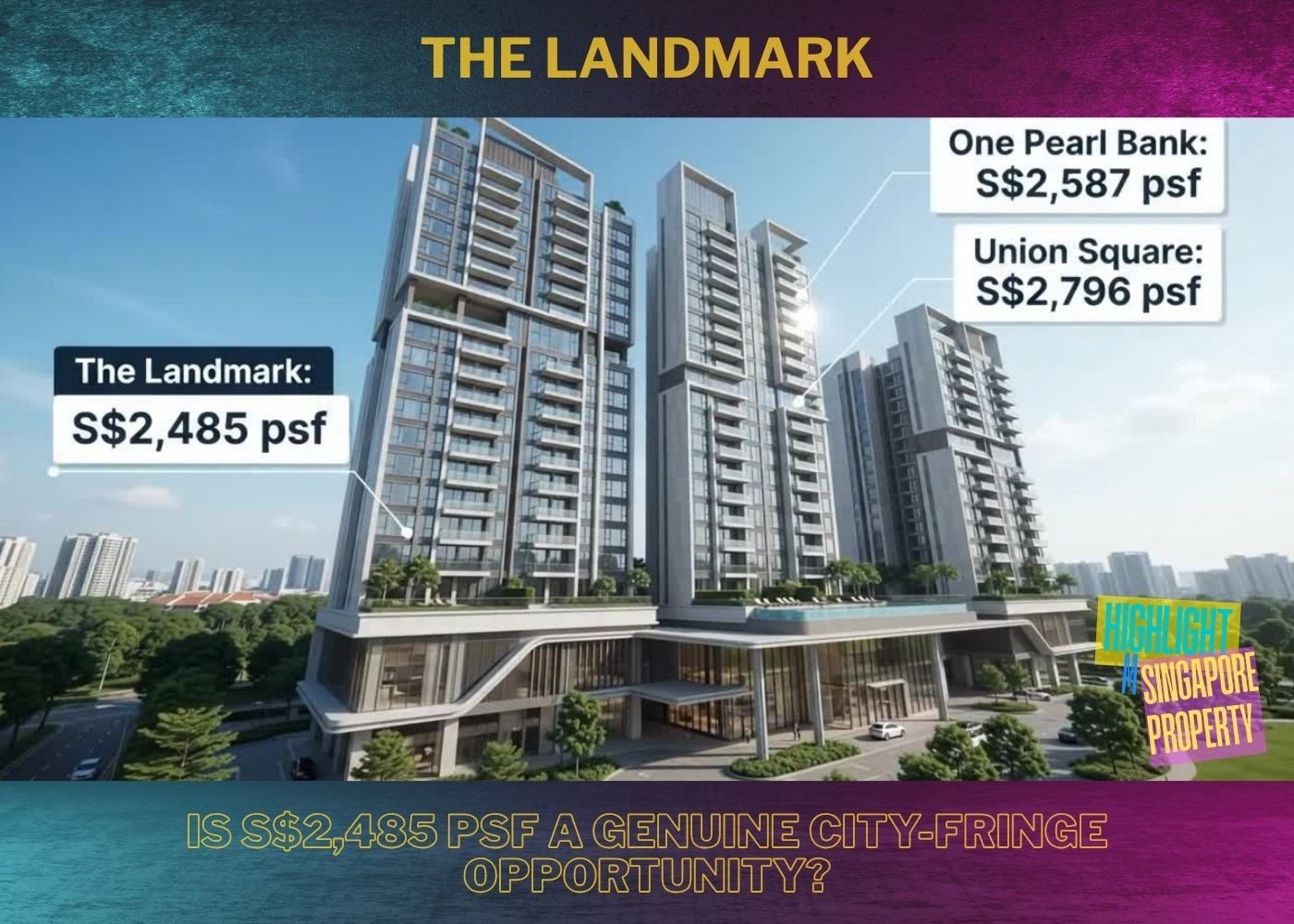
The Landmark: Is S$2,485 PSF a Genuine City-Fringe Opportunity?
A Full Investment Analysis and Gap Analysis Against One Pearl Bank and Union Square Residences
The Landmark is an interesting project because it sits in a part of Singapore that is undergoing a fundamental change.
Historically, Outram was seen as a city-fringe location. Close to Chinatown, Tiong Bahru and the CBD, but still somewhat peripheral compared with the traditional prime districts.
That description is becoming increasingly outdated.
With the transformation of the SGH Campus, the development of Pearl’s Hill, new homes around Outram Park MRT, improved pedestrian connectivity and the longer-term evolution of the Greater Southern Waterfront, Outram is gradually becoming a more integrated urban residential node.
But a good location does not automatically make a good investment.
The real question is more specific:
At today’s resale prices, does The Landmark offer enough value to justify buying it over established resale alternatives such as One Pearl Bank, or paying more for newer stock such as Union Square Residences?
My answer is:
Yes, but only at the right price and with the right unit.
I would not call The Landmark an obvious bargain at every price point.
I would call it a good city-fringe investment when purchased selectively, particularly around the S$2,350 to S$2,550 PSF range, with the strongest opportunity concentrated in the 2-bedroom units.
1. The Landmark at a Glance
| Factor | The Landmark |
|---|---|
| District | D03 |
| Location | 173 Chin Swee Road |
| Tenure | 99-year leasehold |
| Lease commencement | 2020 |
| Completion | 2025 |
| Developer | Landmark JV |
| Developers | MCC Land, ZACD, SSLE |
| Units | 396 |
| Storeys | 39 |
| Unit mix | 1BR, 2BR, 3BR |
| 1BR | 495 to 517 sqft |
| 2BR | 678 to 764 sqft |
| 3BR | 1,076 to 1,141 sqft |
| Nearest major MRT access | Outram Park / Chinatown |
| Current 12-month median | Approximately S$2,485 PSF |
| Current positioning | City-fringe, near-core urban residential |
| Investment profile | Capital appreciation + rental demand |
| Ideal holding period | 7 to 10 years |
The project comprises 396 units in a 39-storey residential tower. The relatively modest project size is important.
It is not a mega-development with thousands of units competing against one another.
At the same time, the 144 one-bedroom units represent a substantial portion of the project. This becomes relevant when considering rental competition and future resale liquidity.
The official developer information also positions The Landmark around Outram Park, Chinatown, Robertson Quay and the future development of the SGH Campus and Greater Southern Waterfront.
2. The First Principle: What Are You Actually Buying?
If we strip away the marketing language, The Landmark is essentially a bet on three things.
1. Outram becoming more central in economic and lifestyle terms.
2. A newer completed product eventually commanding a premium over older city-fringe stock.
3. The Landmark maintaining a valuation gap against newer projects such as Union Square Residences while gradually closing part of that gap.
That is a much more useful way to look at the project than simply saying:
“It is near Chinatown.”
The location itself is already established.
The investment opportunity comes from the change in the quality and perception of the surrounding urban environment.
This distinction is important.
You are not buying The Landmark because Outram is undiscovered.
You are buying it because Outram is becoming increasingly integrated into the city.
3. Location: The Landmark’s Biggest Strength
The Landmark sits at the intersection of several established neighbourhoods.
You have Chinatown.
You have Outram.
You have Tiong Bahru.
You have the Singapore General Hospital cluster.
You have Robertson Quay and the Singapore River.
And you are relatively close to the CBD.
This gives the location something I like in property investment:
multiple demand drivers rather than a single demand driver.
A project that depends entirely on one future infrastructure announcement is speculative.
The Landmark does not have that problem.
Even without future development, the surrounding employment, transportation, healthcare, lifestyle and heritage ecosystem already exists.
Outram Park MRT is particularly important because it is an interchange serving the East-West, North-East and Thomson-East Coast Lines. The connectivity story is therefore already present rather than entirely dependent on a future MRT announcement.
That said, I would not describe The Landmark as an “MRT-integrated” project.
It is not directly above the MRT.
That distinction matters.
The value proposition is proximity to a major transport node, rather than direct MRT integration.
4. The Outram Transformation
This is where the longer-term thesis becomes much more interesting.
URA’s Master Plan 2025 provides for approximately 6,000 new homes around Pearl’s Hill, together with a mixed-use development integrated with Outram Park MRT.
There are also plans for improved pedestrian connections linking Outram Park MRT towards Eu Tong Sen Street and Chinatown, together with stronger connections to Pearl’s Hill City Park, Robertson Quay and Fort Canning.
This is potentially significant for The Landmark.
Why?
Because property value is not only about the building.
It is also about what happens outside the development.
If the surrounding neighbourhood becomes:
- more walkable
- more connected
- more residential
- more amenity-rich
- better integrated with Chinatown
- better connected to Pearl’s Hill
- more commercially active
then the entire micro-market can become more valuable.
This is one of the reasons I prefer looking at The Landmark as a city-fringe transformation play rather than simply another D03 condominium.
5. But There Is a Catch: Transformation Creates Competition
This is one area where I would be more cautious than the typical bullish property analysis.
The same Master Plan that creates demand can also create supply.
Approximately 6,000 additional homes around Pearl’s Hill means there will eventually be more residential stock competing for buyers and tenants.
Therefore:
Pearl’s Hill is both a catalyst and a competitor.
That is an important investment distinction.
If the new developments are substantially better positioned, newer and priced competitively, they could put pressure on older projects.
But if the neighbourhood improves significantly while The Landmark remains one of the newer completed developments in the established part of the area, The Landmark can benefit from the rising tide.
So I would not model Pearl’s Hill as an automatic capital appreciation guarantee.
I would model it as:
positive for the neighbourhood, but requiring project-level selection.
6. SGH Campus: The More Immediate Structural Catalyst
In my view, the SGH Campus transformation is more important to The Landmark’s rental thesis than the Greater Southern Waterfront.
The SGH Campus is a major healthcare ecosystem involving patient care, research and education. SGH describes the future campus as Singapore’s largest medical campus when completed.
The next major phase includes the Elective Care Centre and National Dental Centre, with the Elective Care Centre expected to be ready in 2027.
This creates a structural tenant pool.
Not because every healthcare worker will rent at The Landmark.
But because the surrounding ecosystem supports demand from:
- doctors
- researchers
- healthcare professionals
- academics
- medical executives
- international professionals
- DINK couples
- professional tenants working around the CBD and city centre
This is a much stronger rental thesis than simply saying:
“There are expats in Singapore.”
The question is whether the project sits in a location where multiple employment nodes can feed tenant demand.
The Landmark does.
The SGH Campus is one of those nodes.
The CBD is another.
The broader city-centre employment ecosystem is another.
7. Greater Southern Waterfront: Long-Term, Not Immediate
The Greater Southern Waterfront is another major Singapore transformation story.
The port consolidation will eventually free approximately 1,000 hectares of land and around 30km of coastline for future development.
This could be enormously important for Singapore’s southern corridor.
But I would be careful about using it as the primary justification for buying The Landmark.
The Landmark is not sitting directly on the waterfront.
Therefore the relationship is indirect.
My interpretation is:
SGH and Outram are nearer-term project-level catalysts.
Pearl’s Hill is a medium-term neighbourhood catalyst.
Greater Southern Waterfront is a long-term regional catalyst.
That hierarchy matters.
8. The Physical Product
The Landmark is not simply an old condominium being rebranded as a value proposition.
It was completed in 2025.
The uploaded project review highlights several details that matter from an actual buyer’s perspective, including flush window frames, large trifold balcony doors and layouts designed to make relatively compact units feel visually larger.
The review also highlighted the kitchen specifications and integrated appliances, including the relatively strong appliance package for a compact 2-bedroom unit.
This is important because newer developments compete differently from older resale stock.
The buyer is not only comparing:
S$2,500 PSF vs S$2,600 PSF.
They are also comparing:
- age
- design
- maintenance
- appliances
- facilities
- condition
- renovation requirements
- lease age
- perceived quality
- future resale appeal
That is why The Landmark can justify a premium over some older D03 stock.
9. The Leasehold Question
The Landmark’s lease commenced in 2020.
One Pearl Bank’s lease commenced in 2019.
Union Square Residences’ lease commenced in 2024.
Therefore the lease advantage over One Pearl Bank is only approximately one year.
This is important.
I would not make the argument that The Landmark has a dramatically better lease profile than One Pearl Bank.
It does not.
The real difference is:
newer physical product rather than dramatically superior lease tenure.
Against Union Square, however, there is a more meaningful lease-age difference.
Union Square has the newer 2024 lease commencement and is positioned as a newer development.
Therefore The Landmark must be bought at a sufficient discount to compensate for that difference.
10. Current Transaction Reality
This is where the analysis gets interesting.
The Landmark’s latest 12-month median is approximately:
S$2,485 PSF.
PropertyBeep’s October 2026 transaction data shows the latest recorded August 2026 sale at S$1.70 million for 678 sqft, or approximately S$2,507 PSF. The same source shows an approximately 12.6% year-on-year increase in PSF and places The Landmark at roughly an 11% discount to the broader D03 median.
Recent transactions have broadly ranged from the low S$2,000s to the high S$2,700s PSF depending on unit size, floor and timing.
Examples include:
- 678 sqft at S$1.70m, S$2,507 PSF
- 678 sqft at S$1.67m, S$2,463 PSF
- 678 sqft at S$1.80m, S$2,654 PSF
- 678 sqft at S$1.65m, S$2,433 PSF
- 495 sqft at S$1.10m, S$2,222 PSF
- 678 sqft at S$1.88m, S$2,772 PSF
This tells us something important.
There is no single “The Landmark price”.
There is a price range.
And that means unit selection matters enormously.
11. The One Pearl Bank Comparison
This is the most important comparison.
One Pearl Bank is the strongest established resale benchmark because it occupies a similar city-fringe/Outram/Pearl’s Hill investment universe.
Current 12-month data places One Pearl Bank at approximately:
S$2,587 PSF median.
Its latest September 2026 transaction included an 807 sqft unit at S$1.90m, or S$2,354 PSF.
The current gap is therefore approximately:
One Pearl Bank: S$2,587 PSF
The Landmark: S$2,485 PSF
Difference:
S$102 PSF
or approximately:
3.9%.
That is not a huge discount.
And this is one of the most important conclusions in this analysis.
If someone says:
“The Landmark is much cheaper than One Pearl Bank.”
I would disagree.
It is cheaper.
But not dramatically cheaper.
The more accurate statement is:
The Landmark trades at a modest discount to One Pearl Bank despite being physically newer.
That is interesting.
But One Pearl Bank has advantages:
- iconic architecture
- larger project
- established resale history
- mature rental evidence
- stronger recognition
- established tenant pool
- limited immediate uncertainty around the completed development
One Pearl Bank therefore deserves some premium.
The question is whether that premium should be 4%.
In my view:
Yes, a small premium is reasonable.
But I would be reluctant to pay a large premium for One Pearl Bank solely because of its branding.
12. Rental Comparison
Rental performance provides another useful lens.
The Landmark’s rental evidence shows median monthly rents around S$4,500 in recent 2026 data, with monthly medians broadly around S$4,100 to S$4,550 across much of the year.
Typical rental ranges reported include:
1-bedroom: approximately S$3,400 to S$4,500
2-bedroom: approximately S$4,100 to S$6,000
3-bedroom: approximately S$7,000 to S$9,800
One Pearl Bank has stronger rental evidence on some larger units.
Current data shows a median monthly rent of approximately S$4,200 across the project, with 2-bedroom median rents around S$5,500 in one dataset.
This suggests an important nuance.
One Pearl Bank can command stronger absolute rents.
But The Landmark may compensate through a lower purchase quantum.
That is where yield can become interesting.
13. Yield: Do Not Chase the Headline Number
Some datasets put The Landmark’s indicative gross rental yield around 3.4%.
But yield calculations vary significantly depending on:
- whether purchase price is based on median transaction or asking price
- whether rent is matched to the same unit size
- whether maintenance fees are included
- vacancy
- furnishing
- renovation
- transaction costs
Therefore I would not sell The Landmark purely as a “high-yield” property.
I would describe it as:
a reasonably rentable city-fringe asset where the entry price can produce a respectable gross yield if bought correctly.
The entry price is therefore critical.
A S$1.65m unit rented at approximately S$4,500 per month has a very different investment profile from a similar unit purchased at S$1.85m.
14. The Union Square Residences Comparison
This is where The Landmark’s valuation case becomes stronger.
Current 12-month data places Union Square Residences at approximately:
S$2,796 PSF.
There have been transactions above S$3,000 PSF, including a September 2026 743 sqft transaction at approximately S$3,152 PSF.
But I would not use S$3,100 to S$3,200 PSF as the project’s average market value.
The current median is much closer to S$2,800 PSF.
This distinction is important.
The gap between:
The Landmark: S$2,485 PSF
and
Union Square: S$2,796 PSF
is approximately:
S$311 PSF
or about:
11.1%.
That is a meaningful gap.
Union Square deserves a premium because it has:
- newer lease
- new-development positioning
- newer product
- Clarke Quay/River Valley positioning
- strong market acceptance
- smaller overall unit count
- new-sale premium
But the question becomes:
Is the newer lease and newer-launch positioning worth 11% more?
That is much harder to answer.
For an owner-occupier who loves Union Square, perhaps yes.
For an investor, The Landmark becomes more interesting.
15. The Real Gap Analysis
Let’s simplify the three projects.
| Project | Approx. 12M Median PSF | Relative Position |
|---|---|---|
| Union Square Residences | S$2,796 | Premium/newer |
| One Pearl Bank | S$2,587 | Established resale |
| The Landmark | S$2,485 | Discount/newer completed |
The Landmark therefore sits in a very interesting middle position.
It is:
newer than One Pearl Bank
but
cheaper than One Pearl Bank.
It is:
older in lease commencement than Union Square
but
significantly cheaper than Union Square.
That is the investment gap I find interesting.
16. But Why Is The Landmark Cheaper?
This is the question investors must ask.
If the asset is so attractive, why hasn’t the market already priced it closer to One Pearl Bank?
There are several possible reasons.
1. Project recognition
One Pearl Bank is architecturally distinctive and has stronger brand recognition.
2. Micro-location
The Landmark is close to Outram Park and Chinatown, but it is not directly integrated with the MRT.
3. Unit mix
A large percentage of the development comprises smaller units.
4. Newness premium
Union Square benefits from new-launch psychology.
5. Market perception
Outram still does not command the same psychological pricing as traditional prime districts.
6. Future supply
The Pearl’s Hill transformation introduces more residential competition.
7. Investor uncertainty
The Landmark is still relatively young in its resale history.
None of these are necessarily permanent problems.
But they explain why the valuation gap exists.
17. Is The Landmark Undervalued or Is Union Square Overvalued?
This is the central investment question.
I would not automatically conclude that The Landmark is undervalued.
There are two possibilities.
Scenario A: The Landmark is undervalued.
If Outram continues to strengthen, rental demand remains resilient and buyers eventually pay more for newer city-fringe product, The Landmark could close some of the gap toward One Pearl Bank and Union Square.
Scenario B: Union Square is simply expensive.
If the new-project premium normalises, Union Square’s higher PSF may eventually compress without The Landmark needing to rise substantially.
This distinction matters.
Your investment does not require The Landmark to reach S$3,000 PSF.
It only requires the market to recognise that S$2,485 PSF is reasonable relative to competing stock.
18. The Price Matrix
This is where I would personally draw the line.
| Entry PSF | M View |
|---|---|
| Below S$2,350 | Very attractive |
| S$2,350 to S$2,450 | Attractive |
| S$2,450 to S$2,550 | Fair to attractive |
| S$2,550 to S$2,650 | Needs a good unit |
| S$2,650 to S$2,800 | Full pricing |
| Above S$2,800 | Difficult to justify for investment |
These are my analytical thresholds, not market consensus.
At approximately S$2,485 PSF, The Landmark sits in the middle of the “fair to attractive” zone.
That means:
I like the project.
But I would not chase it.
19. The Quantum Matters More Than the PSF
This is especially important for The Landmark.
The 2-bedroom units range from approximately 678 to 764 sqft.
A 678 sqft unit at:
S$2,450 PSF = S$1.661m
A 678 sqft unit at:
S$2,550 PSF = S$1.729m
A 678 sqft unit at:
S$2,650 PSF = S$1.796m
The difference in PSF looks relatively small.
But the quantum difference is substantial.
For an investor, I would therefore focus on:
What is my total entry quantum?
rather than simply:
What is the PSF?
20. My Preferred 2-Bedroom Target
The 678 sqft 2-bedroom is probably the most interesting investment configuration.
I would particularly look for:
S$1.65m to S$1.75m
depending on:
- floor
- facing
- stack
- view
- layout
- condition
- seller motivation
At S$1.65m, the PSF is approximately:
S$2,434 PSF.
At S$1.70m:
S$2,507 PSF.
At S$1.75m:
S$2,581 PSF.
This gives us a useful target.
The sweet spot is not necessarily the cheapest unit.
It is the unit where:
quantum + layout + view + floor + rental demand + resale liquidity
come together.
21. The 764 SQFT 2-Bedroom
The larger 764 sqft 2-bedroom is also interesting.
A S$1.90m purchase equates to approximately:
S$2,487 PSF.
A S$2.00m purchase equates to approximately:
S$2,618 PSF.
The larger unit could be more attractive for own-stay buyers and potentially easier to differentiate on resale.
The problem is quantum.
Once the price approaches S$2m, buyers may start comparing the unit with:
- One Pearl Bank
- Union Square
- other city-fringe resale options
- larger older units
- competing new launches
This is why I would prefer the larger unit only if the unit itself is clearly superior.
22. The 1-Bedroom
There are approximately 144 one-bedroom units.
That is a lot.
This creates both opportunity and risk.
The opportunity is obvious.
Lower quantum.
Potentially good rental demand.
Large professional tenant pool.
Easy entry for investors.
But the risk is resale competition.
When you eventually sell, you are not competing against only other condominiums.
You are competing against:
other one-bedroom units within The Landmark itself.
That is why I would not blindly buy the cheapest 1-bedroom.
I want:
- good stack
- higher floor
- attractive view
- efficient layout
- strong natural light
- low road noise
- rental-friendly positioning
The one-bedroom works.
But for me, it is not the strongest investment configuration.
23. The 3-Bedroom
The 3-bedroom units range from approximately 1,076 to 1,141 sqft.
There are only around 72 of them.
That scarcity is useful.
A larger family unit can appeal to a different resale buyer pool.
It is also more difficult for future developments to replicate exactly the same combination of:
- established city location
- mature infrastructure
- newer completed building
- relatively large family layout
But the problem is quantum.
As an investor, I would need the price to make sense against larger competing developments.
For own-stay, I am more positive.
For pure investment, I prefer the 2-bedroom.
24. Unit Selection Hierarchy
My order would be:
#1. 678 sqft 2BR
Best investment configuration.
Look for an efficient layout, good facing and an entry price around S$1.65m to S$1.75m.
#2. 764 sqft 2BR
Excellent if the unit can be bought around S$1.9m to S$2.0m and has superior attributes.
#3. 1,076 to 1,141 sqft 3BR
More attractive for own-stay and long-term family ownership.
#4. 495 to 517 sqft 1BR
Only when the entry price and rental yield are clearly compelling.
25. What About the View?
This is one area where I would not generalise.
The Landmark’s physical position means the exact stack matters significantly.
A higher-floor unit with an open view can be fundamentally different from a lower-floor unit facing:
- another building
- road traffic
- future construction
- service areas
The uploaded project review specifically noted the visual openness and river/urban views from a higher-floor 2-bedroom corner unit.
For an investment purchase, I would therefore rank:
open view > floor > internal layout > cosmetic condition.
A renovated unit can be renovated again.
A bad facing cannot be renovated.
26. Holding Period
I would not buy The Landmark with a three-year mindset.
The project thesis is stronger over:
7 to 10 years.
Why?
Because several of the major catalysts are gradual.
SGH’s campus transformation is multi-phase.
Pearl’s Hill is a multi-year neighbourhood transformation.
Greater Southern Waterfront is a multi-decade transformation.
Urban perception also changes slowly.
Therefore, The Landmark is not a quick-flip thesis.
It is a:
buy the city transformation before the full value is priced in
thesis.
27. Exit Price Scenarios
Let’s assume an entry at the current median:
S$2,485 PSF.
I would not forecast one price.
I would model scenarios.
Five-year scenario
At 3% annual appreciation:
approximately S$2,881 PSF
At 4%:
approximately S$3,021 PSF
At 5%:
approximately S$3,173 PSF
These are mathematical scenarios, not forecasts.
This is important.
At 3% annual growth, the project does not need to become an “outperforming superstar”.
It simply needs to participate in long-term Singapore residential price growth.
28. Eight-Year Scenario
At 3% annual growth:
approximately S$3,148 PSF
At 4%:
approximately S$3,401 PSF
At 5%:
approximately S$3,672 PSF
This is where the investment case becomes more interesting.
A 7 to 10 year holding period gives the urban transformation story time to mature.
But again, this does not mean these prices will definitely happen.
The purpose of the exercise is to ask:
Does today’s entry price provide enough room for a reasonable future outcome?
I believe it does if the purchase is made below or around the current median.
29. Ten-Year Scenario
At 3% annual growth:
approximately S$3,340 PSF
At 4%:
approximately S$3,678 PSF
At 5%:
approximately S$4,049 PSF
The 4% and 5% scenarios should not be treated as base cases.
They are upside scenarios.
The more conservative investment thesis is simply that the property participates in the broader appreciation of established Singapore city-fringe housing.
30. Stress Test
Now let’s reverse the argument.
What if The Landmark does not outperform?
Suppose Union Square remains around S$2,800 PSF.
Suppose One Pearl Bank continues trading around the mid-S$2,500s.
Suppose The Landmark remains around S$2,500 to S$2,600 PSF.
Would I still be comfortable owning it?
If I bought around:
S$2,350 to S$2,450 PSF
yes.
If I bought around:
S$2,500 PSF
I am reasonably comfortable.
If I bought:
S$2,750 to S$2,850 PSF
I become much less comfortable.
That is the essence of margin of safety.
The project may be good.
But the price determines whether the investment is good.
31. The $2 Million Psychological Threshold
There is another interesting element here.
For many buyers, S$2 million is psychologically important.
A 678 sqft unit around S$1.7m feels materially different from a similar-sized unit approaching S$2m.
However, I would be careful not to confuse this with a statutory financing threshold.
There is no universal rule that says something magical happens at S$2 million.
The actual financing position depends on:
- loan-to-value
- income
- existing debt
- CPF
- cash
- buyer profile
- stamp duties
- bank valuation
The importance of S$2m is primarily buyer psychology and quantum positioning.
And that matters for resale.
A property that remains within a psychologically accessible quantum band can potentially appeal to a broader buyer pool.
32. Rental Demand Thesis
The Landmark’s rental thesis is quite straightforward.
It is not dependent on one tenant category.
Potential tenant pools include:
Healthcare professionals
SGH and the broader medical ecosystem.
CBD professionals
The CBD remains within practical commuting distance.
DINK couples
The 1BR and 2BR configurations suit professional couples.
International professionals
Chinatown, Tiong Bahru, Robertson Quay and the city centre provide lifestyle appeal.
Researchers and academics
The broader SGH and education ecosystem creates another source of professional demand.
This diversification is positive.
33. But Rental Yield Has a Ceiling
This is where investors need discipline.
Singapore city-fringe property is not a high-yield asset class.
You are paying for:
- land
- location
- scarcity
- connectivity
- capital preservation
- potential appreciation
Therefore, if you pay too much PSF, your rental yield gets compressed.
That is why I prefer buying The Landmark around S$2,350 to S$2,550 PSF rather than automatically chasing the newest or highest floor unit.
34. The Landmark vs One Pearl Bank
My simplified comparison:
| Factor | The Landmark | One Pearl Bank |
|---|---|---|
| Newness | 9 | 8 |
| Lease age | 8 | 8 |
| Architecture/identity | 8 | 9.5 |
| Rental maturity | 8 | 9 |
| Current valuation | 8.5 | 8 |
| Unit selection | 8 | 8.5 |
| Future Outram exposure | 9 | 9 |
| Resale recognition | 8 | 9 |
| Entry quantum | 8.5 | 8 |
| Investment appeal | 8.4 | 8.4 |
This is not saying they are identical.
They are different propositions.
One Pearl Bank is the established benchmark.
The Landmark is the newer value proposition.
If the price gap were only 1% to 2%, I would probably prefer One Pearl Bank.
At around 4%, The Landmark becomes interesting.
35. The Landmark vs Union Square Residences
| Factor | The Landmark | Union Square |
|---|---|---|
| Newness | 8.5 | 9.5 |
| Lease | 8 | 9.5 |
| Location | 9 | 9 |
| City-centre positioning | 9 | 9.5 |
| Current valuation | 8.5 | 7.5 |
| Rental maturity | 8 | 7.5 |
| Future upside | 8.5 | 8 |
| Entry quantum | 8.5 | 7.5 |
| Investment margin | 8.5 | 7.5 |
Union Square is a very good project.
But good property does not mean good investment at every price.
At approximately S$2,800 PSF, Union Square needs stronger future price growth to justify its entry valuation.
The Landmark has more valuation cushion.
36. The Biggest Risk: Future Competition
This deserves emphasis.
The Pearl’s Hill transformation is positive.
But it means the investor must monitor future launches.
If new projects enter the market around:
- Outram Park
- Pearl’s Hill
- Chinatown
- the Singapore River
- the future mixed-use development
at competitive prices, buyers may have alternatives.
This can cap the appreciation of The Landmark.
Therefore I would not pay a premium simply because the area is undergoing transformation.
I want to buy before the transformation is fully priced in.
37. Other Risks
1. 99-year leasehold
There is no freehold advantage.
2. Not directly above MRT
Walking distance and route quality matter.
3. One-bedroom concentration
There are 144 one-bedroom units, increasing internal competition.
4. Future construction
Pearl’s Hill and Outram development could create temporary noise, traffic and view disruption.
5. Competing projects
Union Square and future projects provide alternatives.
6. Rental sensitivity
High purchase prices can reduce gross yield.
7. Market cycle
A good location does not eliminate cyclical property risk.
8. Exit pricing
The future buyer may not value the project the same way the current investor does.
38. What I Would Not Use as a Selling Point
I would not rely heavily on the idea that buyers are still protected by the developer’s defect liability period.
The uploaded material makes this point based on The Landmark’s recent completion.
However, because we are now in October 2026, the exact TOP/CSC and contractual DLP commencement date should be verified for the particular unit before presenting this as a current advantage.
It is a potentially useful historical benefit.
It should not be marketed as an automatic current benefit.
39. PMFX Analysis
Using the same framework:
P = Price: 8/10
At approximately S$2,485 PSF, the project is not dirt cheap.
But it is trading below One Pearl Bank and materially below Union Square’s current median.
The price becomes very attractive below approximately S$2,450 PSF.
Score: 8/10
M = Market: 9/10
Outram benefits from:
- strong existing infrastructure
- SGH
- CBD proximity
- Chinatown
- Tiong Bahru
- Pearl’s Hill
- future residential development
- urban connectivity improvements
The underlying market is strong.
Score: 9/10
F = Fundamentals: 8.5/10
Newer product.
Reasonable project scale.
Good transport connectivity.
Strong employment ecosystem.
Attractive city-fringe positioning.
Main weakness is unit mix and leasehold tenure.
Score: 8.5/10
X = Exit: 8/10
The project should have a reasonably broad resale audience.
But exit competition from One Pearl Bank, Union Square and future Pearl’s Hill projects cannot be ignored.
Score: 8/10
40. Overall PMFX
The Landmark: 8.4/10 at the right price
This is not an 8.4/10 property at any price.
It is an:
8.4/10 investment opportunity when purchased selectively.
At S$2,800 PSF, my score would fall.
At S$2,350 to S$2,450 PSF, my score would rise.
That is the entire point of price discipline.
41. M Scorecard
| Category | Score |
|---|---|
| Location | 9/10 |
| Connectivity | 9/10 |
| Future transformation | 9/10 |
| Rental demand | 8.5/10 |
| Lease | 8/10 |
| Product/newness | 8.5/10 |
| Unit mix | 7.5/10 |
| Resale liquidity | 8/10 |
| Price value | 8/10 |
| Future competition | 6.5/10 |
| Overall | 8.4/10 |
The weaker score for future competition is deliberate.
I do not want to ignore the supply coming into the area simply because the future transformation story sounds attractive.
42. Who Should Buy The Landmark?
Buyer #1: City-fringe own-stay buyer
Someone who wants:
- city access
- newer product
- MRT connectivity
- Chinatown/Tiong Bahru lifestyle
- healthcare access
- future neighbourhood improvements
This is a strong fit.
Buyer #2: Professional couple
Especially someone working around:
- CBD
- SGH
- Outram
- Marina Bay
- city centre
The 2-bedroom configuration is particularly suitable.
Buyer #3: Long-term investor
Someone with:
7 to 10 years
of holding power.
This is probably the ideal investment profile.
Buyer #4: Investor priced out of newer city-centre projects
The Landmark gives exposure to the city-centre fringe without paying the full premium for newer projects such as Union Square.
43. Who Should Be More Cautious?
Short-term flipper
Not my preferred strategy.
Yield-only investor
There are better markets if pure yield is the only objective.
Buyer above S$2,700 PSF
The margin of safety becomes much thinner.
Buyer buying purely because of SGH
Healthcare transformation is positive, but it does not guarantee capital appreciation.
Buyer buying purely because of GSW
Too long-term and indirect to justify the purchase by itself.
44. What Would Make Me Buy?
I would become increasingly interested if I found:
678 sqft 2BR
Around:
S$1.65m to S$1.75m
with:
- good floor
- efficient layout
- attractive facing
- reasonable maintenance
- no obvious future obstruction
- good natural light
This is the sweet spot.
45. What Would Make Me Walk Away?
I would become uncomfortable if:
- a 678 sqft unit approaches S$1.85m to S$1.90m without exceptional attributes
- the PSF exceeds S$2,800
- the unit has poor facing
- the layout is inefficient
- there is significant future construction directly affecting the stack
- the seller is pricing the unit based purely on Union Square’s highest transactions
At that point, I would simply compare again with One Pearl Bank and other D03 alternatives.
46. The Showflat/Resale Viewing Test
For any Landmark unit I would inspect:
1. Actual walking route to MRT
Do not rely on a map radius.
Walk it.
2. Noise
Especially road-facing stacks.
3. Afternoon sun
This can materially affect liveability.
4. Future construction
Check what is planned around the immediate stack.
5. View permanence
Do not pay a premium for a “good view” that is actually temporary.
6. Layout efficiency
Measure usable space, not just strata area.
7. Balcony efficiency
Ask whether the balcony genuinely improves the unit or simply increases the headline size.
8. Rentalability
Imagine the unit furnished for an actual tenant.
9. Exit buyer
Ask:
Who will buy this from me in seven years?
If the answer is unclear, do not overpay.
47. The Deeper Lesson
The Landmark is not the cheapest property in Outram.
It is not the newest property in the broader city-fringe market.
It is not the most iconic.
And it is not the highest-yielding property.
Its advantage is different.
It sits between:
an established city neighbourhood
and
a future transformed urban neighbourhood.
That is the interesting part.
You have established infrastructure today.
You have future transformation tomorrow.
And you are paying less than some of the newer stock that has already priced in a large part of that future.
That is a much more compelling investment setup.
48. The Real Investment Gap
The biggest gap is therefore not simply:
S$2,485 vs S$2,796 PSF.
It is:
newer completed product + near-core location + strong employment ecosystem + future Outram transformation
versus
the premium already being paid for newer competing developments.
At the same time, The Landmark trades only modestly below One Pearl Bank.
That creates an interesting relative-value triangle:
One Pearl Bank = established benchmark
The Landmark = newer value play
Union Square = newer premium benchmark
The Landmark sits between the two.
That is precisely where I want it.
49. Final M View
If someone asked me:
“Is The Landmark a good property?”
I would say:
Yes.
If someone asked:
“Is The Landmark a good investment at S$2,800 PSF?”
I would say:
Not necessarily.
If someone asked:
“Is The Landmark attractive around S$2,350 to S$2,550 PSF?”
I would say:
Yes, considerably more attractive.
And if I had to choose one segment?
The 678 sqft 2-bedroom around S$1.65m to S$1.75m would be my first choice.
The larger 764 sqft 2-bedroom would be my second choice if the quantum remains sensible.
50. My Final Verdict
The Landmark is a good property, but more importantly, it can become a good investment when bought at the right price.
I like the combination of:
- 2025 completion
- 99-year lease from 2020
- city-fringe positioning
- proximity to Outram Park
- Chinatown and Tiong Bahru lifestyle
- SGH Campus transformation
- Pearl’s Hill transformation
- future pedestrian connectivity
- established employment ecosystem
- current discount to Union Square
- modest discount to One Pearl Bank
- relatively accessible 2-bedroom quantum
But I would remain disciplined about:
- future supply
- 1-bedroom concentration
- lack of direct MRT integration
- leasehold nature
- competition from One Pearl Bank
- Union Square’s stronger new-project positioning
- future Pearl’s Hill developments
- paying too much PSF
The investment thesis is therefore not:
“Buy The Landmark because Outram is going to boom.”
The stronger thesis is:
“Buy a relatively new city-fringe asset in an already established location, at a reasonable discount to newer competing stock, and give the surrounding urban transformation 7 to 10 years to mature.”
That is a much more defensible investment strategy.
M’s Investment Score
8.4 / 10 at the right price
Below S$2,350 PSF: Excellent value territory.
S$2,350 to S$2,450 PSF: Strong buy territory.
S$2,450 to S$2,550 PSF: Attractive, provided the unit is good.
S$2,550 to S$2,650 PSF: Selective.
S$2,650 to S$2,800 PSF: Full pricing.
Above S$2,800 PSF: I would rather compare harder against One Pearl Bank, Union Square and other alternatives.
Ultimately, the lesson from The Landmark is the same lesson I apply to every Singapore property investment:
A good property is not automatically a good investment.
The investment is created by the entry price.
And at the right entry price, The Landmark has a credible case as a city-fringe transformation play with both rental support and long-term capital appreciation potential.
#M #ThisIsM #ThisisMMikeChin #Propnex #MAssociate #Msingaporeproperty #AIForRealtors #RealEstate #PropertyForSale #InvestIngRealEstate #RealEstateInvestment #HomeBuyers #PropertyInvestment #DreamHome #HouseGoals #PropertyMarket #RealEstateLife #RealEstateExpert #HomesForSale #InvestIngProperty #RealEstateDevelopment #NewHome #OpenHouse #RealEstateSingapore #CondoLife #LuxuryLiving #HomeSweetHome #RealEstateTips #RealEstateInvestor #businessmentorship #Landmarkresidences #Thelandmark
www.msingaporeproperty.com