Boon Keat ❂ CHIN
Real Estate Consultant | Trusted Advisor with 14+ Years of Experience | Founder of M | MIKE Framework Architect l FCPA (AUS) CA (SIN) MBA
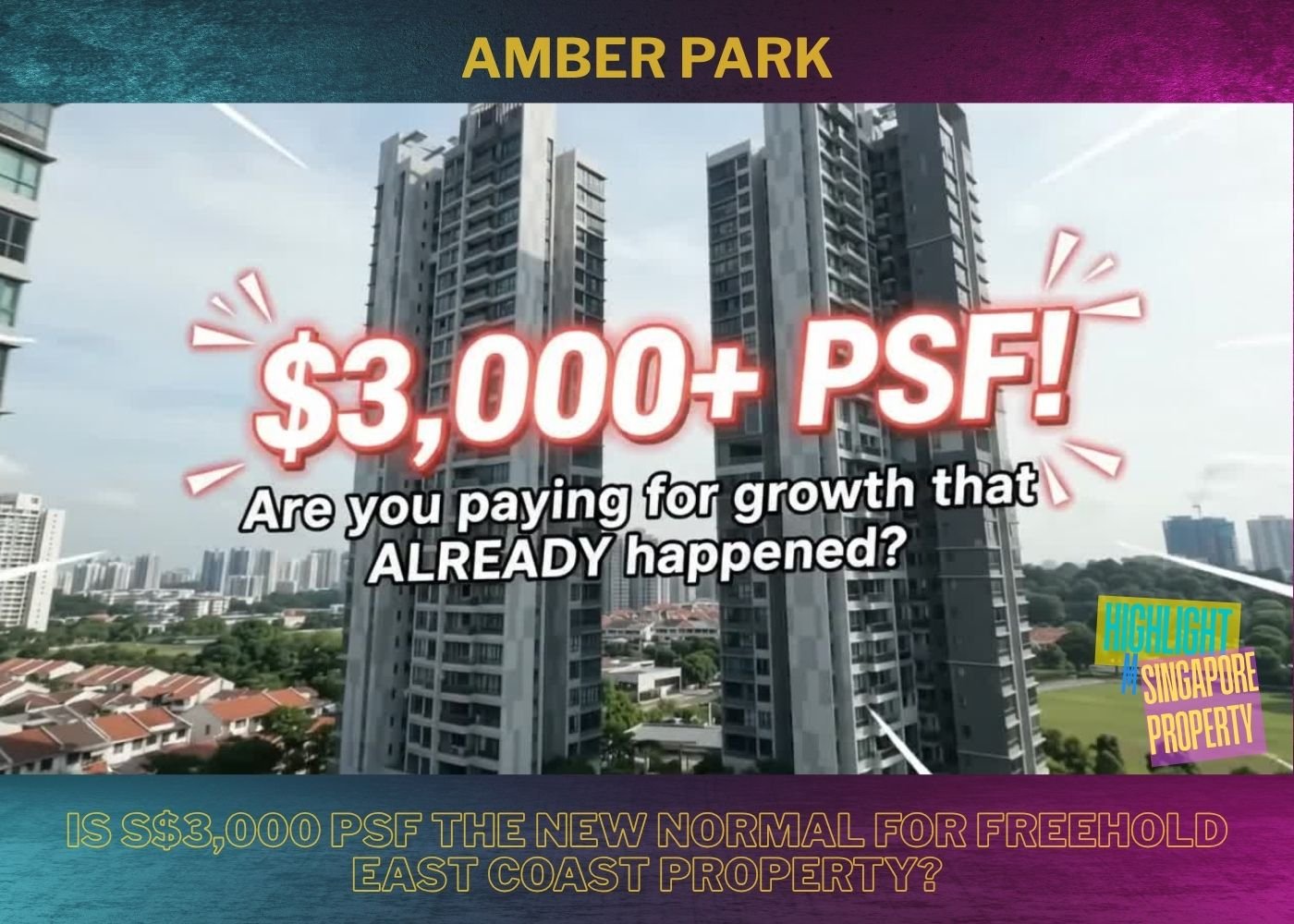
Amber Park: Is S$3,000 PSF the New Normal for Freehold East Coast Property?
A full investment analysis of location, architecture, resale performance, rental yield, competing projects and future exit potential
Project: Amber Park
Location: Amber Gardens, District 15, Singapore
Tenure: Freehold
Developer: City Developments Limited (CDL) and Hong Realty
Total units: 592
Completion: 2023
Latest market reference: October 2026
Indicative 12-month median transaction price: Approximately S$2,910 PSF
Reported record transaction: S$3.515 million, or S$3,170 PSF, for a 1,109 sq ft unit
This analysis uses the supplied Amber Park research transcript and supplements it with available transaction data. Market figures are time-sensitive. Historical performance, scenario calculations and investment opinions should not be interpreted as guarantees of future returns.
1. The central investment question
Can a completed freehold condominium in Singapore’s East Coast still offer attractive capital appreciation after its resale prices approach S$3,000 PSF?
That is the question buyers should ask about Amber Park.
At first glance, the development has several advantages. It is freehold, was completed in 2023, has a distinctive elevated recreational deck and sits in the established District 15 residential market.
However, a good development is not automatically a good investment.
The higher the entry price, the more future appreciation a buyer needs to justify the purchase. A buyer paying S$2,700 PSF faces a very different investment equation from someone paying S$3,170 PSF for a comparable unit.
The critical question is not simply whether Amber Park can appreciate further.
It is whether the next buyer will be willing to pay enough to compensate for your entry price, transaction costs, financing costs and holding risks.
My initial view: Amber Park has credible long-term lifestyle and scarcity attributes. At current pricing, however, buyers should be selective about unit choice and entry quantum rather than assume every unit will benefit equally from the freehold premium.
2. Project overview: What makes Amber Park different?
Amber Park replaced an earlier development on the Amber Park site. The new project was developed by CDL and Hong Realty, with architecture associated with SCDA Architects.
Its defining feature is the Stratosphere, an elevated communal deck positioned approximately 72 metres above ground level across three 21-storey residential towers.
According to the supplied research transcript, the development comprises 592 residential units and received its Temporary Occupation Permit in 2023.
The design attempts to create a different residential experience by shifting a substantial part of the recreational offering above ground level.
Key project features
- Freehold tenure.
- 592 residential units.
- Three 21-storey residential towers.
- Stratosphere elevated recreational deck.
- Approximately 600-metre jogging track.
- Elevated gym, yoga deck and spa pools.
- Ground-level lagoon pool and other communal facilities.
- Private dining and social spaces.
- Smart-home features and premium branded fittings.
- Reported BCA Green Mark Gold Plus certification.
The supplied transcript also notes that Amber Park does not have a tennis court. This is worth considering because buyers who regularly play tennis may value that facility more than an elevated jogging track or sky deck.
The absence of a tennis court does not make the development inferior. It highlights a key principle in property selection: facilities should be evaluated according to the needs of the future buyer, not simply by counting how many facilities a project advertises.
Source note: Project characteristics and facilities above are drawn primarily from the supplied research transcript. Buyers should verify individual unit specifications and current project information before making a purchase.
3. The Stratosphere: Genuine differentiation or expensive architecture?
The Stratosphere is Amber Park’s most recognisable feature.
Rather than relying only on conventional ground-level landscaping, the development places a significant recreational area above the residential towers. The elevated deck incorporates a jogging track, gym, yoga space and spa pools.
There are two ways to evaluate this feature.
The positive investment argument
First, the Stratosphere gives Amber Park a recognisable identity. Buyers comparing several completed condominiums may remember a development with a distinctive architectural feature more easily than one offering a conventional collection of facilities.
Second, it creates a lifestyle experience that is difficult to replicate simply by renovating an older condominium.
Third, the elevated setting may appeal to buyers who value views, privacy and a different sense of space.
Finally, the feature could help Amber Park maintain its position within the premium end of the local resale market, particularly when compared with older developments that have more conventional facilities.
The counterargument
Architecture is valuable only to the extent that buyers are willing to pay for it.
The construction and design costs are already embedded in the property. A future purchaser may appreciate the Stratosphere without being willing to pay a substantial premium for it.
The same principle applies to designer interiors, branded appliances and smart-home systems. They may improve the ownership experience, but they do not guarantee equivalent resale value.
The lack of a tennis court is also a reminder that the design represents a trade-off. A buyer who prioritises tennis, a larger ground-level garden or another specific amenity may prefer a competing development.
Investment conclusion: The Stratosphere is a meaningful point of differentiation, but buyers should not pay an unlimited premium for it. The relevant question is how much of its perceived value is already included in the asking price.
4. Unit layouts and liveability: The details that matter after the viewing
The supplied transcript describes a unit mix ranging from compact one-bedroom apartments to larger penthouses.
It also highlights several practical features:
- Some three-bedroom layouts have bedrooms that can accommodate queen-sized beds.
- Certain dining areas may be relatively compact.
- Penthouses are described as having private lift access and double-volume living spaces.
- Premium sanitary fittings and kitchen appliances form part of the development’s specifications.
- Smart-home features include voice control and connected home functions.
These features should be assessed at the individual-unit level. A development’s reputation cannot compensate for a layout that does not meet a buyer’s needs.
My unit-selection priorities
1. Functional layout
Check whether bedrooms, dining areas and circulation space work for everyday living. A beautiful living room is less useful if the dining area becomes awkward when the family sits down together.
2. Natural light, orientation and ventilation
Assess the actual unit rather than relying on marketing images. Afternoon sun, surrounding buildings and the direction of the view can materially affect comfort.
3. View durability
A view is more valuable when it is unlikely to be obstructed by future development. Buyers should investigate surrounding land use and planning possibilities rather than assume an existing view is permanent.
4. Entry quantum
The total purchase price affects the buyer pool at resale. A lower-quantum unit may appeal to more buyers, although compact units must also be assessed for layout efficiency and competition from other small apartments.
5. Maintenance and condition
For a completed development, buyers can inspect the actual property, common facilities and general maintenance condition. This is an advantage over relying entirely on plans and show-flat representations.
5. Freehold tenure: An advantage, not a guarantee
Freehold tenure is one of Amber Park’s strongest attributes.
A freehold property does not face the same contractual lease expiry as a conventional leasehold condominium. This can be attractive to owner-occupiers planning to hold for many years, as well as buyers who value the ability to pass an asset to the next generation.
However, freehold tenure should not be confused with guaranteed capital appreciation.
A freehold condominium can still underperform if its entry price is too high, the project becomes less competitive, maintenance costs rise or buyer preferences change.
Leasehold developments can also appreciate substantially when purchased at an attractive price and supported by strong demand.
The correct comparison is therefore not simply freehold versus leasehold.
It is:
Tenure + location + entry price + development quality + future resale demand.
For Amber Park, freehold tenure supports the long-term ownership thesis. It does not remove the need for price discipline.
6. Location analysis: District 15 and the East Coast lifestyle
Amber Park is located in District 15, an established residential area associated with the East Coast lifestyle.
Its appeal includes access to a mature residential neighbourhood, dining and lifestyle amenities, and the wider East Coast area. The project may appeal to buyers who want a premium private residence outside the most central parts of Singapore.
However, location analysis should go beyond general descriptions such as “prime” or “desirable”.
Buyers should evaluate the exact walking route to public transport, access to daily amenities, road conditions, noise exposure and the convenience of reaching their workplaces.
For families, school access can influence the decision. Nevertheless, buyers should independently verify school distance, registration rules and eligibility requirements. Proximity does not guarantee admission.
What supports the location thesis?
- An established residential catchment.
- A recognisable East Coast lifestyle proposition.
- Freehold tenure within a mature private residential market.
- Potential demand from owner-occupiers who value the neighbourhood.
- A completed development that buyers can inspect before committing.
What limits the thesis?
- District 15 contains competing developments across different tenures, ages and price points.
- Buyers may compare Amber Park with newer launches rather than only with older resale condominiums.
- Lifestyle desirability does not necessarily translate into high rental yield.
- A substantial premium can reduce the future buyer pool if household budgets do not rise at the same pace.
My view: The location supports the case for long-term residential demand, but the investment result will still depend heavily on the price paid and the unit selected.
7. Market performance: What do the October 2026 numbers tell us?
Available transaction sources place Amber Park’s 12-month median resale price at approximately S$2,900 to S$2,910 PSF.
PropertyBeep reports a 12-month median of S$2,910 PSF based on 26 transactions, with a year-on-year increase of approximately 1.0%. Property Lim Brothers reports a median of S$2,903 PSF across 23 sales in the 12 months to October 2026. Differences can arise from the transaction window and data filters used by each source.
Selected recent transactions
| Transaction | Size | Price | PSF |
|---|---|---|---|
| October 2026 | 1,109 sq ft | S$3,515,000 | S$3,170 |
| October 2026 | 678 sq ft | S$1,952,888 | S$2,880 |
| September 2026 | 463 sq ft | S$1,350,000 | S$2,917 |
| September 2026 | 700 sq ft | S$2,020,000 | S$2,887 |
| August 2026 | 1,582 sq ft | S$4,550,000 | S$2,876 |
Source: PropertyBeep’s recorded transaction data.
The S$3,170 PSF sale is noteworthy, but one record transaction should not be treated as the market value of every unit.
Floor level, view, size, layout and individual transaction circumstances can all affect pricing. The median is generally a better starting point for understanding the broader market, although it also changes with the mix of units sold.
The longer-term data provides useful context. reports annual median prices of approximately S$2,482 PSF in 2022, S$2,545 PSF in 2023, S$2,828 PSF in 2024, S$2,909 PSF in 2025 and S$2,903 PSF across its reported 2026 period. These annual figures are based on different transaction samples and should not be interpreted as a perfectly matched index of identical units.
The broad picture is that Amber Park has moved to a much higher PSF level than in its earlier resale years. More recent data suggests that the market is operating around S$2,900 PSF, rather than showing uninterrupted rapid appreciation.
The investment implication: The historical rise supports the case that buyers have accepted higher prices for the development. It does not establish that the next stage of appreciation will be equally strong.
8. The 100% profitable resale claim: What can we conclude?
The supplied transcript reports that 88 units bought since the 2019 launch and subsequently resold had all recorded gross gains, with a median gross gain of approximately 17% and an average holding period of just under four and a half years.
That is an interesting historical observation, but it needs careful interpretation.
First, the result applies to the particular set of transactions in the source dataset. It should not be treated as proof that every buyer or every future resale will be profitable.
Second, gross resale gains are not the same as net investment returns. Depending on the buyer and transaction, the final outcome may be affected by stamp duties, agent fees, legal costs, financing, renovation, maintenance and the opportunity cost of capital.
Third, the units that were resold may not represent every owner in the development. Owners who have not sold are not included in a realised resale-profit sample.
Fourth, the result reflects the market conditions and holding periods experienced by those sellers. Buyers entering at today’s higher price level face a different starting point.
My conclusion: The reported resale history is encouraging, but it should be treated as historical evidence rather than a forecast. Before relying on the 88-unit statistic, buyers should confirm the underlying transaction records, purchase and resale dates, and whether the calculation includes all relevant costs.
9. Rental yield: Is Amber Park an income investment?
The supplied transcript cites indicative median monthly rent of approximately S$5,366 and a gross rental yield of around 1.9% based on a representative purchase price of S$3.33 million.
The arithmetic is broadly consistent:
S$5,366 × 12 = S$64,392 annual rent.
S$64,392 ÷ S$3,330,000 = approximately 1.93% gross yield.
This is an illustrative calculation based on the transcript’s figures, not a verified matched yield for a specific unit.
What does a 1.9% gross yield mean?
Gross yield is calculated before expenses such as property tax, maintenance fees, repairs, vacancy, leasing fees and financing costs.
The net yield will therefore be lower if those costs are material.
It also means that rental income may cover only a limited portion of the ownership cost. A buyer relying on rental income to service a large mortgage should model the cash flow carefully, including changes in interest rates and periods without a tenant.
Who might still buy Amber Park as an investment?
A buyer may accept a low gross yield if the principal objective is long-term capital appreciation, wealth preservation or future owner-occupation.
But that strategy is not automatically superior to a higher-yielding alternative. The buyer is exchanging current income for the possibility of future price growth, and that growth is uncertain.
My view: Amber Park appears better suited to buyers who can comfortably support the holding costs and value the asset’s lifestyle and tenure attributes. It is less compelling for investors whose main objective is strong rental cash flow.
10. Affordability and financing: The S$3.33 million example
The transcript uses a representative purchase price of S$3.33 million to illustrate the capital required.
At that price, a 25% down payment is:
S$3,330,000 × 25% = S$832,500.
This is before buyer’s stamp duty and other transaction expenses.
The exact cash and CPF requirements depend on the loan structure and applicable regulations. For a typical bank loan, the minimum cash component and the permitted loan amount must be checked against the buyer’s circumstances and current rules.
The transcript also refers to buyer’s stamp duty of approximately S$140,000, monthly income of approximately S$24,399 for loan qualification and a mortgage payment of approximately S$11,225. These should be treated as source estimates, not universal requirements.
The mortgage figure depends on loan size, interest rate and tenure. The income required depends on applicable debt-servicing rules, other liabilities and the borrower’s circumstances.
The practical affordability test
Before buying, ask:
- Can I fund the down payment, stamp duty and purchase expenses without weakening my emergency reserves?
- Can I service the loan if interest rates rise or rental income falls?
- Can I hold the property through a weaker market without being forced to sell?
- Does the expected return justify the capital committed?
- Would a lower-quantum unit or another development provide a more resilient financial position?
A premium condominium should not become a financial burden simply because its long-term story sounds attractive.
11. Competitive gap analysis: Amber Park vs Meyer Blue vs The Shore Residences
A property should not be valued in isolation. Buyers choosing Amber Park may also compare it with a newer freehold launch or an older leasehold development.
Meyer Blue: The newer freehold comparison
Meyer Blue provides a useful comparison because it is a newer freehold development in District 15. OpenProperty.sg reports a median of approximately S$3,203 PSF over its stated 12-month period, updated through July 2026.
Compared with Amber Park’s approximate S$2,910 PSF 12-month median, that represents a gap of about S$293 PSF, or roughly 10%.
This gap may make Amber Park appear relatively attractive to buyers who want freehold tenure and a completed home.
However, the comparison is not a direct valuation formula. Meyer Blue and Amber Park differ in project age, facilities, unit mix, purchase stage and transaction sample. A newer development may command a premium for reasons beyond its headline PSF.
The so-called halo effect is a plausible market mechanism: high prices at a new launch can influence how buyers perceive nearby resale properties. But it is not proof that the resale property must appreciate or that the gap will close.
The Shore Residences: The older leasehold comparison
The Shore Residences is a useful contrast because it has a 103-year lease commencing in 2009.
PropertyBeep reports a 12-month median of approximately S$2,186 PSF and a recorded October 2026 sale at S$2,586 PSF for a 1,141 sq ft unit.
The difference in median PSF between Amber Park and The Shore Residences is approximately S$724 PSF.
That gap is substantial, but it cannot be attributed solely to tenure. The developments also differ in completion age, facilities, unit characteristics and the mix of recent transactions.
Comparison summary
| Factor | Amber Park | Meyer Blue | The Shore Residences |
|---|---|---|---|
| Tenure | Freehold | Freehold | 103-year lease from 2009 |
| Development stage | Completed, TOP 2023 | Newer development | Completed, older |
| Indicative 12-month median | About S$2,910 PSF | About S$3,203 PSF in the cited data | About S$2,186 PSF |
| Main investment argument | Completed freehold asset with distinctive facilities | Newer freehold alternative | Lower PSF entry point |
| Main consideration | Price and rental yield | Premium entry price and future resale competition | Lease duration and differences in age and facilities |
The median figures come from different reporting windows and should be checked again at the point of purchase.
My interpretation
Amber Park occupies an interesting position between a newer, higher-priced freehold alternative and an older leasehold development with a lower PSF benchmark.
That position may appeal to buyers who want a completed freehold condominium without paying the full price of a newer launch.
But the word relative value is only meaningful if the unit’s absolute price is justified. A discount to a more expensive project does not automatically make a property cheap.
12. Entry-price analysis: What is a reasonable PSF to pay?
The following bands are my own analytical screening framework, not official valuations or guarantees of future returns.
| Entry price | Initial assessment | What I would require |
|---|---|---|
| Below S$2,650 PSF | Potentially attractive | Verify condition, facing, floor and reason for discount |
| S$2,650 to S$2,800 PSF | Attractive for further investigation | A functional layout and no major unit-specific drawbacks |
| S$2,800 to S$2,950 PSF | Fair to potentially attractive | Good unit attributes and disciplined comparison with recent sales |
| S$2,950 to S$3,100 PSF | Selective | A clear justification for the premium |
| S$3,100 to S$3,250 PSF | Premium pricing | Strong unit-specific advantages and a credible exit strategy |
| Above S$3,250 PSF | Difficult to justify for a typical investment | Exceptional attributes and a buyer who understands the higher entry risk |
These bands should not replace a valuation based on comparable units, current listings and actual transaction evidence.
A high-floor unit with an enduring view may deserve a premium. A unit with an awkward layout or a less desirable facing may warrant a discount, even if it sits in the same development.
Why the entry price matters so much
Consider two buyers:
- Buyer A enters at S$2,750 PSF.
- Buyer B enters at S$3,170 PSF.
If both units eventually sell at S$3,500 PSF, Buyer A has gained S$750 PSF before costs, while Buyer B has gained only S$330 PSF before costs.
Both may have made a gross gain, but their investment outcomes are very different.
The same future market price does not produce the same return for every buyer.
The best unit is not necessarily the most impressive unit. It may be the unit with the strongest combination of entry price, functionality and future resale appeal.
13. Future price scenarios: What if Amber Park appreciates from S$2,910 PSF?
To evaluate today’s price, it helps to calculate what different appreciation rates would imply for a future resale.
The table below starts with S$2,910 PSF and applies hypothetical annual compound growth rates. These are mathematical scenarios, not forecasts.
| Annual appreciation scenario | After 5 years | After 8 years | After 10 years |
|---|---|---|---|
| 0% | S$2,910 | S$2,910 | S$2,910 |
| 2% | S$3,213 | S$3,409 | S$3,547 |
| 3% | S$3,372 | S$3,685 | S$3,904 |
| 4% | S$3,541 | S$3,977 | S$4,301 |
| 5% | S$3,710 | S$4,284 | S$4,738 |
The calculations assume that the starting price is S$2,910 PSF and that growth compounds annually. They exclude transaction costs, financing, taxes, rental income and inflation.
How should buyers use these scenarios?
If you assume 3% annual appreciation over ten years, the implied exit price is approximately S$3,904 PSF.
The important question is whether a future buyer would realistically pay that amount for the specific unit, considering the property’s age at that point, competing developments, market conditions and the buyer’s available alternatives.
If your investment case only works at 5% annual appreciation, you should be more cautious than if it remains acceptable under a lower-growth scenario.
Do not select the most optimistic line and treat it as your expected return.
My preferred approach is to stress-test the purchase at 0%, 2% and 3% appreciation before considering stronger upside scenarios.
14. Holding period and exit strategy
Amber Park’s freehold tenure and completed status may suit buyers with a long-term ownership horizon.
However, the ideal holding period depends on the buyer’s financial situation and reason for purchasing.
Owner-occupiers
For a family planning to live in the property for many years, the lifestyle benefits may justify some premium. The decision should still account for affordability, layout, school access and future household needs.
Long-term capital-growth buyers
These buyers should assess whether the entry price leaves enough room for appreciation after costs. They should also consider how Amber Park will compete with future new launches and other completed freehold properties.
Rental investors
A low gross yield means the investment may require significant cash support. These buyers should be especially careful about financing costs, vacancy and the possibility of a flat resale market.
Buyers considering a short holding period
A short holding period increases the importance of transaction costs and market timing. It leaves less time for the investment thesis to play out and makes the result more sensitive to the price at which the property is resold.
I would not build a purchase strategy around the assumption that a recent record transaction means another record is imminent.
15. The main risks buyers should not ignore
Risk 1: Paying too much for the Stratosphere
A distinctive facility is an advantage only when the price premium is justified. The future buyer may appreciate it without paying the premium you paid.
Risk 2: Low rental yield
The indicative gross yield of around 1.9% suggests that income alone may not justify the purchase for many investors. Net yield will be lower after expenses.
Risk 3: Competition from newer launches
New developments can attract buyers with modern specifications and fresh marketing. Amber Park must compete on its own merits, including tenure, layout, condition, price and lifestyle.
Risk 4: Competition from older, lower-quantum units
Some buyers prioritise a lower total purchase price over newer facilities. Amber Park’s premium positioning may narrow its resale audience when affordability becomes more important.
Risk 5: Interest rates and household affordability
Higher financing costs or tighter lending capacity can reduce the pool of eligible buyers for expensive homes.
Risk 6: Unit-specific weaknesses
Poor orientation, compromised privacy, noise, awkward layouts or uncertain views can affect resale demand even when the overall development performs well.
Risk 7: Mistaking gross gains for net returns
Historical resale gains should not be treated as investment returns without considering purchase and selling costs, financing, taxes and holding expenses.
Risk 8: Overconfidence in future appreciation
A property that has already appreciated substantially may continue to rise, stagnate or decline. Historical performance does not settle which outcome will occur next.
16. My preferred unit-selection hierarchy
If I were evaluating Amber Park for a buyer, I would rank the considerations in this order.
1. Entry price relative to comparable units
Begin with actual transaction evidence. Identify whether the asking price is justified by the unit’s attributes.
2. Layout and usable space
A functional layout can appeal to both owner-occupiers and future buyers. Do not let a spectacular view distract from poor everyday usability.
3. View quality and durability
Assess the view from the actual unit and investigate possible future obstructions.
4. Orientation, noise and privacy
These factors affect comfort and can influence resale demand.
5. Total purchase quantum
The total price determines which future buyers can realistically afford the unit.
6. Floor level and stack
Higher floors may be desirable, but the premium must be compared with the value likely to be recognised by the resale market.
7. Facilities and branding
The Stratosphere and premium fittings are supporting attributes. They should not override the economics of the purchase.
My guiding principle is simple:
Buy the best-priced unit for its actual qualities, not the unit with the most impressive marketing story.
17. Buyer suitability: Who should consider Amber Park?
Potentially suitable
- Owner-occupiers who value freehold tenure and the East Coast lifestyle.
- Buyers who can comfortably afford the purchase without relying on aggressive appreciation.
- Long-term holders who appreciate the development’s architectural identity.
- Buyers who have compared similar units and can justify the entry price.
- Purchasers who value a completed development and can inspect the actual unit and facilities.
Buyers who should be more cautious
- Investors who require strong immediate rental cash flow.
- Buyers who need to sell within a short period.
- Purchasers who must stretch their finances to meet the entry price.
- Buyers paying a large premium without a clear unit-specific justification.
- Investors whose projected return depends on rapid price growth continuing.
Amber Park is not necessarily unsuitable for these buyers. The point is that the financial assumptions need to match the property’s characteristics.
18. The M investment scorecard
The following is my qualitative assessment of Amber Park. It is an analytical framework, not a formal valuation or an independently verified investment rating.
| Factor | Score out of 10 | Rationale |
|---|---|---|
| Location and lifestyle | 7.5 | Established District 15 residential proposition |
| Market differentiation | 8.5 | Distinctive Stratosphere and recognisable design |
| Freehold tenure | 9.0 | Long-term ownership appeal |
| Completed-product certainty | 8.0 | Buyers can inspect actual units and facilities |
| Rental-income appeal | 4.5 | Indicative gross yield is relatively low |
| Entry-price sensitivity | 6.5 | Attractive only if the individual unit is priced appropriately |
| Overall qualitative assessment | 7.5/10 | Stronger as a selective long-term ownership proposition than as a high-yield investment |
The score is deliberately not a simple average of the individual categories. It reflects my view that the development has meaningful lifestyle and tenure strengths, while the relatively low rental yield and current entry price deserve significant weight.
19. Final verdict: Is Amber Park still worth considering?
Amber Park has several qualities that are difficult to dismiss.
It is freehold, was completed in 2023 and offers a distinctive architectural feature in the Stratosphere. The available transaction data shows that buyers have accepted prices around S$2,900 PSF, with individual transactions reaching approximately S$3,170 PSF.
Its positioning between newer freehold developments and older leasehold alternatives gives buyers a useful comparison point.
But the investment case is not risk-free.
At current pricing, rental yield appears modest. Future appreciation is uncertain, and a premium paid for architecture or tenure may already be reflected in the purchase price. Buyers also need to consider financing, total quantum, unit quality and future competition.
My conclusion is that Amber Park deserves consideration, but not at any price.
For an owner-occupier with a long-term horizon, the combination of freehold tenure, lifestyle and completed-product certainty may be compelling.
For an investor, the decision requires greater discipline. The entry price must leave a reasonable margin for future appreciation after costs, and the buyer must be financially comfortable if the market grows slowly or remains flat for several years.
The most important question is not whether Amber Park has already performed well.
It is whether the specific unit you are buying today offers enough future value to justify the price.
That is the difference between buying a prestigious property and making a disciplined property investment.
20. The final five tests before making an offer
Before committing to Amber Park, I would run five tests.
Test 1: The entry-price test
Compare the asking price with recent transactions for units of similar size, floor, facing and layout. Do not rely on the development-wide median alone.
Test 2: The functionality test
Check the floor plan, natural light, ventilation, dining space, bedroom dimensions and privacy.
Test 3: The competition test
Compare Amber Park with Meyer Blue, The Shore Residences and other realistic alternatives at a similar total purchase quantum.
Test 4: The cash-flow test
Calculate gross and net rental yield, financing costs, maintenance and a vacancy allowance. Make sure the property remains affordable under less favourable assumptions.
Test 5: The exit-price test
Work backwards from a realistic future selling price. Include transaction costs and stress-test the result under low or zero appreciation.
If the investment only looks attractive when you assume an optimistic future selling price, the entry price may be too high.
If the investment remains financially manageable under conservative assumptions, it deserves a more serious look.
The M view: Amber Park’s strongest attributes are its freehold tenure, distinctive design and established East Coast positioning. Its biggest challenge is whether today’s price leaves enough room for tomorrow’s buyer to reward you for owning it.
#AmberPark #SingaporeProperty #District15 #FreeholdCondo #PropertyInvestment #EastCoastSingapore #CondoAnalysis #PropertyMarket #RealEstateInvestment #ThisIsM #MSingaporeProperty #meyerblue #theshoreresidences
msingaporeproperty.com