Boon Keat ❂ CHIN
Real Estate Consultant | Trusted Advisor with 14+ Years of Experience | Founder of M | MIKE Framework Architect l FCPA (AUS) CA (SIN) MBA
A Comprehensive Investment Analysis of Singapore’s First Private Residential Launch in the Bukit Timah Turf City Transformation
There is something unusual about buying a new condominium in a prime Singapore neighbourhood.
Normally, when you buy in Bukit Timah, you are buying an established story.
The roads are already there.
The schools are already there.
The shops are already there.
The surrounding homes are already there.
And the prestige is already reflected in the price.
Dunearn House is different.
You are buying into an established District 11 address, but you are also buying into a neighbourhood that is still being created.
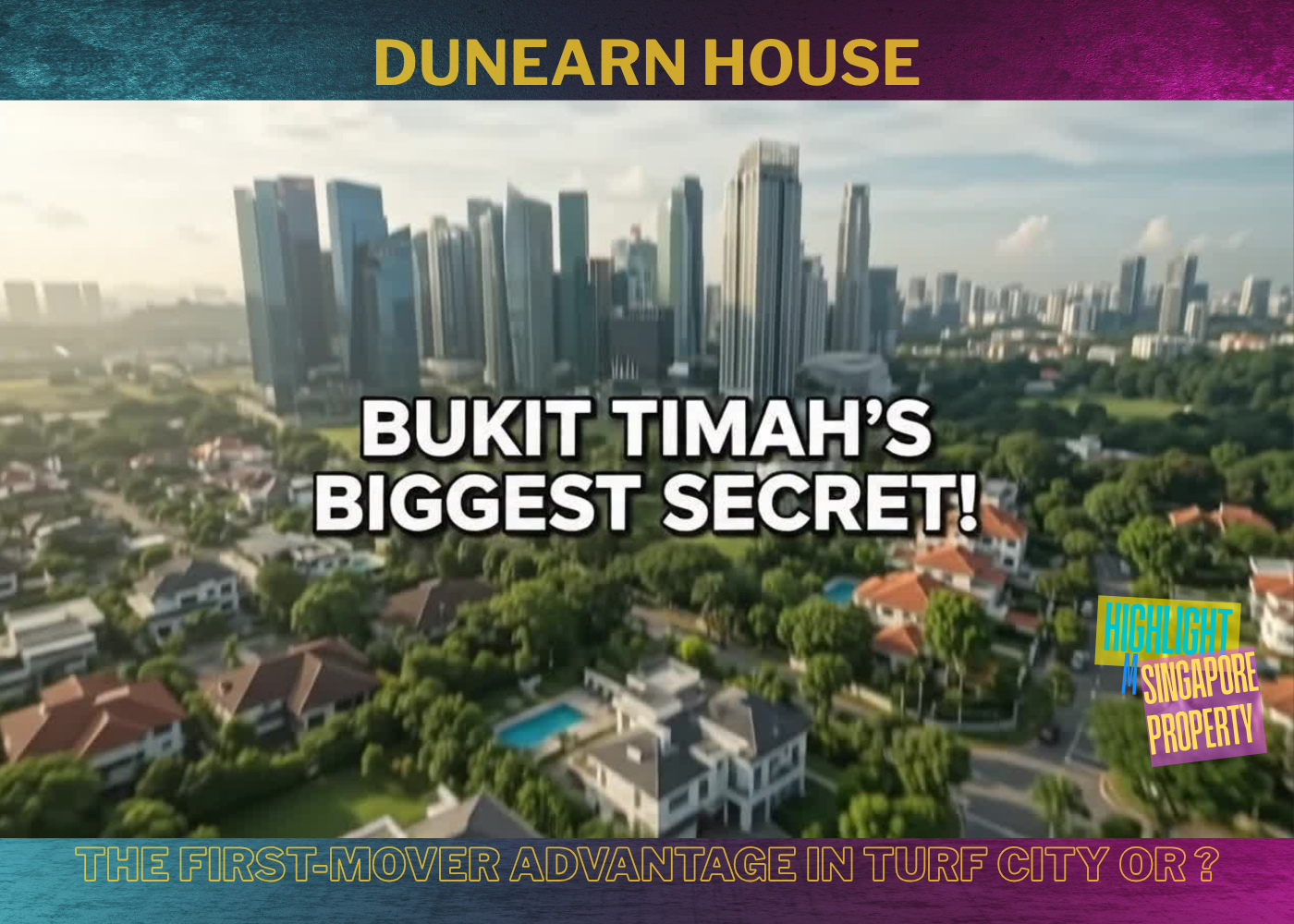
Dunearn House is the first private residential development launched within the Bukit Timah Turf City masterplan.
It has 380 units, a 99-year leasehold tenure, approximately 145,226 sq ft of site area, and is about a four-minute walk from Sixth Avenue MRT on the Downtown Line. The future Turf City station on the Cross Island Line is targeted for 2032.
That creates the central investment question:
Are you getting a genuine first-mover advantage, or are you paying today’s premium for a neighbourhood that may take many years to mature?
That is the question I would use to analyse Dunearn House.
1. DUNEARN HOUSE AT A GLANCE
| Factor | My Assessment |
|---|---|
| Location | Dunearn Road, District 11 |
| Developer | Frasers Property, CSC Land Group & Sekisui House |
| Tenure | 99-year leasehold |
| Units | 380 |
| Blocks | 5 |
| Height | 3 × 10-storey + 2 × 19-storey |
| Site | ~145,226 sq ft |
| Plot Ratio | 2.4 |
| Existing MRT | Sixth Avenue MRT, ~4-minute walk |
| Future MRT | Turf City CRL station, targeted 2032 |
| Expected TOP | 31 Dec 2030 |
| Land Cost | $1,410 PSF PPR |
| Launch Starting Price | From $1.475m / ~$2,799 PSF |
| Launch Weekend | 212 / 380 sold |
| Launch Average | ~$3,140 PSF |
| Aug 2026 Median | ~$3,008 PSF |
| Current Market Position | First private launch in Turf City |
| Main Catalyst | Turf City transformation |
| Main Risk | Paying too much for future potential |
| My Price View | Highly price-sensitive |
The launch result is worth noting.
Dunearn House sold 212 of 380 units, or 56%, during its launch weekend at an average S$3,140 PSF, with all standard three-bedroom units sold.
By August 2026, ERA reported another 18 transactions at a median of approximately S$3,008 PSF.
So the market has already given us an important piece of information.
The project can sell around the S$3,000 PSF level.
The question now is whether buyers at that level have enough future upside.
2. THE REAL STORY IS NOT DUNEARN HOUSE. IT IS TURF CITY.
If you analyse Dunearn House purely as a condominium, you miss the bigger picture.
This is fundamentally a masterplan investment.
URA describes Bukit Timah Turf City as a future inclusive housing estate that will integrate homes, greenery, heritage, amenities and public transport. The plans include retail, F&B, recreational facilities, sports facilities, schools, healthcare facilities and a future bus interchange.
The scale matters.
Turf City covers approximately 176 hectares and is planned to become a new housing estate.
That means Dunearn House is not simply a new condo replacing an old condo.
It is the first private residential component of a much larger urban transformation.
And that creates both:
Opportunity
and
Risk.
3. FIRST-MOVER ADVANTAGE. REAL OR MARKETING?
This is probably the most important question.
Dunearn House has something later developments cannot replicate.
It is the first private residential launch in the Turf City transformation.
The developers themselves position this as a first-mover opportunity.
But first mover does not automatically mean first winner.
The first project in a new precinct has to tolerate:
- construction disruption
- incomplete amenities
- future competing developments
- uncertain buyer perception
- evolving infrastructure
- years of neighbourhood transformation
You are effectively buying the early version of the neighbourhood.
If the transformation succeeds, later buyers may pay more for a more mature environment.
But if you buy at too high a price today, you may have already paid for part of that future appreciation.
This is the central tension.
4. THE MRT STORY IS STRONGER THAN IT FIRST APPEARS
Dunearn House already has something many masterplanned developments do not.
It does not need to wait for its first MRT connection.
Sixth Avenue MRT already exists.
It is approximately a four-minute walk from the development.
That gives Dunearn House an immediate connectivity advantage.
Then comes the second layer.
The Cross Island Line’s Turf City station is under construction, with passenger service for CRL Phase 2 targeted for 2032.
This is important because it means the investment thesis is not:
“Hopefully an MRT comes.”
It is:
“There is an existing MRT today, with another major rail connection planned for the future.”
That is a much stronger proposition.
However, I would not price the entire future MRT benefit into today’s purchase price.
Future infrastructure should be treated as a potential catalyst.
Not guaranteed capital appreciation.
5. THE LAND COST STORY IS ONE OF THE MOST INTERESTING PARTS
The Dunearn Road GLS site was awarded to the Frasers Property, CSC Land Group and Sekisui House consortium for approximately:
$491.45 million
or approximately:
$1,410 PSF PPR.
Nine developers participated in the tender, with CDL submitting the second-highest bid at approximately $1,360 PSF PPR.
That is important.
The developer did not buy the land at an obviously distressed price.
But neither did it pay an extreme premium over the second bidder.
The gap was only around 3.7%.
That tells me something.
The developers were competing for the location, but the bidding remained relatively disciplined.
6. THEN THE SECOND DUNEARN ROAD SITE CHANGED THE EQUATION
This is where the story becomes more interesting.
A separate Dunearn Road GLS site was subsequently awarded to a Wing Tai and Metro Holdings consortium for approximately:
$1,625 PSF PPR.
That was about 15.2% higher than Dunearn House’s $1,410 PSF PPR land cost.
This creates what I call temporal land-cost arbitrage.
Dunearn House bought the first land parcel before the second parcel established a higher benchmark.
That gives Dunearn House an important potential pricing advantage.
If the next-door project eventually launches at a higher PSF because its land cost is higher, Dunearn House could look relatively cheaper.
But there is an important caveat.
A cheaper land cost does not automatically create a higher resale price.
It simply creates a potentially stronger margin of safety.
The market still decides what the completed property is worth.
7. THE TURF CITY SUPPLY QUESTION
Now we have to discuss the biggest counterargument.
Turf City is not going to remain a 380-unit development.
URA’s plan is to progressively introduce more housing and supporting amenities across the precinct.
That means future supply is both:
A catalyst
and
a risk.
More residents can create:
- more shops
- more F&B
- more transport demand
- more community facilities
- more schools
- stronger neighbourhood identity
But more condos also create:
- more resale competition
- more rental competition
- more alternative units
- more pricing benchmarks
This is why I would not use a simplistic:
“First mover means huge appreciation.”
argument.
The more accurate thesis is:
Dunearn House gets first access to a neighbourhood transformation, but it also gets first exposure to future competition.
8. THE PUBLIC HOUSING QUESTION
This is another area where buyers need to think beyond prestige.
URA describes Turf City as an inclusive housing estate with a variety of homes. Government planning documents also state that public and private housing sites will be progressively released.
Some buyers may instinctively think:
“Public housing in Bukit Timah will reduce exclusivity.”
I would look at it differently.
A mixed-tenure neighbourhood can create a much broader resident population.
That can support:
- retail
- F&B
- schools
- childcare
- transport
- healthcare
- community facilities
It can also create a future pool of households who may eventually move within the broader private housing market.
But I would be careful with the claim that HDB residents are a “guaranteed conveyor belt” of future condo buyers.
They are potential demand.
Not guaranteed demand.
That distinction matters.
9. THE BIGGEST PRODUCT DECISION: WHY NO ONE-BEDROOM UNITS?
This is one of the smartest aspects of Dunearn House.
There are no one-bedroom units.
The development focuses on:
2-bedroom
3-bedroom
4-bedroom
This is very different from some earlier projects where a large proportion of units were designed around smaller investor products.
The source analysis makes an important observation here.
Dunearn House’s unit mix is much more aligned with the traditional Bukit Timah family demographic.
That matters because the local buyer is not necessarily looking for:
“The smallest possible condo.”
The buyer may be looking for:
“A modern family home in Bukit Timah without paying the quantum of a huge older unit.”
That is a very different market.
10. GFA HARMONISATION CHANGES THE PSF COMPARISON
This is one of the most important technical points.
Singapore’s floor-area definitions were harmonised from June 2023.
URA states that the revised framework measures floor areas to the middle of the wall, includes all strata areas within GFA and excludes voids from strata area. The revised definitions apply to relevant development applications from 1 June 2023 and GLS sites launched from 1 September 2022.
Why does this matter?
Because buyers often say:
“The old condo is 1,500 sq ft and $2,000 PSF. The new condo is only 1,200 sq ft and $3,000 PSF.”
That comparison may not be completely apples-to-apples.
The older property may have areas measured under a different framework.
However, we should not go too far.
GFA harmonisation does not mean every new-launch square foot is literally usable floor area.
The actual floor plan still matters.
The correct lesson is:
Compare the usable functionality of the unit, not just the headline PSF.
The source analysis makes the same point when examining the efficiency of Dunearn House’s layouts.
11. FLOOR PLAN ANALYSIS. THIS IS WHERE DUNEARN HOUSE GETS INTERESTING
The development uses two collections.
Luxury Collection
Three 10-storey blocks.
Primarily:
- 2-bedroom
- 2-bedroom + study
- 2-bedroom premium
- 3-bedroom
- 3-bedroom + flexi
- 3-bedroom + study
Pinnacle Collection
Two 19-storey towers.
Primarily:
- 3-bedroom premium
- 4-bedroom
- 4-bedroom premium
- 4-bedroom premium + study
The overall size range runs from approximately 527 sq ft to 1,378 sq ft.
The unit mix is particularly important because it creates a relatively clear buyer segmentation.
12. THE 527 SQ FT TWO-BEDROOM
The smallest two-bedroom is approximately 527 sq ft.
At launch:
$1.475 million
or approximately:
$2,799 PSF.
This is the project’s psychological entry point.
It gives buyers a way into District 11 at below $1.5 million.
That is powerful marketing.
But it does not automatically mean it is the best investment.
A small two-bedroom has to compete against:
- other new launches
- resale two-bedroom units
- rental alternatives
- future Turf City developments
The source analysis correctly highlights the efficiency of the smaller layouts and the use of dumbbell-type planning to reduce wasted circulation.
My view:
The 527 sq ft unit is an entry product.
It is not necessarily the project’s strongest investment product.
13. THE THREE-BEDROOM IS WHERE THE MARKET GAVE US AN ANSWER
This is extremely important.
At launch, the standard three-bedroom started from approximately:
$2.597 million
for 872 sq ft.
Those standard three-bedroom units were fully sold during the launch weekend.
That is a very useful market signal.
It tells us that buyers were willing to pay for:
family-sized accommodation in Bukit Timah
rather than simply chasing the cheapest PSF.
This supports the thesis that Dunearn House’s product mix is more aligned with owner-occupier demand than a project heavily dominated by one-bedroom units.
14. THE FOUR-BEDROOM MAY BE THE MOST INTERESTING PRODUCT
This is where I would pay particular attention.
The standard four-bedroom starts from:
$3.588 million
for approximately:
1,184 sq ft
which works out to roughly:
$3,030 PSF.
Current pricing information shows the standard four-bedroom still has a small number of units available around the original launch quantum, while the larger premium four-bedroom formats command higher total prices.
Think about the quantum.
You are paying around $3.6 million for a four-bedroom in a prime District 11 location.
For a family that genuinely wants four bedrooms, this is a very different proposition from a $4.5 million or $5 million older luxury property.
And the source analysis makes an important point.
The 1,184 sq ft four-bedroom layouts are designed to create family functionality without pushing the total quantum into the stratosphere.
That is exactly the type of product that can create resale demand.
15. MY UNIT SELECTION HIERARCHY
If I were analysing Dunearn House for investment, I would rank the product strategy as follows.
🥇 Tier 1. Four-Bedroom
Particularly:
- 1,184 sq ft standard four-bedroom
- good orientation
- higher floor
- quiet facing
- greenery or landed views
- efficient layout
- reasonable quantum
Why?
Because the family buyer pool is relatively clear.
And the supply of modern four-bedroom units in prime Bukit Timah is not unlimited.
🥈 Tier 2. Three-Bedroom + Study / Flexi
This is potentially the sweet spot between:
- family functionality
- quantum
- rental flexibility
- resale demand
The strong launch performance of the three-bedroom segment supports this thesis.
🥉 Tier 3. Two-Bedroom + Study
Potentially interesting for:
- young couples
- investors
- right-sizers
- buyers who want a study/work-from-home room
But price discipline becomes more important.
⚠️ Tier 4. Smallest Two-Bedroom
This is the easiest unit to understand.
It is also the unit most likely to face competition from other small-format condos.
I would only buy it if the quantum and stack are sufficiently attractive.
16. THE LOCATION ADVANTAGE IS NOT JUST MRT
Dunearn House sits inside an established Bukit Timah ecosystem.
You have:
- Sixth Avenue MRT
- established landed housing
- Swiss Club
- Bukit Timah Nature Reserve
- Rail Corridor
- Singapore Botanic Gardens
- established schools
- existing private housing
- PIE access
- future Turf City MRT
- future Turf City amenities
The developer specifically highlights proximity to the Rail Corridor, Bukit Timah Nature Reserve, Central Catchment Nature Reserve and Botanic Gardens.
This is important.
Dunearn House is not a greenfield location in the traditional sense.
It is an established prime neighbourhood being expanded and transformed.
That is a much better starting point than a completely isolated new town.
17. THE SCHOOL STORY NEEDS TO BE HANDLED CAREFULLY
Bukit Timah is famous for its education ecosystem.
But this is where property marketing can become misleading.
Current OneMap-based analysis indicates:
- Methodist Girls’ School Primary is around the 1 km boundary
- Raffles Girls’ Primary is around 1.36 to 1.39 km
- Pei Hwa Presbyterian is around 1.88 to 1.91 km
- Nanyang Primary is around 1.91 to 1.96 km
The final building outline and future OneMap refresh will determine the exact eligibility position.
So I would not market Dunearn House as:
“Guaranteed 1 km MGS.”
That is too aggressive.
The correct statement is:
Dunearn House sits within the Bukit Timah education belt, with several sought-after schools within the 1 km to 2 km range, while MGS Primary is close to the 1 km boundary.
For an investor, that is still useful.
But it is not the same as guaranteed admission.
18. THE GRANDSTAND PROBLEM
Here is something I would tell a buyer during the showflat presentation.
The neighbourhood is not finished.
The former Turf City Grandstand and surrounding amenities are undergoing transformation.
That means the buyer may experience:
- construction activity
- temporary inconvenience
- changing traffic patterns
- incomplete retail
- evolving amenities
The source analysis correctly describes this as the “blank canvas” problem.
This is not necessarily a weakness.
It is the price of being early.
But buyers need to understand what they are signing up for.
19. THIS IS NOT A THREE-YEAR INVESTMENT STORY
This is one of my strongest conclusions.
If you buy Dunearn House and expect:
Buy in 2026.
Sell in 2029.
Make a huge profit.
I would be cautious.
The project itself is expected to obtain vacant possession around December 2030.
The Turf City transformation will take much longer.
The future CRL station is targeted for 2032.
The broader precinct will be built progressively over many years.
So the stronger investment horizon is:
5 to 10 years or longer.
The longer your holding period, the more opportunity there is for the surrounding infrastructure and amenities to mature.
20. THE 99-YEAR LEASEHOLD QUESTION
This is probably the biggest psychological hurdle.
Bukit Timah has historically been associated with:
Freehold.
Dunearn House is:
99-year leasehold.
Some buyers will immediately reject it.
But I think the more useful question is:
What are you buying for the 99-year lease?
You are getting:
- a brand-new development
- a relatively fresh lease
- MRT connectivity
- a new masterplanned precinct
- modern layouts
- modern facilities
- future infrastructure
The tenure trade-off is real.
But the correct comparison is not:
Freehold = good.
Leasehold = bad.
It is:
What price are you paying for each?
That is why entry PSF becomes so important.
21. THE RESALE COMPETITION
This is where I would become very analytical.
Current 12-month median transaction benchmarks include approximately:
| Development | Tenure | Approx. Median PSF |
|---|---|---|
| Fourth Avenue Residences | 99-year | ~$2,504 |
| Mayfair Modern | 99-year | ~$2,241 |
| Maple Woods | Freehold | ~$2,233 |
| The Tessarina | Freehold | ~$2,222 |
| RoyalGreen | Freehold | ~$2,757 |
| Watten Estate | Freehold | ~$2,872 |
| Dunearn House | New launch | ~S$3,000+ |
Fourth Avenue Residences has been transacting around S$2,504 PSF over the past 12 months, while Mayfair Modern is around S$2,241 PSF. Maple Woods and The Tessarina are around S$2,233 and S$2,222 PSF respectively.
RoyalGreen and Watten Estate provide useful prime-location benchmarks at higher levels.
So yes.
Dunearn House is expensive compared with many nearby resale properties.
But it is not necessarily irrationally expensive.
You are paying for:
- new construction
- a fresh lease
- first-mover position
- future MRT
- future precinct amenities
- modern layouts
- new facilities
The question is whether that premium is too large.
22. THE PRICE PREMIUM IS THE INVESTMENT THESIS
This is where I would draw the line.
The launch started from approximately:
$2,799 PSF
but the launch weekend average was:
$3,140 PSF.
August’s median was approximately:
$3,008 PSF.
That tells me the project is not simply a $2,799 PSF story.
The actual investment decision is happening around the $3,000+ PSF range.
And that changes the analysis.
23. MY DUNEARN HOUSE PRICE MATRIX
These are my analytical thresholds, not developer pricing.
| Entry PSF | My View | Analytical Score |
|---|---|---|
| Below $2,850 | Very interesting | ⭐ 8.5/10 |
| $2,850-$2,950 | Attractive | ⭐ 8.3/10 |
| $2,950-$3,050 | Reasonable | ⭐ 8.0/10 |
| $3,050-$3,150 | Selective | ⭐ 7.7/10 |
| $3,150-$3,300 | Price-sensitive | ⭐ 7.2/10 |
| $3,300-$3,450 | High selectivity | ⭐ 6.8/10 |
| Above $3,450 | Very cautious | ⭐ 6.5/10 |
Why?
Because the higher your entry price, the less future upside is available to you.
This is the key difference between:
buying a good project
and
making a good investment.
24. THE QUANTUM TEST
PSF is not enough.
Let’s say you buy:
2-bedroom
Around $1.5 million.
That gives you a relatively accessible entry into District 11.
But your resale buyer will have many alternatives.
3-bedroom
Around $3 million.
Now you enter a much more interesting family segment.
But you are also competing with established resale projects.
4-bedroom
Around $3.6 million and above.
This becomes interesting because the number of modern four-bedroom alternatives at a similar quantum is much smaller.
This is why I believe the quantum-to-functionality equation may be more important than simply buying the lowest PSF.
25. THREE LAYERS OF PRICE PROTECTION
I would analyse Dunearn House using three layers.
Layer 1. Land Cost Protection
Dunearn House:
$1,410 PSF PPR
Second Turf City parcel:
$1,625 PSF PPR
That gives Dunearn House an early land-cost advantage.
Layer 2. Product Protection
The project focuses heavily on:
- 3-bedroom
- 4-bedroom
- family layouts
- efficient floor plans
That aligns better with the Bukit Timah owner-occupier demographic than a project dominated by tiny investor units.
Layer 3. Location Transformation
The project benefits from:
- existing Sixth Avenue MRT
- future Turf City MRT
- Turf City transformation
- new amenities
- greenery
- heritage integration
- future public and private housing
The three layers together create the investment thesis.
26. BUT THERE IS A FOURTH LAYER. PRICE PROTECTION.
This is the one buyers control.
If you buy at:
$2,850 PSF
you have a different investment equation from someone buying at:
$3,350 PSF.
Same project.
Same facilities.
Same MRT.
Completely different investment.
That is why I would never say:
“Dunearn House is a good buy.”
without adding:
“At what price?”
27. SIMPLE APPRECIATION SCENARIOS
Let’s use a simple illustration.
Assume an entry price of:
$3,000 PSF
This is not a forecast.
It is simply a mathematical sensitivity test.
5-Year Scenario
At 3% annual appreciation:
Approximately $3,478 PSF
At 4%:
Approximately $3,650 PSF
At 5%:
Approximately $3,829 PSF
8-Year Scenario
At 3%:
Approximately $3,800 PSF
At 4%:
Approximately $4,106 PSF
At 5%:
Approximately $4,433 PSF
10-Year Scenario
At 3%:
Approximately $4,032 PSF
At 4%:
Approximately $4,441 PSF
At 5%:
Approximately $4,887 PSF
Again, these are scenarios, not predictions.
But this exercise tells us something useful.
If you buy at $3,300 PSF, you require substantially stronger future price growth to produce the same return.
The higher your entry price, the more your future appreciation has already been consumed.
28. WHAT HAPPENS IF YOU BUY AT $3,140 PSF?
The launch weekend average was approximately $3,140 PSF.
At 3% annual growth for five years:
Approximately $3,640 PSF
At 4%:
Approximately $3,824 PSF
At 5%:
Approximately $4,000 PSF
This does not mean those prices will happen.
It simply tells you what level of future appreciation would be required under different assumptions.
That is a much more useful way to think about the investment than:
“The area will definitely go up.”
29. PMFX ANALYSIS
Using my PMFX framework:
P = PRICE
7.5/10
The entry price is the biggest variable.
Around $2,900 to $3,000 PSF, the equation becomes more interesting.
Above $3,200 PSF, I become much more selective.
M = MASS APPEAL
8.5/10
The project has:
- MRT
- family layouts
- schools
- greenery
- District 11
- new facilities
- future amenities
This is not a niche property.
F = FUTURE DEMAND
9/10
The Turf City transformation is significant.
The future CRL station adds another layer.
The broader precinct will bring more residents, amenities and infrastructure.
But the full impact will take time.
X = EXIT STRATEGY
8/10
Potential future buyers include:
- HDB upgraders
- young families
- Bukit Timah families
- professionals
- owner-occupiers
- investors
- right-sizers
- buyers seeking a new project in District 11
The main constraint is price.
The more expensive your unit becomes, the smaller your future buyer pool.
30. THE BOUTIQUE PROJECT TRAP DOES NOT APPLY HERE
Dunearn House has 380 units.
That is not tiny.
It is large enough to create:
- sufficient transaction activity
- multiple unit types
- a reasonable resale pool
- meaningful rental demand
At the same time, it is not a 700 to 1,000-unit mega-project.
That gives it a reasonable balance.
I would therefore be less concerned about liquidity than I would be with an ultra-boutique development.
31. THE RENTAL INVESTMENT IS NOT MY PRIMARY THESIS
This is important.
I would not buy Dunearn House purely because:
“Sixth Avenue MRT means easy rental.”
Yes, MRT connectivity helps.
But the project is entering a precinct where future housing supply will increase.
That means rental competition will also increase.
For me, the stronger thesis is:
owner-occupier demand + family demand + future precinct transformation.
Rental income is the supporting layer.
Not the core investment thesis.
32. DUNEARN HOUSE PROS
1. First private project in Turf City
A genuine first-mover position.
2. Existing MRT
Sixth Avenue MRT is already operational.
3. Future CRL connectivity
Turf City station is targeted for 2032.
4. Strong family product
Three and four-bedroom layouts are central to the project.
5. Fresh 99-year lease
The lease commenced in September 2025.
6. Land-cost advantage
$1,410 PSF PPR versus $1,625 PSF PPR for the subsequent Dunearn Road parcel.
7. Strong launch validation
212 units sold at launch weekend.
8. Prime District 11
Established Bukit Timah positioning.
9. Green and heritage positioning
A major part of the Turf City masterplan.
10. Comprehensive facilities
50m lap pool, wellness pool, tennis court, gym, clubhouses, play areas and landscaped spaces.
33. DUNEARN HOUSE CONS
1. 99-year leasehold
This is a real trade-off in a predominantly freehold neighbourhood.
2. High PSF
At approximately $3,000+ PSF, the project is significantly above many surrounding resale developments.
3. Future supply
Turf City will eventually contain many more homes.
4. Construction disruption
The neighbourhood will remain a work in progress for years.
5. School distance uncertainty
MGS is close to the 1 km boundary, but buyers should not assume guaranteed 1 km eligibility.
6. Amenities are still evolving
The finished neighbourhood does not exist yet.
7. Long holding period
The investment thesis works better over 5 to 10 years than as a short-term flip.
8. Future competition
Later Turf City projects may offer newer products and potentially different pricing.
34. WHO SHOULD CONSIDER DUNEARN HOUSE?
I would seriously consider it if:
1. You are a family buyer.
Especially if you value Bukit Timah, greenery and larger layouts.
2. You want a new project in District 11.
The supply of new private projects in this exact pocket is limited.
3. You have a medium to long-term horizon.
Five years is more realistic than a two-year flip.
4. You believe in the Turf City transformation.
You need to be comfortable buying before the neighbourhood is finished.
5. You can secure a good unit at a sensible PSF.
Price discipline remains critical.
35. WHO SHOULD BE CAREFUL?
I would be cautious if:
You are buying purely because of the “first mover” story.
First mover does not automatically mean best investment.
You want freehold.
This is not your product.
You need immediate amenities.
The neighbourhood is still being transformed.
You need a short-term exit.
There are too many moving parts.
You are stretching financially to buy a four-bedroom.
A good property does not compensate for excessive leverage.
You are buying purely for school admission.
School distance and registration rules must be verified through MOE and OneMap.
36. MY DUNEARN HOUSE SCORECARD
| Category | Score |
|---|---|
| District 11 Location | ⭐⭐⭐⭐⭐ 9/10 |
| Existing MRT | ⭐⭐⭐⭐⭐ 9/10 |
| Future MRT | ⭐⭐⭐⭐⭐ 9/10 |
| Turf City Transformation | ⭐⭐⭐⭐⭐ 9/10 |
| Family Appeal | ⭐⭐⭐⭐⭐ 9/10 |
| Unit Mix | ⭐⭐⭐⭐½ 8.5/10 |
| Facilities | ⭐⭐⭐⭐½ 8.5/10 |
| Schools | ⭐⭐⭐⭐ 8/10 |
| Greenery & Lifestyle | ⭐⭐⭐⭐⭐ 9/10 |
| Rental Potential | ⭐⭐⭐⭐ 8/10 |
| Exit Liquidity | ⭐⭐⭐⭐ 8/10 |
| Tenure | ⭐⭐⭐½ 7/10 |
| Current Pricing | ⭐⭐⭐½ 7/10 |
| Future Supply Risk | ⭐⭐⭐½ 7/10 |
| Overall at the right price | ⭐⭐⭐⭐ 8.0/10 |
37. MY UNIT-SELECTION SCORECARD
If I were buying for investment:
🥇 Four-Bedroom, 1,184 sq ft
Target profile:
High floor.
Quiet facing.
Good greenery or landed view.
Efficient layout.
Reasonable quantum.
Why?
Strong family demand and relatively scarce modern four-bedroom supply.
🥈 Three-Bedroom + Study
Target profile:
Efficient layout.
Good separation between bedrooms and living areas.
Reasonable quantum.
Potential work-from-home functionality.
🥉 Two-Bedroom + Study
Useful for:
Young professionals.
Couples.
Investors.
Right-sizers.
But price discipline is important.
⚠️ Smallest Two-Bedroom
Buy only if:
The price is compelling.
The stack is strong.
The layout is efficient.
And the quantum provides enough protection against competing resale stock.
38. THE FIVE QUESTIONS I WOULD ASK AT THE SHOWFLAT
Before buying Dunearn House, I would ask:
Question 1
What is the exact PSF premium for each floor and facing?
Do not compare only average PSF.
Question 2
Which stacks have direct road or construction exposure?
Future Turf City development means the current view may not remain unchanged.
Question 3
What is the actual usable efficiency of each unit?
Look beyond the stated size.
Question 4
What is the current balance stock by unit type?
A sold-out three-bedroom tells you something very different from 40% unsold two-bedroom inventory.
As of end-August, URA-based data showed around 227 units sold, or approximately 59.7% of the project.
Question 5
What is my exit buyer in 8 years?
If the answer is:
“Someone will buy because Turf City is nice.”
That is not enough.
You need to know:
Who?
What income?
What quantum?
What competing projects?
What resale PSF?
That is how an investment should be analysed.
39. THE DEEPER LESSON
Dunearn House is interesting because it represents a broader shift in Singapore property.
For decades, Bukit Timah property was largely about:
scarcity.
Now the conversation is shifting towards:
planned transformation.
You are no longer simply buying a prestigious address.
You are buying into a government-planned ecosystem.
That ecosystem includes:
- homes
- public housing
- private housing
- MRT
- greenery
- heritage
- retail
- F&B
- schools
- healthcare
- community facilities
That changes the investment equation.
40. BUT DO NOT CONFUSE MASTERPLAN WITH GUARANTEED CAPITAL GROWTH
This is perhaps my biggest warning.
URA can plan a neighbourhood.
LTA can build an MRT.
Developers can build condominiums.
But none of them can guarantee your resale price.
Your return still depends on:
Entry price
Holding period
Market cycle
Unit selection
Future buyer demand
Competing supply
That is why I keep coming back to price.
41. MY FINAL M VIEW
Here is my blunt conclusion.
I like Dunearn House.
But I do not like it simply because it is in Bukit Timah.
And I do not like it simply because it is the first project in Turf City.
I like the combination of several factors.
Layer 1
Prime District 11 location.
Layer 2
Existing Sixth Avenue MRT.
Layer 3
Future Cross Island Line connectivity.
Layer 4
A major government-led precinct transformation.
Layer 5
Strong family-oriented unit mix.
Layer 6
A relatively attractive land cost compared with the later Dunearn Road site.
Layer 7
Modern layouts under the harmonised floor-area framework.
Layer 8
A potential scarcity of modern three and four-bedroom homes in the immediate area.
That is a credible investment thesis.
But there is one condition.
PRICE.
At around:
$2,800 to $2,950 PSF
I become increasingly interested.
At:
$2,950 to $3,100 PSF
I would still consider it, but unit selection becomes critical.
At:
$3,100 to $3,250 PSF
I become selective.
Above:
$3,300 PSF
I want a very specific reason to pay the premium.
A great view.
Exceptional floor.
Excellent stack.
Superior layout.
Or a compelling quantum.
Otherwise, I would rather wait.
42. THE FINAL TEST
Do not ask:
“Will Dunearn House go up?”
That question is too easy.
Almost every Singapore property investor believes their property will go up.
Ask instead:
“If I buy this unit today, will the next buyer still see enough value in it after the Turf City transformation matures?”
That is the real test.
And for Dunearn House, I believe the answer depends on three things:
1. Your entry price.
2. Your unit selection.
3. Your holding period.
Get all three right and Dunearn House becomes a genuinely interesting first-mover play.
Get one badly wrong, especially the entry price, and the masterplan may simply become a beautiful story that you paid too much to own.
THE M VERDICT
Project Quality
🟢 8.5/10
Location & Connectivity
🟢 9/10
Future Growth Potential
🟢 9/10
Family & Owner-Occupier Appeal
🟢 9/10
Unit Mix
🟢 8.5/10
Investment Value Around $2,900-$3,000 PSF
🟢 8.0-8.3/10
Investment Value Around $3,100 PSF
🟡 7.7/10
Investment Value Around $3,300 PSF
🟡 7.2/10
Above $3,450 PSF
🔴 6.5/10
Overall M View:
⭐ 8.0/10 AT THE RIGHT PRICE
Good project. Strong location. Interesting first-mover position.
But this is not a property I would buy blindly.
I would buy the right unit, at the right quantum, with a long enough holding period to allow Turf City to mature.
Because the biggest opportunity in Dunearn House may not be that it is the first condo in Turf City.
It may be that you are buying before the neighbourhood becomes what the masterplan intends it to become.
And that is the difference between buying a finished painting and buying a blank canvas.
The question is not whether the canvas will be beautiful.
The question is:
How much are you paying for it before the painting is finished?
#ThisIsM #MSingaporeProperty #DunearnHouse
www.msingaporeproperty.com