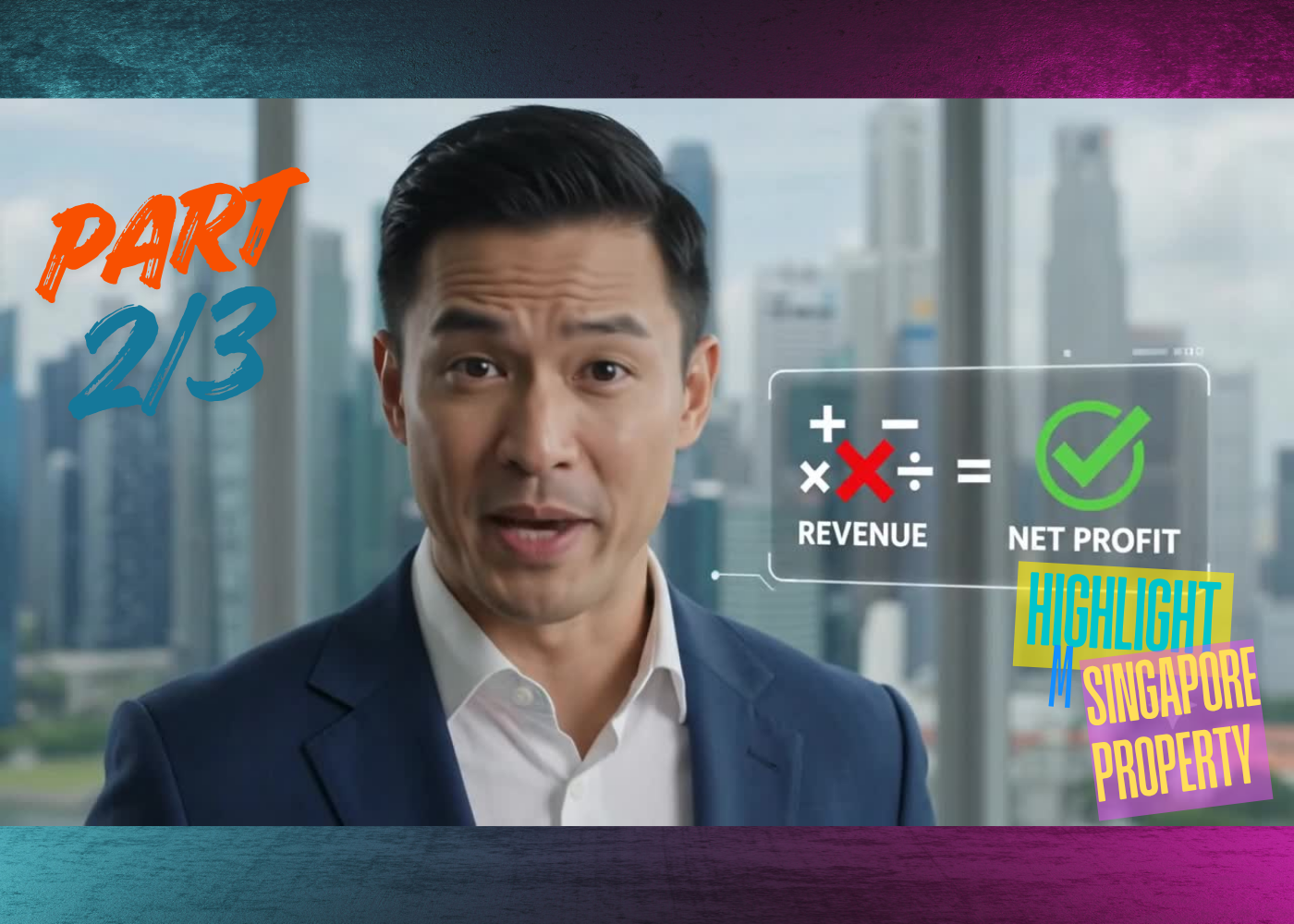
Singapore Property’s Greatest Optical Illusion PART 2/3
Boon Keat ❂ CHIN
Why Many Resale Condo Buyers Think They’re Making Money. Until They Actually Do the Math.
Part 2
In Part One, we uncovered the first illusion.
Many condominium owners proudly celebrate a 1% or 2% annual appreciation without asking a far more important question.
“What did it actually cost me to achieve that gain?”
Because appreciation alone doesn’t create wealth.
Net profit does.
And that’s where the conversation becomes far more interesting.
Rental Income Isn’t the Same as Investment Returns
One of the biggest arguments supporting resale condominiums has always been simple.
“I can rent it out immediately.”
On the surface, that sounds incredibly persuasive.
A newly completed resale condominium can start generating rental income almost immediately.
Meanwhile, someone who purchases a new launch may wait three or four years before collecting their first dollar of rent.
Naturally, many buyers conclude:
Resale must be the better investment.
Unfortunately, that conclusion only looks at revenue.
Successful investors don’t focus on revenue.
They focus on net returns.
There is an enormous difference between the two.
Imagine a condominium producing S$5,000 monthly rental income.
That sounds fantastic.
Until you begin asking where that S$5,000 actually goes.
Every month, part of the rental immediately disappears into mortgage interest.
Another portion pays maintenance fees.
Property tax follows.
Insurance.
Occasional repairs.
Agent commissions whenever tenants change.
Income tax on rental earnings.
Vacancy periods.
Unexpected maintenance.
Air-conditioning servicing.
Painting.
Appliance replacements.
Waterproofing.
Plumbing.
Electrical repairs.
One expense alone rarely hurts.
But dozens of small expenses quietly compound over time.
Many landlords eventually realise something surprising.
The rental income isn’t making them rich.
It’s simply helping them maintain ownership of the property.
That is a completely different outcome.
The Concrete Piggy Bank
One of the best ways to understand resale property is through a simple analogy.
Imagine placing a million dollars inside an enormous concrete piggy bank.
The money remains relatively safe.
It grows steadily over decades.
It is protected from inflation better than cash.
But it doesn’t multiply rapidly.
That is exactly how many resale condominiums function.
They are excellent wealth preservation vehicles.
They protect purchasing power.
They provide stability.
They create forced savings.
Every mortgage payment gradually converts debt into equity.
Over twenty or thirty years, owners accumulate substantial wealth.
But this process is slow.
Very slow.
There is absolutely nothing wrong with that.
The mistake happens when buyers expect this conservative strategy to produce aggressive investment returns.
It simply wasn’t designed for that purpose.
Wealth Preservation vs Wealth Creation
This distinction may be the single most important concept every Singapore property buyer should understand.
Too often, these two ideas become mixed together.
Yet they represent completely different investment philosophies.
Wealth Preservation
The objective is stability.
Protect existing capital.
Reduce volatility.
Generate consistent long-term appreciation.
Create predictable cash flow.
Examples include:
• Established resale condominiums
• Fully tenanted investment properties
• Mature neighbourhoods
• Long-term rental portfolios
The emphasis is reliability.
Not explosive growth.
Wealth Creation
Here, the objective changes entirely.
Instead of protecting capital, you’re attempting to grow it significantly.
That requires accepting uncertainty.
Taking calculated risks.
Entering markets before full price discovery occurs.
Capturing future appreciation rather than existing value.
This is precisely why many new launches perform differently.
Why New Launches Behave Like Growth Stocks
Think about how successful technology companies grow.
Investors who buy after the company becomes globally dominant often experience relatively modest future returns.
The explosive gains usually belong to early investors.
Property behaves surprisingly similarly.
When developers launch a new condominium, they rarely release every unit at the same price.
Pricing evolves throughout construction.
Early buyers typically enjoy the lowest entry prices.
Why?
Because they are effectively helping developers secure financing and demonstrate market demand.
As construction progresses, confidence increases.
Risk decreases.
Prices often rise accordingly.
By the time Temporary Occupation Permit (TOP) arrives, buyers are no longer purchasing uncertainty.
They are purchasing certainty.
And certainty usually commands a premium.
That difference becomes one of the major drivers of capital appreciation.
The Progressive Payment Myth
Despite this, countless Singaporeans remain afraid of buying new launches.
Not because of investment fundamentals.
Because of cash flow.
The fear sounds something like this.
“I’m currently paying S$4,000 rent every month. If I buy a new launch, I’ll also need to service a huge mortgage immediately.”
Many imagine paying two full housing costs simultaneously.
Rent.
Plus a complete mortgage.
For three or four years.
That sounds financially impossible.
Fortunately, that isn’t how progressive payment works.
Understanding Progressive Payments
Unlike completed resale properties, banks do not release the full loan immediately.
Instead, financing follows construction milestones.
The process is gradual.
Foundation completed.
A small percentage is released.
Structural framework completed.
Another small percentage.
Roof completed.
Another stage.
Interior finishes.
Another release.
Your mortgage grows slowly alongside construction.
During the early phases, monthly repayments are often surprisingly manageable because interest applies only to funds already disbursed.
This dramatically changes cash flow planning.
Instead of facing a massive mortgage from day one, buyers experience a gradual increase over several years.
By the time larger repayments begin, construction is usually nearing completion.
Many owners are preparing to move in.
Or preparing to rent the property out.
The feared “double payment” period often turns out to be far smaller than buyers initially imagine.
Understanding this changes how many people evaluate affordability.
Why Numbers Beat Assumptions
One of the biggest mistakes buyers make is relying on emotions instead of projections.
They imagine worst-case scenarios.
They overestimate monthly obligations.
They underestimate future appreciation.
They assume cash flow problems without calculating actual payment schedules.
Successful investors rarely guess.
They calculate.
Every property decision should begin with numbers.
Not feelings.
Because numbers remove fear.
They replace uncertainty with clarity.
And clarity creates confidence.
The Hidden Advantage Most Buyers Miss
Many buyers believe future launches automatically reduce the value of existing projects.
This assumption makes intuitive sense.
After all, newer usually means better.
Right?
Interestingly, Singapore property often behaves in exactly the opposite way.
Instead of competing against older developments, many new launches actually lift surrounding property values.
This phenomenon has repeated itself numerous times over the past decade.
And understanding why could completely change how you evaluate new launch investments.
Your Move
Singapore’s property market has become increasingly sophisticated.
The strategies that worked ten years ago may not deliver the same results over the next decade.
Before making your next property decision, ask yourself:
✅ Am I preserving wealth or trying to create it?
✅ Have I calculated my true net return after every ownership cost?
✅ Does this purchase support my long-term financial goals?
✅ Am I buying based on evidence, or simply following conventional wisdom?
The right property is rarely the one everyone else is talking about.
It’s the one that best aligns with your wealth-building strategy.
If you’re considering your next move, whether it’s a resale condominium, a new launch, upgrading from your HDB, or restructuring your property portfolio, I’d be happy to have a conversation.
Sometimes, a single shift in perspective can change the trajectory of your financial future.
This is M. (Mike Chin)
Helping Singaporeans make smarter property decisions through data, strategy, and long-term wealth planning.
📩 Connect with me for a personalised property consultation.
#ThisIsM #MSingaporeProperty #MAssociate #Majucorporate #M #PropNex #SingaporeProperty #PropertyInvestment #NewLaunch #ResaleCondo #SingaporeRealEstate #WealthBuilding #RealEstateInvesting #PropertyStrategy #HDBUpgrader #FinancialFreedom #LongTermInvesting #HomeOwnership #PropNex