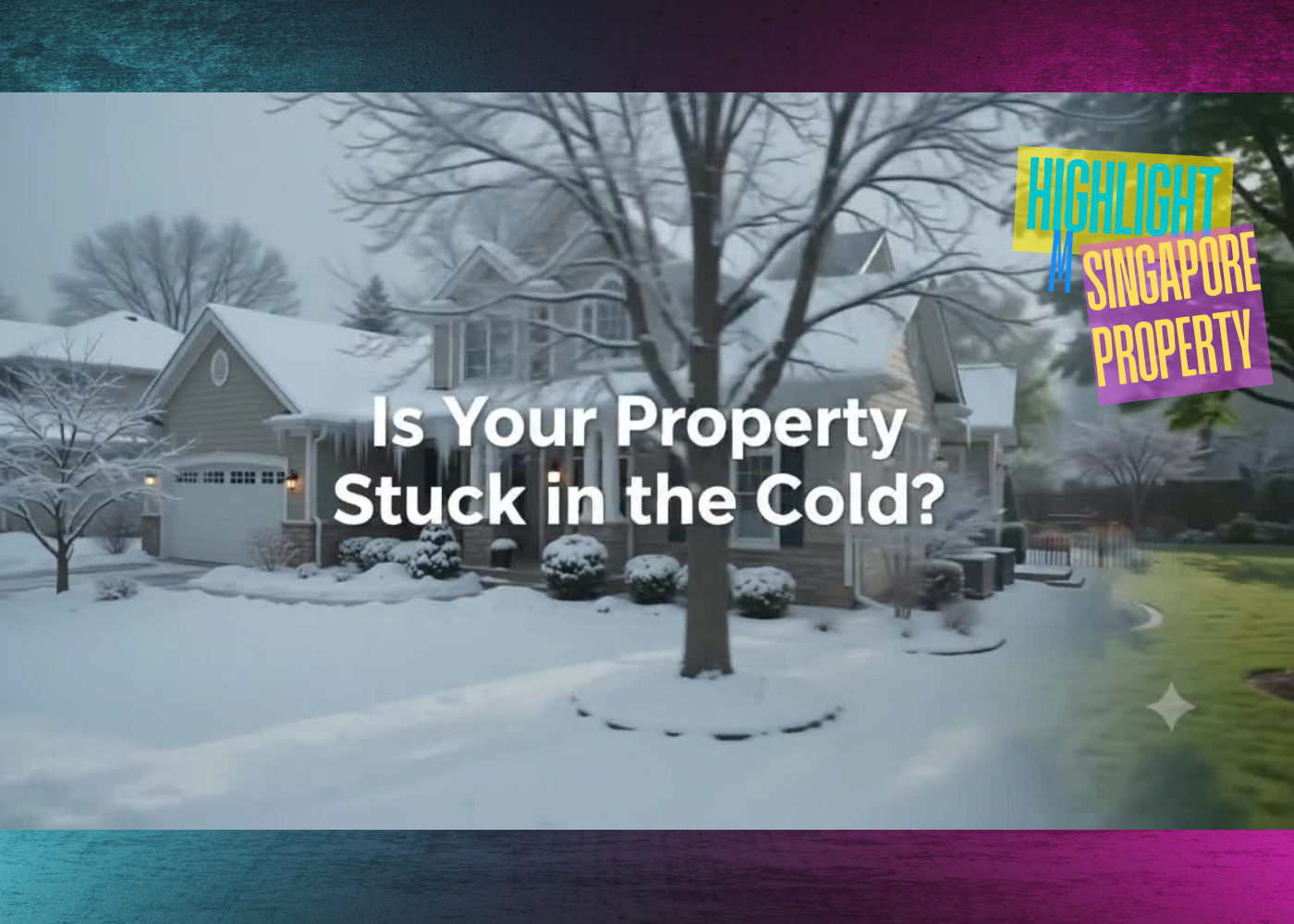
Spring in the Front Yard. Winter in the Backyard.
“Sometimes the biggest investment mistake isn’t buying at the wrong time. It’s believing the market has only one story to tell.”
Imagine standing in the middle of your own garden.
You look towards your front yard.
Everything is alive.
Flowers are blooming.
The weather feels warm.
It looks like spring has arrived.
Then you turn around.
Your backyard is frozen solid.
Snow covers the ground.
It feels like the middle of winter.
Impossible?
Not in Singapore’s property market.
Because that is almost exactly what happened in early 2026.
On one side of the market, private residential prices continued climbing.
On the other, HDB resale prices recorded their first quarterly decline in nearly seven years.
Two completely different realities.
One country.
One economy.
One property market.
How can that happen?
More importantly…
What should buyers, sellers and upgraders actually do?
The answer may completely change how you think about Singapore property over the next five years.
The Headlines Confused Almost Everyone
When the flash estimates were released in April 2026, many Singaporeans were left scratching their heads.
Private residential prices increased approximately 3% during the first quarter.
Healthy.
Stable.
Exactly what many analysts expected.
Then came another headline.
HDB resale prices slipped by 0.1%.
For many people, it seemed impossible.
How could two housing markets within the same country move in opposite directions?
Surely property either goes up…
or down.
Apparently not.
The reality is far more sophisticated.
Because Singapore isn’t managing one housing market.
It is managing two entirely different systems.
One Country. Two Different Missions.
Understanding this changes everything.
The Government has never intended HDB and private housing to achieve the same objective.
They serve different purposes.
HDB Exists To Provide Affordable Housing
Public housing was never designed to become a speculative investment vehicle.
Its primary mission remains simple.
Provide affordable housing for Singaporeans.
That means excessive price growth eventually becomes a problem.
If HDB prices continue rising rapidly forever…
young families suffer.
First-time buyers struggle.
Housing affordability deteriorates.
To prevent this, the Government has been steadily increasing supply.
Not by a little.
By a lot.
The Supply Flood Is Deliberate
Between 2021 and 2025, more than 100,000 Build-To-Order (BTO) flats were launched.
That target has already been exceeded.
But the expansion isn’t stopping.
Another 55,000 flats are expected over the next few years.
Then comes the second wave.
Thousands of existing flats are reaching their Minimum Occupation Period (MOP).
Only a few years ago, approximately 7,400 flats became eligible for resale annually.
That number is now rising dramatically.
Around 13,000 units.
Then over 20,000 units shortly afterwards.
Think about what that means.
Supply is accelerating.
Demand isn’t.
Demand Simply Isn’t Growing Fast Enough
Singapore’s population continues expanding.
Permanent Residents continue arriving.
Yet demand still grows slower than housing supply.
That creates exactly what every economics textbook predicts.
Greater supply.
Moderating prices.
Which is precisely what policymakers intended.
The HDB market isn’t collapsing.
It is normalising.
There is a very important difference.
Private Housing Plays An Entirely Different Role
Now let’s turn around.
Welcome to the front yard.
Private property follows a completely different economic model.
Unlike HDB, private housing sits on scarce land.
Scarcity changes everything.
The Government understands this.
Artificially suppressing private residential prices would create unintended consequences across the wider economy.
Instead…
their objective is sustainable appreciation.
Not explosive growth.
Not speculative bubbles.
Steady long-term appreciation broadly aligned with income growth and economic expansion.
That distinction explains why private housing continues performing differently.
Imagine Two Trains Leaving The Same Station
Picture yourself standing on a railway platform.
One train represents HDB.
The other represents private property.
Initially they travel together.
Then something changes.
The HDB train gradually slows.
The private property train continues accelerating.
If you’re an upgrader…
you are trying to jump from one moving train onto another.
Every month you hesitate…
the gap widens.
This widening gap has become one of the defining characteristics of today’s market.
Why Waiting Can Become Surprisingly Expensive
Many HDB owners believe waiting is the safest strategy.
Perhaps prices will recover.
Perhaps buyers will return.
Perhaps the market will improve.
Sounds reasonable.
Until we examine what actually happens while waiting.
Because time isn’t free.
The Cash Erosion Most Owners Never Calculate
Selling an HDB isn’t simply about the selling price.
Two significant deductions occur first.
Your outstanding housing loan.
Your CPF refund.
Many homeowners focus only on valuation.
But cash determines your ability to upgrade.
Here’s where it becomes interesting.
While you’re waiting for a higher selling price…
CPF accrued interest continues growing.
Your available cash gradually shrinks.
Meanwhile…
private condominium prices continue moving higher.
Suddenly you’re losing from both directions.
Less available cash.
Higher replacement costs.
That’s not standing still.
That’s moving backwards.
Sometimes Accepting Slightly Less Creates More
This feels emotionally difficult.
No one enjoys reducing their asking price.
But wealth isn’t built through pride.
It’s built through mathematics.
Suppose reducing your asking price today allows you to secure your next property before another 5% market increase.
Did you actually lose money?
Or did you preserve purchasing power?
Sometimes what appears to be a concession…
is actually a strategic victory.
The Hidden Story Behind Rising Land Prices
Now let’s examine why private housing continues strengthening.
Many people assume developers simply increase prices because they want larger profits.
Reality is more complicated.
Developers first need land.
Land has become significantly more expensive.
Why?
One major reason involves Gross Floor Area (GFA) Harmonisation.
This policy fundamentally changed how residential developments are designed.
Previously…
developers could include large air-conditioning ledges, planter boxes and various non-livable spaces when calculating saleable area.
Today…
layouts focus much more heavily on usable living space.
Initially this created uncertainty.
Developers weren’t sure buyers would embrace smaller but far more efficient homes.
Land bids softened.
Then something unexpected happened.
Buyers loved the new layouts.
Confidence returned.
Land prices surged.
Why “Cheaper Land” Doesn’t Always Mean Cheaper Homes
Here’s an interesting example.
Imagine reading a headline saying:
“Land Sold 6% Cheaper.”
Sounds encouraging.
Until you examine the details.
Suppose the previous site allowed a 20-storey development.
The new site only allows five storeys.
Although the land appears cheaper…
far fewer apartments are available to spread construction costs.
Result?
Each apartment actually becomes more expensive.
The headline sounds positive.
The economics say otherwise.
Developers Aren’t Reacting.
They’re Positioning.
One of the biggest misconceptions is believing developers passively respond to market conditions.
They don’t.
They actively shape market expectations.
When developers submit aggressive Government Land Sale bids…
they aren’t simply purchasing land.
They’re establishing future pricing benchmarks.
Every record-breaking land bid quietly tells buyers something.
“Future projects will cost even more.”
Suddenly today’s launch appears attractive.
Not because it’s cheap.
Because tomorrow will likely be more expensive.
That psychology influences buying decisions long before construction even begins.
Why Efficient Homes Are Becoming The New Luxury
Another structural change deserves attention.
Luxury used to mean size.
Large living rooms.
Long hallways.
Generous balconies.
Today…
buyers increasingly value efficiency.
A thoughtfully designed 850-square-foot apartment often functions better than an awkwardly planned 1,100-square-foot unit built twenty years ago.
Dead space has become expensive space.
Modern buyers prefer functionality.
Developers understand this.
Future resale buyers understand it too.
That improves long-term liquidity.
Replacement Cost Matters More Than Most Buyers Realise
One of the strongest long-term drivers of private property appreciation isn’t speculation.
It’s replacement cost.
Every new development begins with higher land prices.
Higher labour costs.
Higher construction costs.
Higher financing costs.
Future developers cannot build yesterday’s condominiums at yesterday’s prices.
That naturally raises pricing benchmarks across surrounding neighbourhoods.
History demonstrates this repeatedly.
Projects once criticised for launching at “record prices” later became highly profitable resale developments because future launches established even higher benchmarks.
The Window Many Buyers May Be Missing
There was a brief period when developers acquired land during uncertainty surrounding GFA Harmonisation.
Those projects benefited from lower acquisition costs.
That window is closing.
Future launches increasingly sit on land purchased after confidence returned.
Meaning…
higher land costs become permanently embedded into future pricing.
Waiting no longer guarantees better value.
Sometimes it guarantees paying more.
The Biggest Mistake Isn’t Timing
Many buyers obsess over one question.
“Should I wait?”
Perhaps a better question is:
“What structural forces are unlikely to reverse?”
Because markets fluctuate.
Fundamentals don’t.
Singapore still has finite land.
Construction costs continue rising.
Urban redevelopment continues expanding.
Population growth continues.
Private housing remains scarce.
These structural forces don’t disappear because of one headline.
The Real Divide Isn’t HDB vs Private
After studying today’s market…
I’ve become convinced that the biggest divide isn’t between HDB and condominiums.
It’s between two different ways of thinking.
One group reacts to headlines.
The other studies underlying economics.
One waits for certainty.
The other recognises that certainty usually becomes expensive.
One focuses on today’s prices.
The other understands tomorrow’s replacement costs.
That difference often determines who builds long-term wealth.
Final Thoughts
Singapore’s property market has entered a new phase.
The old assumption that “all property moves together” no longer holds true.
Today we have two carefully managed systems operating with different objectives.
Understanding those objectives allows better decisions.
Especially for upgraders.
Especially for investors.
Especially for families planning their next move.
The market isn’t sending mixed signals.
It’s sending two very clear ones.
The challenge is recognising which signal applies to your situation.
Because sometimes…
the difference between preserving wealth and creating wealth isn’t timing the market perfectly.
It’s understanding the market correctly.
Your Move
Before making your next property decision, ask yourself:
✅ Is my HDB equity quietly eroding while I wait?
✅ Am I evaluating private property based on today’s prices or tomorrow’s replacement costs?
✅ Have I calculated my real upgrading gap instead of relying on headlines?
✅ Is my next purchase aligned with my long-term wealth strategy?
The best property decision is rarely made by following the crowd.
It’s made by understanding the numbers before everyone else does.
If you’re considering upgrading from your HDB, purchasing a new launch, investing in a resale condominium, or restructuring your property portfolio, I’d be happy to help you evaluate your options using data, market structure, and long-term wealth planning.
Sometimes one well-timed conversation can save years of waiting and hundreds of thousands of dollars in opportunity cost.
This is M (Mike Chin).
Helping Singaporeans make smarter property decisions through data, strategy, and long-term wealth planning.
📩 Connect with me for a personalised property consultation.
#M #ThisIsM #ThisisMMikeChin #Propnex #MAssociate #Msingaporeproperty #AIForRealtors #RealEstate #PropertyForSale #InvestIngRealEstate #RealEstateInvestment #HomeBuyers #PropertyInvestment #DreamHome #HouseGoals #PropertyMarket #RealEstateLife #RealEstateExpert #HomesForSale #InvestIngProperty #RealEstateDevelopment #NewHome #OpenHouse #RealEstateSingapore #CondoLife #LuxuryLiving #HomeSweetHome #RealEstateTips #RealEstateInvestor #businessmentorship
www.msingaporeproperty.com