Boon Keat ❂ CHIN
The Market Usually Tells You to Buy Before Completion
For decades, Singapore property investors have been taught a simple formula.
Buy early.
Buy during the preview.
Buy before prices increase.
Wait for the project to TOP.
Then enjoy capital appreciation.
But Tembusu Grand presents an interesting anomaly.
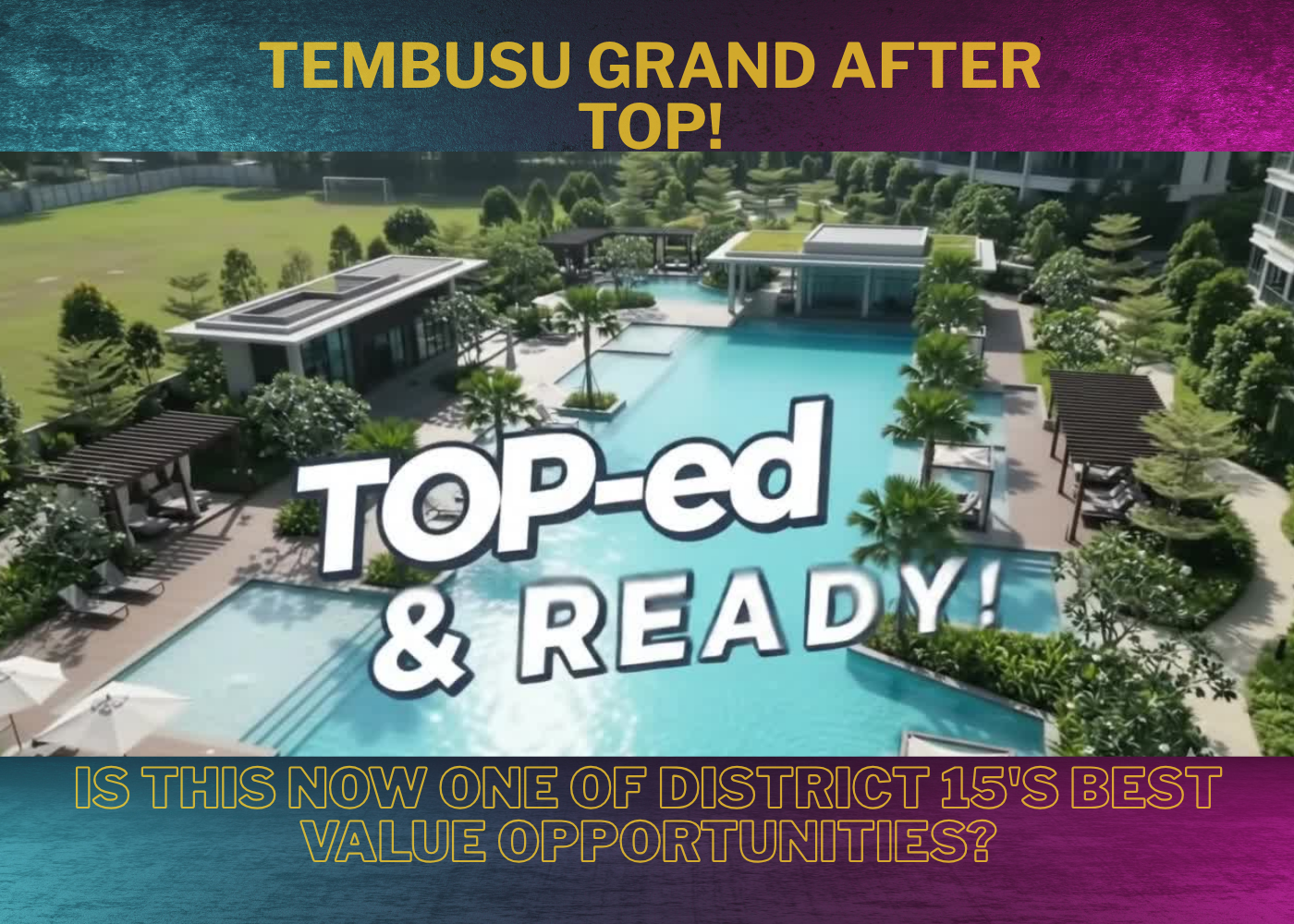
It has already TOP-ed.
You can physically inspect the property.
You can move in immediately.
You can rent it out immediately.
And yet, compared with newer projects launched later, Tembusu Grand may still offer a relatively attractive entry point.
The reason is not simply price per square foot.
The real story is hidden in something investors often ignore.
How much of the 99-year lease are you actually buying?
The Lease Clock. Why Age Matters More Than Many Buyers Realise
Every 99-year leasehold condominium should not be analysed as if it is identical.
A 99-year leasehold condominium with 96 years remaining is fundamentally different from one with 70 years remaining.
Both may be called “99-year leasehold properties”.
But economically, they are not the same asset.
Let’s look at this from first principles.
Tembusu Grand
The lease began in approximately 2022.
That means after TOP, buyers are still effectively purchasing a property with roughly:
95 to 96 years remaining.
For practical investment purposes, that is extremely close to a fresh 99-year lease.
Now compare that with many established resale condominiums around District 15.
Some nearby projects may be 15, 20 or even 30 years old.
That means the buyer could be purchasing a property with:
-
75 years remaining
-
70 years remaining
-
Or significantly less
The important question is therefore not:
“Is Tembusu Grand more expensive per square foot?”
The better question is:
“How much am I paying for every remaining year of usable lease?”
That changes the entire analysis.
The 99-Year Re-Extrapolation Test
Imagine two properties.
Property A. Tembusu Grand
-
Remaining lease: approximately 95 to 96 years
-
Newly completed
-
Modern facilities
-
New MRT connectivity
-
No renovation required
Property B. Older nearby resale condominium
-
Remaining lease: perhaps 70 to 80 years
-
Older facilities
-
Older specifications
-
Potential renovation required
-
Potentially lower financing attractiveness in the future
At first glance, Property B may appear cheaper.
But the buyer is not receiving the same remaining economic life.
This is where investors make a mistake.
They compare only:
Price ÷ square footage = value.
That is incomplete.
A more logical comparison is:
Price + remaining lease + age + future financing + replacement cost.
When you extrapolate the older resale project’s price against the economic value of having an additional 15 to 25 years of lease remaining, the apparent discount may become much less attractive.
In other words:
A cheaper resale property is not automatically a cheaper asset.
Tembusu Grand Is Effectively Buying “Time”
This is one of the strongest arguments for Tembusu Grand after TOP.
A buyer today is not purchasing an old resale condominium and hoping that its age becomes less relevant.
The buyer is acquiring a completed property at the beginning of its physical life.
The building is new.
The facilities are new.
The specifications are current.
The lease is almost fully intact.
This gives Tembusu Grand an unusual position.
It is no longer an off-plan property.
But it is also not yet an ageing resale property.
It sits in the middle.
And that may be the sweet spot.
The Replacement Cost Argument
Now we come to an even more important point.
Why are newer launches around Tembusu Grand generally commanding higher prices?
Because developers are not building at yesterday’s cost.
They are building at today’s cost.
Land prices have increased.
Construction costs have increased.
Financing costs have increased.
Labour costs have increased.
Material costs have increased.
This creates an important structural advantage for buyers of an earlier project such as Tembusu Grand.
If a future developer buys land at a higher price, that developer cannot simply choose to sell cheaply.
The mathematics may not allow it.
A future project has to recover:
-
Higher land cost.
-
Higher construction cost.
-
Higher financing cost.
-
Marketing and professional fees.
-
Developer’s required profit margin.
This creates what I call the:
Replacement Cost Floor
Tembusu Grand does not need future projects to become worse.
It simply benefits from the fact that future projects may become more expensive to reproduce.
That matters enormously.
The Completed Asset Paradox
Here is the paradox.
Many buyers assume that buying before TOP is always financially superior.
But that assumption ignores cost inflation.
A buyer who purchased Tembusu Grand during its launch phase took on:
-
Construction risk.
-
Progressive payment.
-
Interest rate uncertainty.
-
Delayed rental income.
-
The inability to physically inspect the finished unit.
Today’s buyer does not receive the same early-bird price.
That is true.
But today’s buyer receives something different.
Certainty.
The buyer knows exactly:
-
What the building looks like.
-
What the views look like.
-
How the sunlight enters the unit.
-
How the facilities function.
-
What the actual surrounding environment feels like.
-
What the completed market is willing to pay.
And most importantly.
The buyer is still acquiring almost the entire 99-year lease.
Comparing Tembusu Grand Against Older Resale Projects
The most interesting comparison is not Tembusu Grand against another new launch.
It is:
Tembusu Grand versus older District 15 resale condominiums.
Suppose an older condominium is 25 years old.
It may still be a perfectly good property.
But from a capital perspective, the buyer is purchasing:
A building that has already consumed approximately one-quarter of its lease.
Tembusu Grand, by comparison, has consumed only approximately three to four years.
That difference matters.
Imagine two investors.
Investor A buys an older resale condominium with 70 years remaining.
Investor B buys Tembusu Grand with approximately 95 years remaining.
Twenty years later:
Investor A
Remaining lease could fall to approximately 50 years.
Investor B
Remaining lease could still be approximately 75 years.
That is a dramatic difference.
Investor B’s property may still be viewed as a relatively mainstream financing asset.
Investor A’s buyer may increasingly have to consider:
-
Shorter loan tenures.
-
Greater cash requirements.
-
CPF usage considerations.
-
A potentially smaller buyer pool.
This is why remaining lease should be treated as an investment variable.
Not merely a footnote.
The Future Buyer Test
Every property investor should ask one question.
Who is going to buy this from me?
This is where Tembusu Grand has an advantage.
A future buyer is not purchasing a property with a nearly depleted lease.
They are still purchasing a relatively young condominium.
If an owner sells Tembusu Grand after 10 years, the property may still have approximately 85 years remaining.
That is still a very substantial lease.
If an owner sells after 15 years, there may still be approximately 80 years remaining.
The property remains within a significantly more comfortable range compared with older resale properties that may be approaching more challenging lease levels.
This potentially preserves:
Buyer liquidity.
And liquidity is one of the most underrated factors in Singapore property investment.
Tembusu Grand Versus New Launch Competition
The other side of the equation is equally interesting.
Newer projects around District 15 are generally being launched into a higher cost environment.
Tembusu Grand has already been built.
The construction cost has already been locked in.
The land cost was secured years earlier.
A buyer today may therefore be buying:
Yesterday’s development cost. Today’s completed product. Tomorrow’s replacement cost environment.
That is the investment thesis.
Not simply:
“It is cheaper.”
But:
“How much would it cost someone to build a comparable project today?”
And more importantly:
“Will future developers be able to sell significantly below today’s completed Tembusu Grand prices?”
If the answer is no, Tembusu Grand may enjoy an important degree of downside protection.
The Immediate Rental Advantage
There is another financial advantage.
A completed property can produce income immediately.
A buyer does not need to wait:
-
Two years.
-
Three years.
-
Or four years.
For the property to become operational.
The difference can be substantial.
An investor purchasing an uncompleted property may have to continue servicing:
-
Existing housing costs.
-
Progressive mortgage interest.
While receiving zero rental income.
A Tembusu Grand buyer can theoretically transition into income generation almost immediately.
This changes the effective holding cost.
And for investors, holding cost matters just as much as purchase price.
The Three Different Buyers Who Should Consider Tembusu Grand
1. The Buyer Who Values Certainty
You want to physically inspect the property before committing.
You do not want to wait years.
You want to know exactly what you are buying.
Rating: 9/10
2. The Long-Term Investor
You want a relatively new property.
You want almost the full lease remaining.
You want to exit before lease decay becomes a significant issue.
Rating: 8.5/10
3. The Immediate Rental Investor
You want an asset capable of producing income now.
You do not want to wait for TOP.
You value cash flow and reduced holding uncertainty.
Rating: 8.5/10
The Risks You Still Cannot Ignore
This is not a perfect project.
❌ Risk 1. You Missed the Earliest Entry Price
The earliest buyers purchased before completion.
Some of the first-mover upside has already been captured.
You are buying certainty.
But certainty is not free.
❌ Risk 2. It Is Still 99-Year Leasehold
Tembusu Grand is not freehold.
Over an extremely long holding period, lease decay will eventually become relevant.
This is not the ideal asset for someone whose primary objective is holding a property indefinitely for multiple generations.
❌ Risk 3. Subsale Buyers Pay the Market Price
With the project substantially sold, the developer has little reason to offer aggressive incentives.
Your negotiation depends on the individual seller.
The buyer must therefore select the entry price carefully.
Not every unit is automatically a good investment.
My Rating of Tembusu Grand After TOP
CategoryRating
Location and Lifestyle⭐⭐⭐⭐⭐ 9/10
MRT Connectivity⭐⭐⭐⭐½ 8.5/10
Remaining Lease Strength⭐⭐⭐⭐⭐ 9.5/10
Immediate Rental Potential⭐⭐⭐⭐½ 8.5/10
Capital Appreciation Potential⭐⭐⭐⭐½ 8.5/10
Entry Price Versus New Launches⭐⭐⭐⭐½ 9/10
Value Versus Older Resale Condos⭐⭐⭐⭐½ 9/10
Long-Term Lease Risk⭐⭐⭐½ 7.5/10
Overall Investment Score⭐⭐⭐⭐½ 8.8/10
VERDICT: EARN. BUT BUY THE RIGHT UNIT.
Tembusu Grand’s strongest investment case is not that it is a completed condominium selling below unfinished projects.
That is merely the surface.
The deeper investment argument is this.
You are buying a completed asset with immediate usability, modern specifications and approximately 95 to 96 years of lease remaining, in an environment where replacement land and construction costs are rising.
When compared against older resale condominiums, buyers need to stop looking only at the price per square foot.
Ask instead:
How many years of economic life am I actually buying?
A 70-year remaining lease and a 95-year remaining lease should not be valued as identical simply because both properties happen to be called “99-year leasehold”.
Tembusu Grand offers something increasingly difficult to find.
A nearly new condominium that is no longer a construction promise.
A completed property that still has almost an entire lease cycle ahead of it.
And potentially, a replacement cost advantage as future projects become increasingly expensive to build.
That is why I believe the strongest Tembusu Grand strategy today is not speculation.
It is buying quality time.
Final Verdict: EARN for buyers with a 7 to 15-year horizon.
The critical factor is simple.
Do not buy Tembusu Grand because it is completed.
Buy it only if your specific unit can be acquired at a price where the remaining 95-plus years of lease, immediate usability and future replacement cost provide a genuine margin of safety.
YOUR MOVE. 你的下一步,决定你的未来。
#ThisIsM #MSingaporeProperty #MAssociate #Majucorporate #M #PropNex
www.msingaporeproperty.com