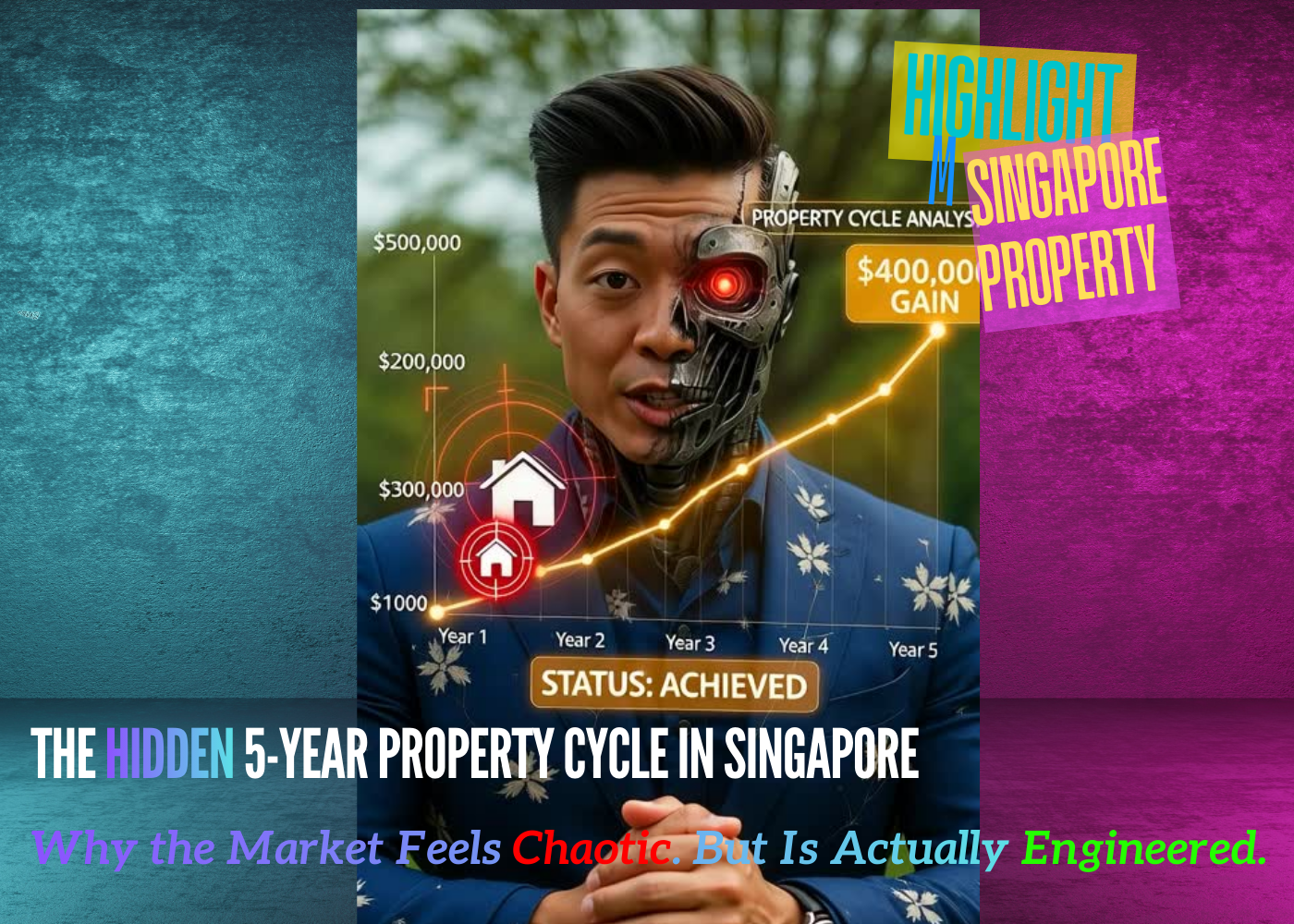
The Hidden 5-Year Property Cycle in Singapore

Boon Keat ❂ CHIN
Why the Market Feels Chaotic. But Is Actually Engineered.
Every property buyer eventually asks the same question.
“Am I buying at the wrong time?”
You watch prices surge. You see headlines about record-breaking transactions. You hear friends say they bought at the perfect moment.
And it creates the uncomfortable feeling that timing the property market requires a crystal ball.
But here is the reality most buyers do not realize.
Singapore’s property market is not chaotic.
It is highly engineered.
Behind the scenes, a series of structural mechanics quietly guide supply, pricing, and transaction activity. Once you understand these mechanics, the market stops looking random.
You begin to see patterns.
And one of the most important patterns is what many analysts describe as the five-year property cycle.
Understanding this cycle can dramatically change how you approach property decisions. Whether you are an investor or a homeowner.
Why Singapore Prioritizes Stability Over Rapid Growth
Before diving into the cycle itself, we need to understand something fundamental.
The Singapore government does not want a wildly volatile property market.
If prices swing up and down dramatically, property stops functioning as a stable economic pillar and starts behaving like a leveraged casino.
From a macroeconomic perspective, extreme volatility creates serious risks.
• Households cannot plan long-term finances • Banking exposure increases dramatically • Asset bubbles form quickly • Economic stability weakens
Instead, policymakers aim for something very different.
They want property prices to behave like a steady escalator, not a roller coaster.
Prices should grow over time. But at a controlled pace that broadly tracks income growth and inflation.
Achieving this stability requires significant behind-the-scenes engineering.
And most of that engineering revolves around supply control.
The Hidden Supply Valve: Government Land Sales (GLS)
Many buyers assume the private property market operates freely.
In reality, the supply of new condominiums is carefully regulated.
The key mechanism is the Government Land Sales (GLS) program, administered by the Urban Redevelopment Authority.
Through GLS, the government releases land parcels for developers to bid on.
Think of GLS as a master valve controlling supply.
If the government sees rising demand and limited housing stock, they can release more sites.
If the market appears overheated, they can slow down the release.
This means the supply of private homes is not random.
It is deliberately calibrated.
Why Developers Prefer GLS Sites
You might assume developers would aggressively pursue private land instead of government sites.
Yet the opposite is true.
Developers strongly prefer GLS sites because they offer certainty.
When a developer wins a GLS bid, the following parameters are clear immediately:
• Plot ratio • Land use guidelines • Development timeline • Technical constraints
This clarity allows developers to forecast costs and profits accurately.
In contrast, private land acquisitions often involve complex negotiations, legal complications, and unpredictable development conditions.
GLS provides a clean development canvas.
Why the En-Bloc Market Has Slowed Dramatically
A decade ago, Singapore saw a wave of collective sales.
Entire developments were sold to developers through en-bloc transactions.
Today the market is significantly quieter.
The reason is simple.
The math no longer works.
For an en-bloc deal to succeed today, developers must offer homeowners extremely high premiums.
But developers themselves face rising costs, including the Additional Buyer’s Stamp Duty (ABSD) penalties for unsold units.
Because of these pressures:
• Owners demand higher payouts • Developers cannot justify the cost
The result is a stalemate.
This has effectively removed en-bloc activity as a major supply source.
Cooling Measures Changed Buyer Behaviour
Over the past decade, Singapore introduced multiple cooling measures.
Two of the most impactful are:
• Additional Buyer’s Stamp Duty (ABSD) • Seller’s Stamp Duty (SSD)
ABSD increases taxes for buyers purchasing additional properties.
SSD penalizes those who sell within the first three years.
These policies were designed to eliminate short-term speculation.
And they worked.
The days of buying and flipping properties within months are largely gone.
But these policies created an unexpected side effect.
Homeowners now hold properties for much longer periods.
Selling has become expensive.
Re-entering the market is costly.
So many owners simply stay put.
The Resale Market Has Quietly Tightened
Longer holding periods mean fewer resale units entering the market.
This creates a subtle but powerful shift.
The resale market becomes less liquid.
Fewer sellers appear.
And buyers searching for options often turn toward new launches instead.
This is one of the reasons new launches dominate transaction volumes today.
Why New Launch Condos Capture So Much Demand
New launches benefit from several structural advantages.
First, buyers can access progressive payment schemes.
Instead of servicing the full loan immediately, payments are staggered based on construction milestones.
Second, buyers avoid negotiation battles with individual sellers.
Prices are fixed.
The process is streamlined.
Third, buyers often prefer modern layouts, smart home technology, and updated facilities.
Human psychology plays a role here.
People simply prefer new homes.
The $400 PSF Phenomenon
One of the most interesting patterns in Singapore’s property market is the periodic jump in price benchmarks.
Historically, analysts observe that new launches in certain districts can reset pricing by roughly $400 per square foot every few years.
To put this into perspective:
For a 1,000-square-foot apartment, that represents a $400,000 increase in price.
This type of shift significantly changes affordability levels.
But these jumps are not random.
They are closely tied to the development cycle.
The Five-Year Property Cycle
Developers operate under a strict rule.
After purchasing land, they generally have five years to complete and sell their project before facing substantial ABSD penalties.
This timeline naturally creates a five-year development rhythm.
Property analysts often describe this rhythm using the metaphor of four seasons.
Spring: Land Acquisition
Spring is the planting season.
Developers aggressively bid for land through GLS or private acquisitions.
Billions of dollars change hands.
However, this stage is largely invisible to consumers.
No showflats.
No marketing campaigns.
But beneath the surface, the cost of future homes is already being determined.
Summer: New Launch Frenzy
Summer is the launch phase.
This is when marketing machines activate.
Showflats open.
Agents mobilize.
Sales numbers appear in the news.
Developers launch units at prices reflecting the land costs secured during spring.
This is often when buyers see the dramatic PSF benchmark jumps.
Summer also brings intense buyer psychology.
Queues form.
Units sell quickly.
Fear of missing out rises.
Autumn: Market Stabilisation
Autumn arrives after the initial sales rush.
Most prime units are already sold.
Developers focus on clearing remaining inventory.
Prices usually stabilize rather than continue rising rapidly.
Developers may introduce small incentives or promotions to complete sales.
But the new price benchmark has already been set.
Winter: Quiet Holding Phase
Winter is the calm period.
Projects approach completion.
Owners receive keys.
The market becomes quiet.
Developers pause major launches and begin preparing for the next land acquisition phase.
Eventually, the cycle restarts.
Why Understanding the Cycle Matters
Recognizing where a district sits within this cycle can influence decision-making significantly.
For example:
If a market is deep in summer, prices may already reflect peak hype.
Buyers may be paying a premium driven by marketing momentum.
If a district is in winter, the noise has faded.
Prices have stabilized.
This can sometimes create opportunities in resale or subsale transactions.
Understanding the cycle does not guarantee perfect timing.
But it improves risk awareness.
Property Is Not Just About Price
Many buyers focus exclusively on price levels.
But successful property decisions often depend more on market mechanics.
These include:
• Land acquisition costs • Regulatory timelines • Supply pipelines • Buyer psychology • Liquidity cycles
When you understand these factors, you stop reacting emotionally to headlines.
Instead, you begin analyzing the market structurally.
The Bigger Question
There is an interesting question worth reflecting on.
If the Singapore property market is so heavily regulated and structured, has property investment evolved?
Some might argue it now resembles something closer to a regulated long-term yield instrument, rather than a high-risk speculative asset.
That perspective is debatable.
But it highlights how deeply the market is shaped by policy and macroeconomic design.
Final Thoughts
The Singapore property market can appear chaotic.
Prices surge.
Headlines change weekly.
But beneath the noise lies a highly engineered system.
Understanding the five-year cycle helps you see the patterns behind the headlines.
Instead of reacting emotionally to market sentiment, you can begin making decisions based on structure and timing.
And in property, clarity often creates the biggest advantage.
Want a Strategic Property Breakdown?
If you found this analysis useful, I share weekly deep dives on Singapore property strategy through my LinkedIn newsletter.
These breakdowns focus on:
• Market timing frameworks • Asset progression strategies • New launch analysis • Real investor case studies
📩 Subscribe to the newsletter to receive future insights directly.
And if you are currently evaluating a property purchase or planning your next move in the market:
Send me a direct message with the word “CYCLE.”
I will share a simple framework we use with clients to identify where a district currently sits in the property cycle.
Because the biggest advantage in property is not luck.
It is understanding the mechanics before everyone else does.
#M #ThisIsM #ThisisMMikeChin #Propnex #MAssociate #Msingaporeproperty #AIForRealtors #RealEstate #PropertyForSale #InvestIngRealEstate #RealEstateInvestment #HomeBuyers #PropertyInvestment #DreamHome #HouseGoals #PropertyMarket #RealEstateLife #RealEstateExpert #HomesForSale #InvestIngProperty #RealEstateDevelopment #NewHome #OpenHouse #RealEstateSingapore #CondoLife #LuxuryLiving #HomeSweetHome #RealEstateTips #RealEstateInvestor #businessmentorship