Boon Keat ❂ CHIN
Real Estate Consultant | Trusted Advisor with 14+ Years of Experience | Founder of M | MIKE Framework Architect l FCPA (AUS) CA (SIN) MBA
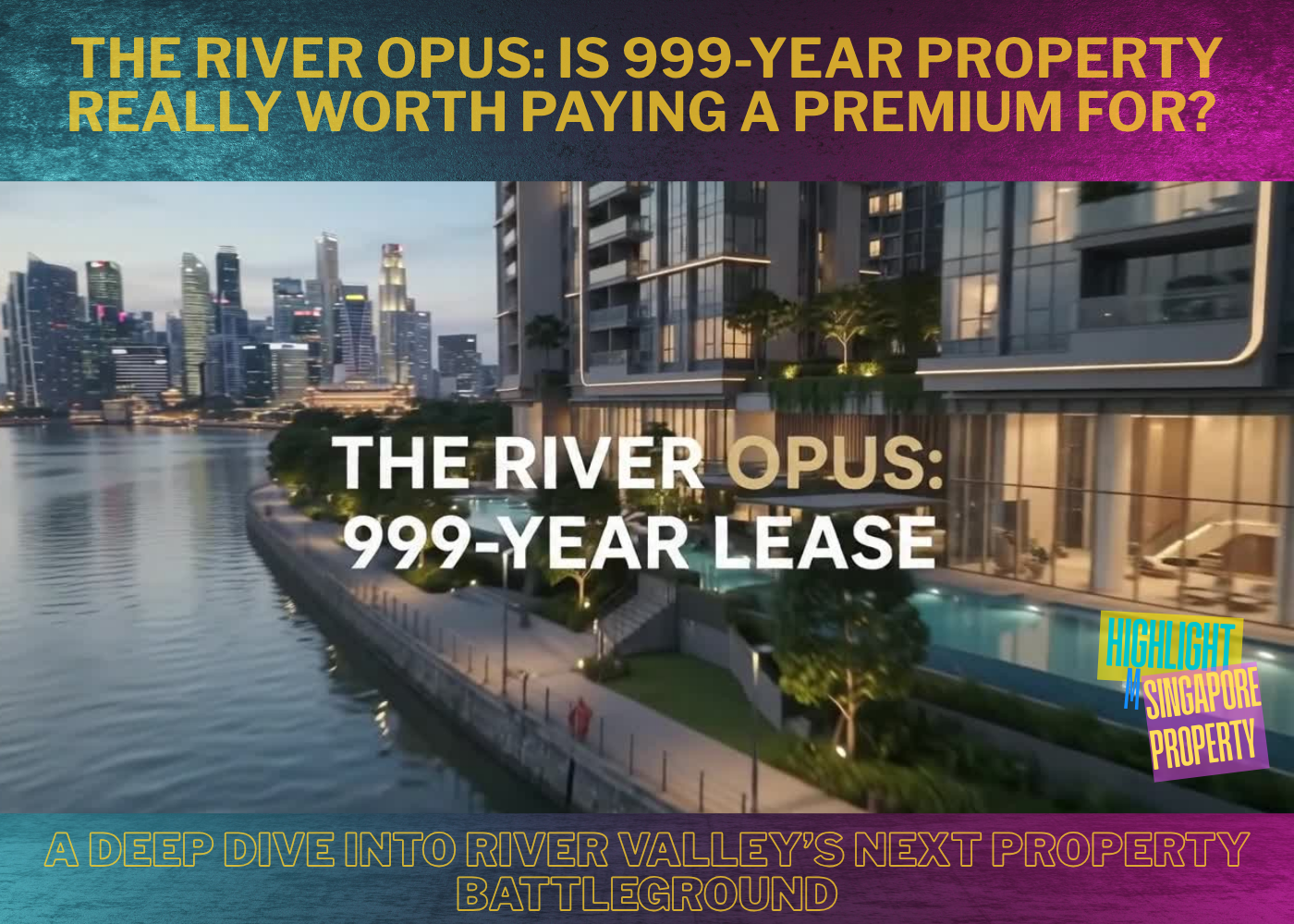
The River Opus: Is 999-Year Property Really Worth Paying a Premium For? A Deep Dive into River Valley’s Next Property Battleground
A 999-year lease. A riverfront address. Larger family homes. But no direct MRT connection.
Would you pay more for a property that could remain in your family for generations, even if another condominium offers more convenient transport connectivity today?
This is the investment question facing buyers considering The River Opus, the upcoming redevelopment of Valley Point in District 10.
At first glance, The River Opus appears to have a compelling proposition. It offers a rare 999-year tenure, a riverfront setting, a mixed-use development concept and a reported allocation of larger family-sized units.
However, it enters a competitive market where buyers have already demonstrated their willingness to pay premium prices for modern developments with direct MRT connectivity.
River Modern and The Robertson Opus are two important benchmarks. Completed developments such as Martin Modern, Irwell Hill Residences, Riviere and Rivergate provide additional resale alternatives.
The real question is not whether The River Opus is a good development.
The real question is whether its eventual launch price will offer sufficient value compared with the alternatives.
Let’s examine the numbers.
1. The River Opus. What are buyers actually purchasing?
The River Opus is the proposed redevelopment of the former Valley Point site by Frasers Property and Mitsubishi Estate.
Based on the available project announcement and preliminary market research:
| Project details | Information |
|---|---|
| Project | The River Opus |
| District | D10, River Valley |
| Address | 491 River Valley Road |
| Developers | Frasers Property and Mitsubishi Estate |
| Tenure | 999-year leasehold |
| Site area | Approximately 144,662 sq ft |
| Residential units | Approximately 407 |
| Additional components | Fraser Suites serviced residence and retail / lifestyle podium |
| Target launch | 2027, with February reported as a possible target |
| Expected completion | Around 2031 |
The redevelopment is intended to combine private residential homes, serviced residences and retail components within an established River Valley location.
The 999-year tenure is an important differentiator.
For practical residential ownership, it is very close to freehold in terms of the time horizon most buyers are likely to consider. However, it remains legally a leasehold interest, not freehold ownership.
Why does the unit mix matter?
Preliminary research indicates that the development may have two broad residential offerings:
- A main collection of approximately 377 units, reportedly ranging from one-bedroom plus study to four-bedroom configurations.
- Approximately 30 larger Sky Villas, with reported three- to five-bedroom configurations.
Reported indicative unit sizes range from approximately 527 sq ft to 2,540 sq ft.
The final unit mix and dimensions must be verified against the official developer brochure.
Nevertheless, the strategy is interesting.
For several years, many new launches have prioritised compact units to keep the total purchase quantum manageable.
The River Opus appears to be taking a different approach by allocating a meaningful proportion of its development to larger family homes.
This could attract buyers who want more living space and longer-term family ownership rather than simply an investment unit.
But there is a trade-off.
Larger units come with higher purchase quantums, which means a smaller pool of potential buyers when owners eventually sell.
2. Understanding the River Valley competitive landscape
The River Opus is not entering an empty market.
It will be competing against developments offering different combinations of tenure, connectivity, lifestyle and pricing.
I would divide the competition into two broad categories.
Category A: Convenience-led developments
- River Modern
- River Green
These developments appeal to buyers who prioritise immediate MRT connectivity, efficient layouts and manageable purchase quantums.
Category B: Legacy and lifestyle-led developments
- The River Opus
- The Robertson Opus
- Rivergate
- Riviere
- Martin Modern
- Irwell Hill Residences
These projects offer different combinations of longer-term ownership, riverfront living, established residential surroundings and completed resale opportunities.
The distinction matters because buyers are not necessarily comparing identical products.
The three key new-launch benchmarks
River Modern
- Developer: GuocoLand
- Tenure: 99-year leasehold
- Units: 455
- Location: River Valley Green
- Key advantage: Direct Great World MRT connectivity
- Reported launch average: Approximately S$3,266 psf
- Reported launch-weekend sales: 410 units, approximately 90%
River Modern demonstrates how much buyers value a combination of modern layouts, direct MRT access and integration with an established retail destination.
The Robertson Opus
- Developers: Frasers Property and Sekisui House
- Tenure: 999-year leasehold
- Residential units: 348
- Retail units: 26
- Location: Robertson Quay
- Reported median transaction price: Approximately S$3,362 psf in the available September 2026 dataset
Its strongest proposition is its long tenure, Robertson Quay lifestyle and low-density residential positioning.
The River Opus
- Developers: Frasers Property and Mitsubishi Estate
- Tenure: 999-year leasehold
- Residential units: Approximately 407
- Location: Former Valley Point site
- Preliminary estimated price range: S$2,970 to S$3,350 psf
Its differentiation is the combination of long tenure, riverfront surroundings, mixed-use redevelopment and larger family-home positioning.
3. Price gap analysis. Is The River Opus cheaper than its competitors?
This is where the analysis becomes interesting.
For this comparison, we use the following reference prices:
| Development | Price benchmark |
|---|---|
| The River Opus | S$2,970–S$3,350 psf, estimated |
| River Modern | S$3,231 psf, transaction median reference |
| River Modern | S$3,266 psf, reported launch average |
| The Robertson Opus | S$3,362 psf, transaction median reference |
Important: These are different pricing measures and reporting periods. They are indicative market benchmarks, not matched-unit valuations.
What does the price gap tell us?
If The River Opus launches at S$2,970 psf:
- Approximately 8.1% below River Modern’s S$3,231 psf benchmark.
- Approximately 11.7% below The Robertson Opus’s S$3,362 psf benchmark.
At S$3,350 psf:
- Approximately 3.7% above River Modern’s S$3,231 psf benchmark.
- Almost level with The Robertson Opus’s S$3,362 psf benchmark.
The difference is significant.
At the lower end of the estimated pricing range, The River Opus could offer an attractive entry point for buyers seeking a long-tenure asset.
At the upper end, the price advantage becomes much less compelling.
Buyers would need to justify paying a premium over River Modern despite the latter’s direct MRT connection.
The absolute quantum test
Let’s assume a hypothetical 1,000 sq ft apartment.
| Development / pricing assumption | Illustrative purchase price |
|---|---|
| The River Opus at S$2,970 psf | S$2.970 million |
| River Modern at S$3,231 psf | S$3.231 million |
| The Robertson Opus at S$3,362 psf | S$3.362 million |
| The River Opus at S$3,350 psf | S$3.350 million |
At the lower estimated price, The River Opus could cost approximately:
- S$261,000 less than River Modern.
- S$392,000 less than The Robertson Opus.
At the higher estimated price, however, it would be almost level with The Robertson Opus.
This illustrates an important principle in property investment:
Do not just compare price per square foot. Compare the total quantum you have to pay.
A buyer must consider the actual purchase price, financing commitment, stamp duties, monthly maintenance and future resale affordability.
4. The biggest competitive advantage. 999-year tenure versus direct MRT connectivity
This is arguably the most important debate.
The River Opus and The Robertson Opus offer 999-year tenure.
River Modern offers 99-year leasehold tenure but has direct Great World MRT connectivity.
Which is more valuable?
There is no universal answer.
The case for 999-year tenure
For a family intending to hold a property for several decades, long tenure has genuine value.
It reduces the practical relevance of lease decay over the ownership period.
It may also appeal to buyers who want to preserve an asset for future generations.
However, buyers must understand that long tenure does not automatically guarantee higher capital appreciation.
A poorly priced 999-year property can still underperform a well-priced 99-year property.
The case for direct MRT connectivity
River Modern has a practical advantage.
Residents can access Great World MRT directly.
This matters for:
- Daily commuters.
- Families with teenagers who travel independently.
- Tenants who prioritise public transport.
- Professionals working in the CBD and Marina Bay.
- Residents who want a more convenient sheltered route during Singapore’s frequent rain and hot weather.
The River Opus offers access to nearby MRT stations, but it does not have the same direct integration.
A 10-minute walk in Singapore’s heat and humidity is not necessarily a small inconvenience, especially for residents who commute daily.
And remember, wealthy buyers are not the only people who will use the property.
Their children, family members, tenants and domestic helpers may also depend on public transport.
The location’s transport convenience therefore affects the broader resale and rental audience.
My conclusion: tenure protects the long-term ownership proposition. Connectivity strengthens everyday convenience and potentially rental demand. Both have value, but they serve different buyers.
5. GFA harmonisation. Why comparing PSF alone can be misleading
Singapore’s GFA harmonisation framework has changed the way residential floor areas are measured.
Under the harmonised framework, certain spaces such as air-conditioning ledges are excluded from strata area calculations.
This can make newer developments appear more expensive on a PSF basis compared with older developments.
However, buyers should not assume that every square foot in a newer unit is completely unobstructed or that an older unit’s PSF should automatically be discounted by 5%, 7% or 8%.
The correct approach is to compare:
- Actual internal floor plan.
- Bedroom dimensions.
- Living and dining space.
- Kitchen functionality.
- Storage and circulation.
- Structural columns and restrictions.
- Total purchase quantum.
A 900 sq ft apartment with an inefficient layout can be less functional than an 850 sq ft apartment with a better design.
This is why I would place more emphasis on actual usable space and layout efficiency than headline PSF alone.
The layout question
Before buying The River Opus, I would want to examine:
- Does the unit have a long entrance corridor?
- Can the dining area accommodate a proper dining table?
- Is the kitchen enclosed or open?
- Are the bedrooms practical for everyday use?
- Is there sufficient storage?
- Can the living area accommodate the family’s lifestyle?
- Are there structural restrictions on internal alterations?
The final floor plans will determine whether The River Opus delivers a genuine functional advantage.
6. Nearby resale developments. Are buyers better off purchasing a completed property?
A new launch is not the only way to enter the River Valley market.
Buyers should also compare the following completed developments.
| Development | Tenure | TOP | 2025 average resale benchmark |
|---|---|---|---|
| Martin Modern | 99-year | 2021 | S$2,768 psf |
| Irwell Hill Residences | 99-year | 2024 | S$2,933 psf |
| Riviere | 99-year | 2023 | S$2,935 psf |
| OUE Twin Peaks | 99-year | 2015 | S$2,229 psf |
| Up@Robertson Quay | 99-year | 2015 | S$2,069 psf |
| River Place | 99-year | 1999 | S$1,830 psf |
Source: EdgeProp market trends data as at January 2026. These are project-level averages, not matched-unit valuations. Transaction volume and unit mix can materially affect the averages.
Martin Modern
A completed GuocoLand development offering a modern residential environment.
Its 2025 average resale benchmark of approximately S$2,768 psf provides a useful reference point.
Buyers can inspect the actual apartment, building quality and landscaping before committing.
Irwell Hill Residences
A relatively new completed development.
Its 2025 average resale benchmark of approximately S$2,933 psf makes it a useful comparison against the estimated launch pricing of The River Opus.
Riviere
A riverfront development that provides a particularly relevant lifestyle comparison.
Its 2025 average resale benchmark was approximately S$2,935 psf.
Buyers should compare the actual river views, layout and unit condition against the premium they may have to pay for a new development.
Rivergate
A freehold development with an established Robertson Quay location.
It is worth examining for buyers who value freehold ownership and larger legacy floor plans.
The main considerations are building age, renovation costs, maintenance and the actual condition of individual units.
The key question
If a completed project can be purchased at a lower price, why pay a premium for a new launch?
The answer must be supported by genuine advantages such as:
- Better layout.
- Better facilities.
- Superior building specifications.
- Longer tenure.
- Better views.
- More attractive future demand.
- A meaningful difference in total quantum.
Do not assume that newer automatically means better value.
7. Rental analysis. Can The River Opus deliver attractive yields?
The River Opus has not been completed and therefore has no established residential rental track record.
Any future rent projection should be treated as an estimate.
Potential tenant groups include:
- CBD professionals.
- Expatriate families.
- Professionals working around Orchard and the central region.
- Families seeking River Valley’s residential environment.
- Tenants who value riverfront lifestyle and nearby amenities.
However, rental demand does not automatically translate into high rental yield.
Let’s run a simple sensitivity analysis.
Assume a 1,000 sq ft apartment.
| Purchase price | Rent $7,000/month | Rent $8,000/month | Rent $9,000/month |
|---|---|---|---|
| S$2.97m | 2.83% | 3.23% | 3.64% |
| S$3.10m | 2.71% | 3.10% | 3.48% |
| S$3.25m | 2.58% | 2.95% | 3.32% |
| S$3.35m | 2.51% | 2.87% | 3.22% |
These are illustrative gross yields, not rental forecasts.
They exclude:
- Property tax.
- Maintenance fees.
- Vacancy.
- Repairs.
- Leasing fees.
- Financing costs.
- Stamp duties.
The calculation demonstrates a simple point.
If the purchase price rises but rent does not increase proportionately, the rental yield falls.
For an investor focused on rental income, River Modern may deserve priority because of its direct MRT integration.
For an owner-occupier who values larger family homes and long tenure, The River Opus may still be attractive even if its rental yield is lower.
8. The M Property PMFX framework. How should buyers assess The River Opus?
I would assess the development using four dimensions.
P. Price
The preliminary estimated range of S$2,970 to S$3,350 psf creates very different investment outcomes.
At the lower end, the project could offer attractive relative value.
At the upper end, buyers must justify the premium against River Modern and The Robertson Opus.
M. Mass Appeal
The reported larger family-home allocation is a positive differentiator.
However, larger units carry higher purchase quantums.
The resale market for a S$5 million apartment is naturally smaller than the resale market for a S$2 million apartment.
The unit must therefore appeal to a sufficiently strong pool of future buyers.
F. Future Demand
The River Valley location, riverfront setting and mixed-use redevelopment provide structural support.
The final quality of the retail components, pedestrian connectivity and residential facilities will influence the actual attractiveness of the completed development.
X. Exit Strategy
The 999-year tenure may appeal to long-term buyers.
However, resale liquidity depends on:
- Total quantum.
- Unit layout.
- Location convenience.
- Competing supply.
- Rental performance.
- Market conditions when the owner exits.
A property is only as liquid as the next buyer’s willingness and ability to purchase it.
9. My entry-price risk framework
Before the official price list is released, I would use the following preliminary screening framework.
| Estimated launch price | My assessment | Strategy |
|---|---|---|
| Below S$3,000 psf | Attractive | Shortlist good layouts and stacks |
| S$3,000–S$3,100 psf | Potentially fair | Compare with nearby new launches and resale |
| S$3,101–S$3,250 psf | Selective | Buy only if the unit has a genuine advantage |
| S$3,251–S$3,350 psf | Premium | Stronger justification required |
| Above S$3,350 psf | High entry risk | Do not rely on tenure alone |
These are analytical decision thresholds, not official valuations or guaranteed investment returns.
The final decision must also consider floor level, orientation, view, unit type and total purchase quantum.
What could go wrong?
There are several risks buyers should not ignore.
- Overpricing: The developers may price the project aggressively based on its 999-year tenure and riverfront positioning.
- Quantum risk: Larger family units may have a narrower resale buyer pool.
- Transport convenience: River Modern may continue to attract tenants and buyers who prioritise direct MRT access.
- Retail execution: The success of the mixed-use component depends on the quality of the retail tenant mix and actual footfall.
- Competing supply: Future launches and completed resale developments may offer more attractive value.
- Financing conditions: Higher interest rates or tighter affordability can reduce demand for larger CCR homes.
10. Which development should different buyers consider?
There is no universal winner.
The right development depends on what the buyer is trying to achieve.
| Buyer profile | Development to investigate first | Main reason |
|---|---|---|
| Daily MRT commuter | River Modern | Direct Great World MRT connection |
| Long-term family owner-occupier | The River Opus | 999-year tenure and larger family-home positioning |
| Robertson Quay lifestyle buyer | The Robertson Opus | Long tenure and established lifestyle location |
| Buyer wanting a completed modern home | Martin Modern / Irwell Hill | Actual units and established resale evidence |
| Riverfront lifestyle buyer | The River Opus / Riviere | River Valley and riverfront environment |
| Freehold buyer | Rivergate | Established freehold alternative |
My recommendations
For investors: Do not buy The River Opus simply because it has 999-year tenure. Compare its entry price against the rental income you can realistically achieve. River Modern deserves serious consideration if rental demand and transport convenience are your priorities.
For owner-occupiers: The River Opus deserves serious consideration if you value a larger family home, long tenure and the River Valley environment. The MRT walking route should be assessed against your family’s daily routine.
For legacy buyers: Compare The River Opus directly with The Robertson Opus. Both offer 999-year tenure. The decision should be based on layout, privacy, view, lifestyle and price rather than the tenure label alone.
For value-conscious buyers: Do not overlook completed resale developments. Martin Modern, Irwell Hill Residences, Riviere and Rivergate offer alternatives with actual transaction evidence and the ability to inspect the unit before purchasing.
11. My final verdict. Is The River Opus worth waiting for?
I believe The River Opus is a development worth monitoring.
Its 999-year tenure, riverfront setting, mixed-use concept and reported family-oriented unit mix give it a distinct market proposition.
However, I would not automatically rank it above River Modern.
River Modern has a significant practical advantage through its direct Great World MRT connectivity.
Nor would I automatically rank The River Opus above The Robertson Opus.
Both have 999-year tenure, so buyers must examine the actual location, layout, design and pricing differences.
My preliminary view:
- Below S$3,000 psf: The River Opus becomes particularly interesting.
- S$3,000–S$3,100 psf: Worth serious consideration for long-term owner-occupiers.
- S$3,101–S$3,250 psf: Selective. Compare individual units carefully.
- Above S$3,250 psf: The premium must be supported by a superior unit, view, layout or lifestyle proposition.
- Above S$3,350 psf: I would be cautious unless the unit offers a genuinely exceptional proposition.
Ultimately, the quality of a property and the quality of an investment are two different things.
A beautiful development can still be a poor investment if the buyer overpays.
A 999-year lease can preserve long-term ownership potential, but it cannot protect an investor from an overpriced entry.
The most important question is not how long you can own the property. It is whether the next buyer will be willing to pay more for it when you eventually sell.
That is the difference between buying a prestigious address and buying a strategically priced asset.
A question for property buyers and investors
If you had the choice between:
A. A 99-year leasehold condominium with direct MRT connectivity and efficient layouts.
B. A 999-year leasehold condominium with larger family homes and a riverfront setting, but without direct MRT integration.
Which would you choose, and why?
I would be interested to hear your views.
#PropNex #MSingaporeProperty
#PropNex #MSingaporeProperty #TheRiverOpus #TheRobertsonOpus #Rivergate #Riviere #Martin Modern #Irwell Hill Residences
www.msingaporeproperty.com