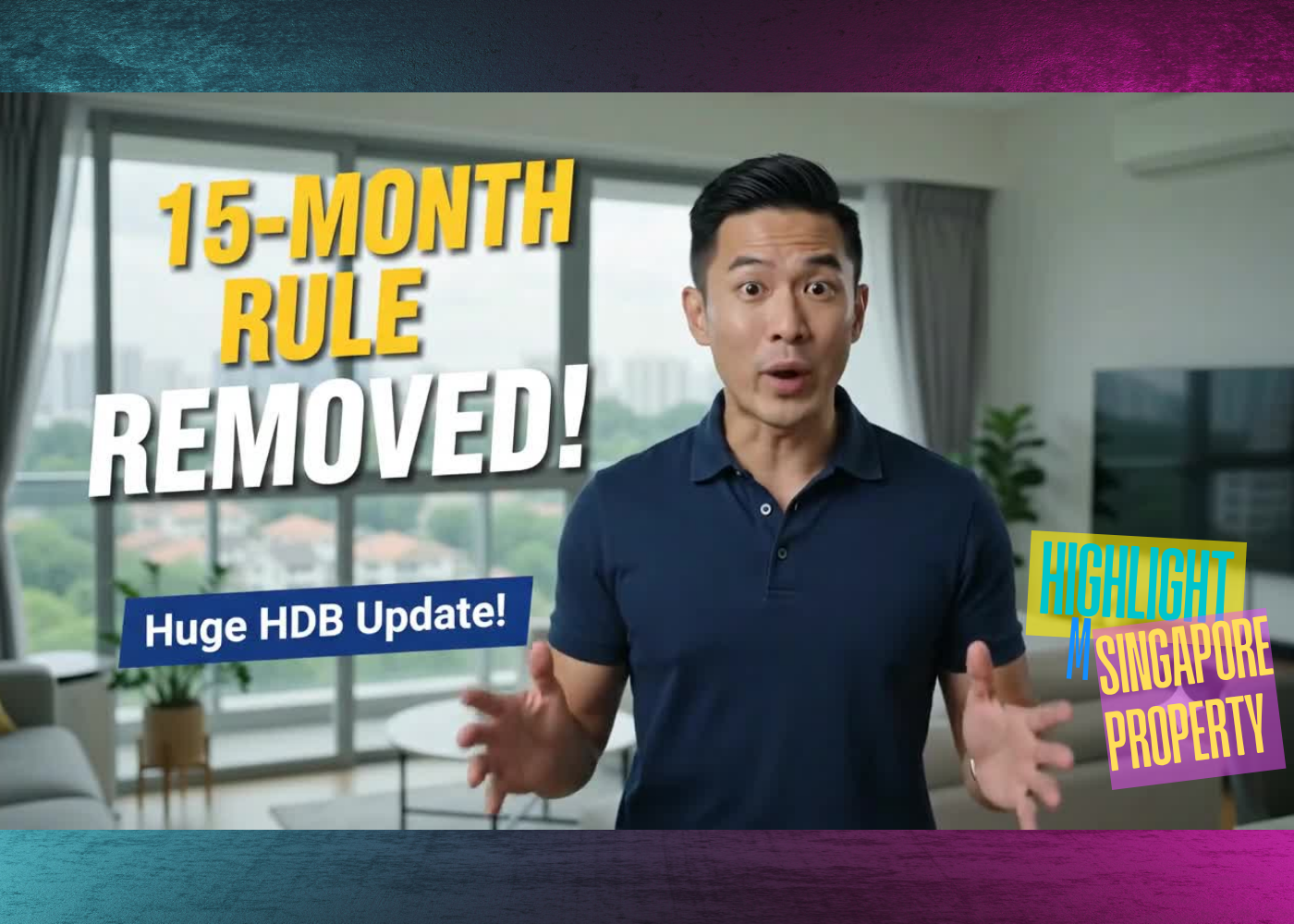
“Sometimes the biggest changes in the property market don’t begin with interest rates. They begin with a single policy announcement.”
For nearly four years, one cooling measure quietly influenced thousands of property decisions across Singapore.
Not Additional Buyer’s Stamp Duty.
Not loan restrictions.
Not Seller’s Stamp Duty.
Instead, it was a rule many homeowners only discovered when they wanted to downgrade.
The 15-month wait-out period.
This policy required many private property owners to wait 15 months after selling their home before they could purchase a non-subsidised HDB resale flat.
Today, that requirement has been removed with immediate effect.
To many people, this may sound like a minor administrative adjustment.
I believe it is far more significant than that.
Because this policy does not simply affect downgraders.
It affects liquidity.
Cash flow.
Buyer psychology.
The resale HDB market.
The private property market.
And perhaps most importantly…
It changes how wealth moves between different segments of Singapore’s housing ecosystem.
Why Was The 15-Month Wait Introduced?
To understand today’s decision, we first need to understand why the rule existed.
Back in September 2022, Singapore’s HDB resale market was extremely heated.
Cash-rich private property owners were selling condominiums and immediately purchasing resale HDB flats.
Many of these buyers arrived with substantial cash proceeds.
This created additional demand in the resale market.
The Government responded by introducing the 15-month wait-out period.
The objective was straightforward.
Reduce immediate demand from private downgraders.
Allow first-time HDB buyers to compete in a less aggressive market.
Moderate resale price growth.
It was never intended to be permanent.
It was introduced as a temporary cooling measure.
Fast forward to today.
The Government believes market conditions have changed.
Recent HDB resale prices have shown signs of moderation, supported by a larger pipeline of Build-To-Order flats and a significant increase in flats reaching their Minimum Occupation Period (MOP). Based on these conditions, the Government has decided the temporary restriction is no longer necessary.
This Isn’t Just About HDB
Many headlines describe this as an HDB policy.
I disagree.
This is actually a liquidity policy.
Let’s imagine a private homeowner.
They own a condominium worth S$2.2 million.
They wish to retire.
Their children have moved out.
They no longer need a large apartment.
Previously, they had three options.
• Rent for 15 months.
• Appeal for an exemption.
• Delay selling.
All three created friction.
Now?
That friction disappears.
They can sell their condominium.
Purchase an HDB resale flat almost immediately (subject to the applicable rules).
Release hundreds of thousands, or even over a million dollars, in cash.
That liquidity can now be invested.
Used for retirement.
Passed to children.
Or simply preserved.
The removal of waiting time increases the velocity of capital throughout the property market.
Why Timing Matters
Interestingly, this policy wasn’t removed during a booming HDB market.
It was removed after signs of moderation appeared.
That timing matters.
Government policy has always been adaptive.
When markets become too hot…
Cooling measures appear.
When markets stabilise…
Restrictions can be eased.
This tells us something important.
Housing policy in Singapore is increasingly dynamic rather than permanent.
What Happens To HDB Prices?
This is the question everyone is asking.
Will prices surge again?
The answer is more nuanced than many headlines suggest.
On one hand…
Yes.
Demand will increase.
Some private homeowners who were previously waiting will now enter the resale market immediately.
That creates additional buying activity.
On the other hand…
Supply today looks very different from 2022.
The Government has substantially increased BTO launches over recent years, and a much larger number of flats are reaching MOP, expanding resale supply. Those supply dynamics were cited as key reasons for removing the wait-out period.
Demand increases.
Supply increases.
Those two forces partially offset each other.
Therefore…
Rather than expecting another explosive price cycle…
I believe this policy is more likely to support market stability than create another frenzy.
The Biggest Winners
Several groups stand to benefit.
1. Retirees
Many retirees own valuable private properties but no longer require large homes.
The removal of the wait period allows them to unlock housing wealth much sooner.
That improves retirement flexibility.
2. Downsizers
Families whose children have moved out can right-size without spending over a year in temporary accommodation.
This reduces both inconvenience and cost.
3. Buyers Of Larger HDB Flats
Private downgraders typically have stronger purchasing power.
This may increase competition for larger resale flats in mature estates.
Not every HDB segment will experience the same effect.
4. The Private Resale Market
A policy often overlooked.
Every successful downgrader also creates supply.
When someone sells a condominium to buy an HDB…
Another private property becomes available.
That increases transaction activity across the private market.
Higher liquidity generally benefits market efficiency.
Who Could Face More Competition?
First-time resale buyers.
Especially those shopping for well-located larger flats.
These buyers may now compete against cash-rich households exiting the private market.
That doesn’t automatically mean prices will spike.
But it does mean competition could become more intense in selected segments.
Psychology Is More Powerful Than Numbers
One fascinating aspect of property markets…
Prices don’t move solely because of mathematics.
They move because of expectations.
Once buyers hear:
“The wait-out period is gone.”
Many interpret that as:
“Demand is returning.”
Whether that ultimately proves correct or not…
Confidence itself influences behaviour.
Some sellers may become less willing to negotiate.
Some buyers may accelerate purchase decisions.
Some homeowners may decide that now is finally the right time to downgrade.
Policy changes often reshape psychology before they reshape prices.
What The Public Is Saying
Public reaction has been sharply divided.
Some see the change as a sensible response to stabilising market conditions and an improvement for retirees and households needing to right-size.
Others worry that additional demand could place renewed upward pressure on resale prices or make it harder for younger buyers to compete.
The number of people who will benefit from this change is quite small. Might be a test for bigger demand side changes, such as reducing age singles can buy flats or increasing the income ceiling for BTOs.
Give feedback
These reactions illustrate an important point.
Markets are driven not only by policy, but also by how people interpret policy.
What This Signals About Government Thinking
In my view, the most important message isn’t the removal itself.
It’s what the removal tells us.
The Government appears increasingly confident that HDB supply is catching up with demand.
That confidence allows temporary cooling measures to be rolled back.
It also suggests policymakers believe the market is better positioned to absorb additional demand than it was in 2022.
My Long-Term View
Over the next few years, I expect several trends to become more visible.
• More private homeowners will consider right-sizing earlier.
• Retirement planning through housing equity will become increasingly common.
• Transaction volumes may rise in both the HDB resale and private resale markets.
• Larger HDB resale flats in mature estates could see stronger demand than smaller units.
• The distinction between “housing” and “retirement planning” will continue to blur.
The removal of the 15-month wait-out period is unlikely, by itself, to trigger a dramatic surge in prices.
But it could meaningfully improve liquidity and mobility within Singapore’s housing system.
And in property markets, liquidity is often the first step toward healthier, more efficient price discovery.
The Bigger Lesson
Many people think property success is about predicting prices.
I think it’s about understanding policy.
Singapore’s property market is one of the most policy-driven real estate markets in the world.
Every major policy change alters incentives.
Every incentive changes behaviour.
Every behavioural shift eventually shows up in transaction data.
The investors who consistently perform well aren’t necessarily the ones who predict the next headline.
They’re the ones who understand what the headline changes beneath the surface.
Your Move
Whether you’re:
✅ Planning to downgrade from a private property.
✅ Upgrading from an HDB.
✅ Building a long-term property portfolio.
✅ Preparing for retirement.
This policy deserves careful consideration.
The right decision isn’t simply whether to buy or sell.
It’s whether your next property move aligns with your long-term financial objectives.
Property decisions are rarely about today’s market alone.
They’re about where you want to be five, ten, or even twenty years from now.
If you’re considering your next move, I’d be happy to help you evaluate your options using data, market trends, and a personalised wealth strategy, rather than relying on headlines alone.
This is M. (Mike Chin)
Helping Singaporeans make smarter property decisions through data, strategy, and long-term wealth planning.
📩 Connect with me for a personalised property consultation.
#M #ThisIsM #ThisisMMikeChin #Propnex #MAssociate #Msingaporeproperty #AIForRealtors #RealEstate #PropertyForSale #InvestIngRealEstate #RealEstateInvestment #HomeBuyers #PropertyInvestment #DreamHome #HouseGoals #PropertyMarket #RealEstateLife #RealEstateExpert #HomesForSale #InvestIngProperty #RealEstateDevelopment #NewHome #OpenHouse #RealEstateSingapore #CondoLife #LuxuryLiving #HomeSweetHome #RealEstateTips #RealEstateInvestor #businessmentorship
www.msingaporeproperty.com