Boon Keat ❂ CHIN
Real Estate Consultant | Trusted Advisor with 14+ Years of Experience | Founder of M | MIKE Framework Architect l FCPA (AUS) CA (SIN) MBA
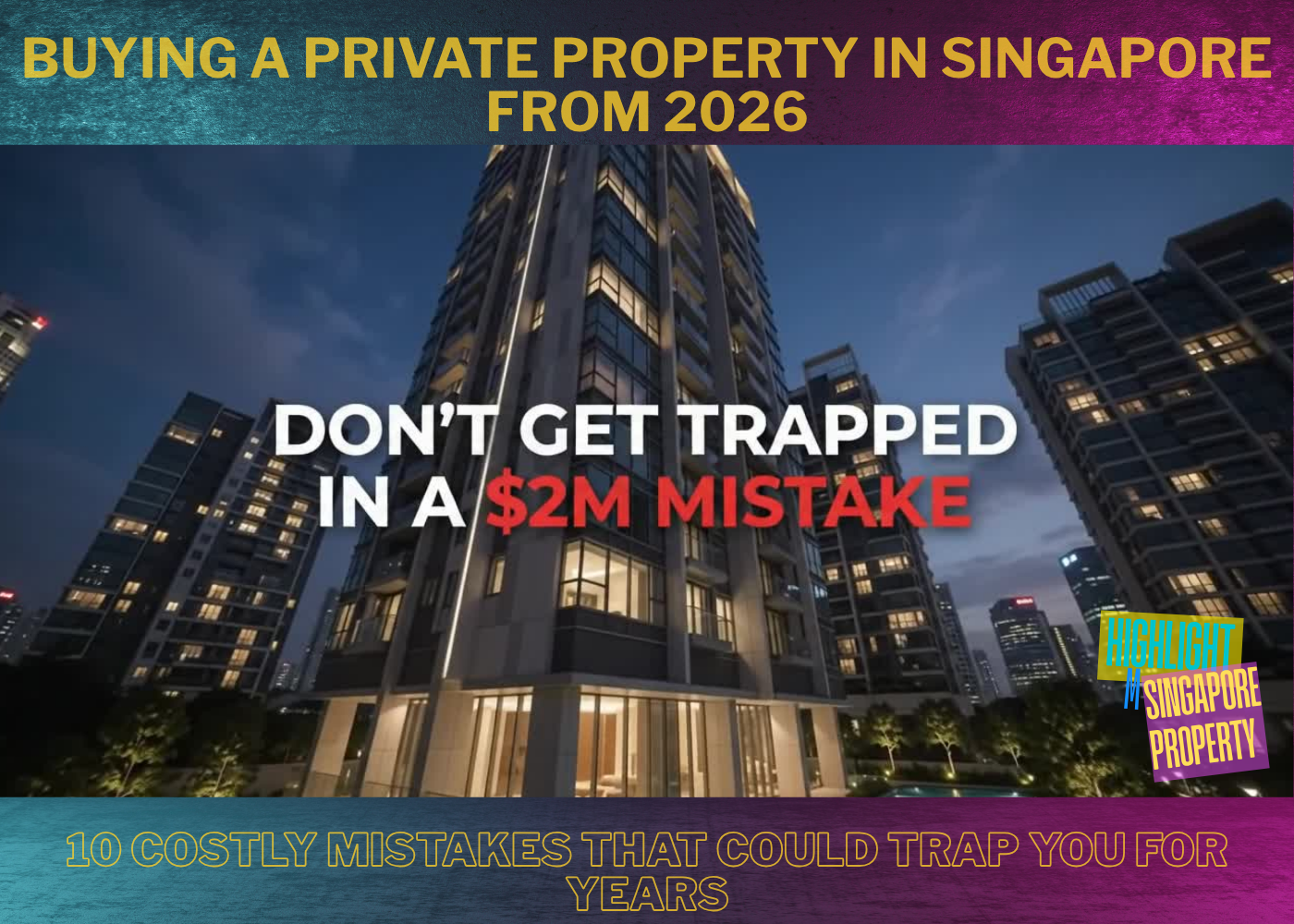
Buying a Private Property in Singapore from 2026: 10 Costly Mistakes That Could Trap You for Years
The biggest property investment mistake may not be buying at the wrong price. It may be buying the wrong property with the wrong financial strategy.
Imagine committing $2 million to a private property.
You have spent years saving for the down payment. You have studied the location, visited the showflat, compared floor plans and imagined your family’s future there.
But have you examined what happens if:
- The bank approves a smaller loan than expected?
- Your existing HDB flat does not sell in time?
- You cannot recover the Additional Buyer’s Stamp Duty (ABSD)?
- Interest rates rise?
- Your property becomes difficult to resell?
- The next buyer simply does not want your unit?
A property purchase is not just a lifestyle decision. It is a multi-million-dollar financial commitment.
And from 2026 onwards, buyers need to be increasingly disciplined about two things:
1. Whether they can safely afford the property.
2. Whether the property itself will remain attractive to future buyers.
In this article, I combine two important perspectives: the financial mistakes that can derail first-time private property buyers, and the physical property characteristics that may create resale difficulties.
Let’s examine 10 potential traps.
PART 1: THE FINANCIAL TRIP WIRES
1. Ignoring the TDSR stress test
One of the biggest mistakes buyers make is calculating affordability based on the interest rate advertised by the bank.
That is not necessarily how the bank assesses your borrowing capacity.
Singapore’s Total Debt Servicing Ratio (TDSR) limits a borrower’s total monthly debt obligations to 55% of gross monthly income.
This includes:
- Your proposed property loan.
- Existing housing loans.
- Car loans.
- Personal loans.
- Other applicable debt obligations.
Banks also apply an interest-rate stress test when assessing property loans. The applicable assessment rate should be confirmed with the lender before committing to a purchase.
Let’s use the 4% assessment rate discussed in our source material as an illustration.
Example: Buying a $2 million condominium
| Item | Amount |
|---|---|
| Purchase price | $2,000,000 |
| Illustrative loan at 75% | $1,500,000 |
| Loan tenure | 25 years |
| Illustrative assessment rate | 4% |
| Estimated monthly instalment | About $7,918 |
| Minimum gross monthly household income at 55% TDSR | About $14,400 |
This assumes no other monthly debt obligations and that the buyer qualifies for the illustrated loan amount and tenure.
The important lesson?
A household may be comfortable servicing a mortgage at today’s actual interest rate but still fail the bank’s affordability assessment.
Do not confuse your preferred monthly instalment with the loan amount the bank will approve.
My advice: Obtain an In-Principle Approval (IPA) before committing to a property.
Do not let excitement at a showflat replace financial preparation.
2. Underestimating the real cash and upfront costs
Many buyers focus on the down payment and forget the other expenses involved in acquiring a property.
Let’s continue with the $2 million example.
| Expense | Illustrative amount |
|---|---|
| 25% down payment | $500,000 |
| Buyer’s Stamp Duty (BSD) | $69,600 |
| Legal fees | $3,000 to $4,000 |
| Renovation for resale property | $50,000 to $150,000 |
| Other costs | Depends on the purchase |
The BSD of $69,600 is calculated using the current residential property BSD rates, assuming a $2 million purchase price and market value.
One important cash-flow consideration: stamp duty must be paid within the required timeline. Eligible buyers may use CPF funds subject to CPF rules and processing requirements, but they should not assume that CPF reimbursement will solve an immediate cash shortfall.
A property purchase can become financially uncomfortable when too much of your available liquidity is committed upfront.
Do not use every dollar you have just to secure the property. Keep sufficient reserves for ownership, renovation and unexpected expenses.
3. Misunderstanding ABSD when upgrading from HDB to private property
This is one of the most important issues for HDB upgraders.
If you purchase a private residential property while still owning your existing HDB flat, you may be treated as acquiring a second residential property for ABSD purposes.
For a Singapore Citizen purchasing a second residential property, the current ABSD rate is 20%.
On a $2 million property, that represents:
<title> $400,000 </title>
That is a substantial additional financial commitment.
There is, however, an ABSD remission arrangement for eligible married couples.
A married couple purchasing a second residential property jointly may qualify for a refund if at least one spouse is a Singapore Citizen and all the applicable conditions are met.
One critical condition is that the first residential property must be sold within six months after the purchase of the completed second property. Different timing rules apply where the second property is uncompleted.
The conditions are strict. IRAS does not generally grant extensions simply because the first property takes longer to sell.
Consider what could go wrong:
- Your HDB flat receives fewer offers than expected.
- You price it too aggressively.
- The buyer’s financing or completion process is delayed.
- You underestimate the time required to complete the transaction.
The potential consequence is losing the $400,000 ABSD refund.
This is not a minor administrative issue. It can materially change the financial outcome of your upgrade.
A safer strategy for many upgraders is to sell the existing property first, secure the sale proceeds and then purchase the next property.
You may need temporary accommodation, but you remove the pressure of the ABSD deadline.
Always confirm your eligibility and transaction sequence with your conveyancing lawyer and the relevant authorities before proceeding.
4. Letting FOMO dictate your purchase timeline
“Last unit at this price.”
“Prices are increasing next month.”
“Other buyers are already interested.”
These statements can create urgency, but urgency is not a substitute for due diligence.
A buyer who rushes into a property without understanding financing, stamp duties and exit options may end up paying a much higher price for a mistake that lasts years.
There will always be another property.
The question is whether the next property is financially and strategically suitable.
If you cannot complete your calculations before committing, you are not ready to commit.
Never allow the fear of missing one unit to make you miss the bigger picture.
5. Paying an option fee before checking your financing
For a typical resale private property transaction, the Option Fee is commonly 1% of the purchase price, although the agreed terms and transaction structure matter.
On a $2 million property, that is $20,000.
Imagine paying the option fee before obtaining a proper assessment of your borrowing capacity.
You subsequently discover that the bank will not grant the loan you expected.
Depending on the contractual terms and circumstances, you could lose the option fee.
This is why financial preparation must come before emotional commitment.
Obtain an IPA, understand your loan eligibility and check the relevant purchase conditions before exercising an option.
PART 2: THE PHYSICAL PROPERTY TRAPS
Passing the bank’s affordability assessment does not mean you have selected a good property.
You can buy a property that is financially affordable today but difficult to sell tomorrow.
The next five mistakes focus on the physical asset itself.
6. Assuming every small CCR unit is a safe investment
For years, some investors viewed one-bedroom and compact two-bedroom units in the Core Central Region (CCR) as attractive investment choices.
The reasoning was straightforward:
- Lower entry quantum compared with larger units.
- Potential demand from expatriates and professionals.
- Proximity to business districts and lifestyle amenities.
- Rental income to support mortgage payments.
But an investment thesis must evolve with the market.
The tenant profile, corporate housing policies, affordability and competing supply can change.
A small city-centre unit may face a narrower resale buyer pool than an investor initially expects.
A wealthy owner-occupier looking for a prime residence may prefer a larger three- or four-bedroom apartment.
A price-sensitive investor may compare the rental yield and total purchase quantum against properties outside the CCR.
The question is not whether all small CCR units are bad investments.
It is whether the specific unit has a sufficiently deep pool of future buyers and tenants.
Before purchasing, examine:
- Historical resale transactions.
- Current competing listings.
- Rental transactions and tenant demand.
- Unit size and layout efficiency.
- Purchase quantum.
- Future supply in the surrounding area.
A low entry price does not automatically mean a good exit strategy.
7. Buying a low-floor unit without considering resale demand
Floor level can influence a property’s appeal.
Some buyers prefer higher floors for:
- Better views.
- Greater privacy.
- More natural ventilation.
- Reduced exposure to certain forms of noise.
Other buyers may prefer lower floors because of accessibility, convenience or personal preference.
The source material specifically warns about second-, third-, fourth-, fifth- and sixth-floor units.
However, I would not treat every low-floor unit as an automatic investment mistake.
A fourth-floor unit with an excellent landscape view may be more attractive than a higher-floor unit facing a neighbouring block.
The correct question is:
What does the unit actually offer, and how many future buyers will value those characteristics?
Consider the following before purchasing:
- Is the view permanently or potentially obstructed?
- Is there road or car park noise?
- Is there sufficient privacy?
- Does the unit receive adequate natural light?
- Is the floor level attractive to the likely buyer profile?
Do not pay a premium simply because a unit is on a higher floor. Pay for a genuine advantage.
8. Overpaying for ground-floor gardens or penthouse space
Ground-floor units and penthouses can be attractive.
But they are also niche products.
For ground-floor units, consider:
- How much of the private outdoor space is genuinely usable?
- Is it exposed to rain and humidity?
- Does it offer sufficient privacy?
- Will future buyers value the garden enough to pay a premium?
For penthouses, consider:
- How much of the floor area is practical living space?
- Is the high ceiling or void area included in the strata floor area?
- Is the layout functional?
- Is the purchase premium justified by actual buyer demand?
A unique feature is only valuable when the next buyer is willing to pay for it.
Do not pay a large premium for space or features that may be difficult to monetise when you eventually sell.
9. Ignoring privacy, facing and surrounding environment
A property’s value is not determined by its interior alone.
The surrounding environment can have a significant influence on buyer perception.
For example:
- Facing a multi-storey car park may expose the unit to vehicle noise and headlights.
- Facing another residential block at close range may reduce privacy.
- A poor view may make the unit less attractive during viewings.
- Road noise or nearby mechanical equipment may affect the living experience.
In a condominium, many buyers prefer an unblocked view or a good pool-facing orientation.
However, pool-facing units may also involve noise, privacy or afternoon sun considerations depending on the development’s layout.
Do not simply assume that every pool-facing unit is superior.
Visit the unit at different times of the day.
Stand at the windows. Observe the neighbouring blocks. Listen to the surrounding environment.
A beautiful showflat cannot tell you everything about the actual unit you are buying.
10. Underestimating boutique developments and ageing condominiums
This is an area where investors need to look beyond the advertised price per square foot.
An older condominium may appear attractive because it offers larger floor areas at a lower psf compared with a new launch.
A boutique development may also appeal because of its exclusivity and smaller number of units.
But both require additional due diligence.
For boutique developments, examine:
- Transaction frequency.
- Availability of comparable sales.
- Bank valuation considerations.
- Maintenance fund adequacy.
- Lift and facility condition.
- Management quality.
- Monthly maintenance contributions.
A development with very few transactions may make it harder for buyers and valuers to establish reliable market benchmarks.
A small development may also have fewer owners contributing to the maintenance fund. Major repairs can become financially significant for each owner.
For older condominiums, examine:
- Concrete spalling and water leakage.
- Plumbing and electrical systems.
- Lift condition.
- Building façade and common areas.
- Maintenance and sinking fund accounts.
- Outstanding repair requirements.
- Renovation costs.
- Whether the total purchase quantum is affordable to the likely resale buyer.
Do not buy an old condominium simply because its psf is lower.
A 1,000 sq ft apartment may look like a bargain compared with a new 800 sq ft unit, but the total quantum could be significantly higher.
The next buyer must be able to afford that total purchase price.
And if the property needs extensive renovation, the actual cost of ownership could be much higher than the initial asking price suggests.
One more important point: Do not buy an ageing condominium purely because you expect an en bloc sale.
Collective sale potential depends on many factors, including land value, development potential, planning parameters, owners’ expectations and developer economics.
It is an uncertain possibility, not a guaranteed exit strategy.
PART 3: THE PROPERTY BUYER’S 7-POINT DUE DILIGENCE CHECKLIST
Before committing to any private property, I would assess these seven areas.
| Due diligence area | Key question |
|---|---|
| 1. Financing | Can I comfortably service the loan under the bank’s assessment and my own stress test? |
| 2. Upfront costs | Have I budgeted for down payment, BSD, ABSD, legal fees and renovation? |
| 3. Transaction sequence | Am I exposed to an ABSD deadline or other timing risk? |
| 4. Location and demand | Is there sustainable demand from genuine buyers and tenants? |
| 5. Unit selection | Does the floor, facing, layout and privacy offer a competitive advantage? |
| 6. Development quality | Are maintenance, sinking funds and building condition satisfactory? |
| 7. Exit strategy | Who is likely to buy this property from me in five to ten years? |
The last question is particularly important.
Many buyers spend months calculating their monthly mortgage instalment.
But how many spend the same amount of time studying the future resale buyer?
A property is not a good investment simply because you can afford to purchase it.
It must also remain relevant to the next generation of buyers.
My final perspective: Protect your downside before chasing your upside
Singapore property can be a powerful wealth-building asset.
But leverage, stamp duties, financing restrictions and changing buyer preferences mean that mistakes can be expensive.
There are two different ways to get trapped.
Financially trapped: You overcommit, underestimate the upfront costs or fail to plan your transaction timeline.
Asset trapped: You purchase a property with weak resale appeal, poor physical attributes or ownership costs that make it difficult to attract the next buyer.
A good property strategy must address both.
Do not buy simply because the showflat looks impressive.
Do not buy simply because the psf looks cheap.
Do not buy simply because an agent says the price will increase.
And do not buy simply because you are afraid of missing out.
Run the numbers. Study the unit. Understand the buyer pool. Plan your exit.
The best property purchase is not the one that makes you feel wealthy on the day you sign the papers. It is the one that protects your financial position throughout the ownership journey.
A question for property buyers and investors
If you were buying a private property in Singapore today, which risk would concern you more?
- The financial risk of TDSR, ABSD and upfront cash commitments.
- The physical risk of buying a unit that may be difficult to resell.
- The market risk of paying too much at the wrong point in the property cycle.
Share your thoughts in the comments.
#PropNex #MSingaporeProperty
www.msingaporeproperty.com